Pilates for Your Back and Core After 40 (Without the Crunches)
Core work doesn't mean crunches — and after 40, that distinction actually matters. Here's what your core really is, why the sit-ups you learned may be the least useful (and, for some of us, the riskiest) exercise on the list, and what Pilates offers instead: bracing, breathing, and learning to hold still.

By Diane Marsh··10 min read
Claims on this page are checked against Cleveland Clinic, Harvard Health, Mayo Clinic and 2022 guidelines in the British Journal of Sports Medicine — all five sources are linked below.
General education, not medical advice. Talk to your doctor before starting something new.
The short version
- Your core is not your abs — it's the whole cylinder: deep abdominals, the muscles along your spine, your pelvic floor and your diaphragm, all working together to keep your spine steady.
- The classic 'core work' most of us learned — crunches, sit-ups, toe touches — repeatedly bends your spine forward, which isn't what a stabilizing core actually needs to practice.
- If you have osteoporosis, osteopenia or a spinal fracture history, that same forward-bending motion is one of the patterns published guidance flags as raising fracture risk — talk with your doctor or a physical therapist before doing any of it.
- Pilates offers a different approach: bracing, breathing and holding still against movement, instead of repeatedly bending.
- A strong core shows up as carrying groceries without your back complaining — not a certain look.
Somewhere along the way, a lot of us were taught that 'core work' means crunches until your neck aches and your abs burn. I want to gently take that apart today, because after 40 it stops being a small technicality and starts actually mattering — for your back, and in some cases, for your bones.
Here's the short version, up front: your core isn't your abs. Your abs are one muscle in a much bigger system, and building that system well looks a lot more like a slow, controlled hold than a hundred sit-ups.
What your core actually is (hint: it's not your abs)
The muscle most of us picture when we hear 'abs' — the rectus abdominis — is only one small piece of a much bigger system. Your real core is a full cylinder: deep abdominal muscles wrapping around like a corset, muscles running along either side of your spine, your pelvic floor underneath, and your diaphragm on top.
None of this is new information exactly, but it's easy to lose in a sea of ab workouts. And there's a reason it deserves fresh attention after 40: this is also the decade when bone density becomes a real consideration for a lot of women, which is exactly why how you load your spine — not just whether you 'work your core' — starts to matter. (More on that in our guide to bone-density exercise, if that's new territory for you.)
That's the anatomy. Here's the part that actually changes how you'd train it: your core's job isn't to bend and crunch. It's to hold still.
What a strong core actually feels like
A strong core rarely shows up as a certain look. It shows up when you carry both grocery bags in one trip and your back doesn't complain on the stairs after. It shows up when you twist to grab something off the back seat without a flinch, or get up off the floor without needing to think through how you're going to do it. That's the only 'result' worth chasing here: capability. Every low-impact routine on this site is built around that same idea.
Here's the part almost nobody tells you: crunches are the least useful — and sometimes the riskiest — 'core work' you can do
If you grew up doing gym-class sit-ups, or a nightly round of crunches, I understand why that's what 'core work' means to you — it's what most of us were taught, and it's still what most fitness content defaults to. But crunches, sit-ups and toe touches all do the same basic thing: they repeatedly bend your spine forward, under load, over and over. That's close to the opposite of what a stabilizing core needs to practice.
There's also a simpler, non-scary reason to reconsider crunches even if osteoporosis isn't part of your picture at all: a crunch trains your core to crunch — to create movement. Pilates-style holds like a dead bug or a bird-dog train your core to do the thing it does the other 99% of your day: stay steady while everything around your spine moves. That's a lot closer to what actually happens when you're carrying something heavy up a flight of stairs.
For most people, that mostly just makes crunches an inefficient use of time — your spine gets better at bending forward, which isn't a movement you actually need much of in daily life. But if you have osteoporosis, osteopenia, or a history of a spinal fracture, it's not just inefficient. It may be one of the more genuinely risky items on your workout list, and this next part is worth reading carefully.
What Pilates offers instead: bracing, breathing, and learning to hold still
Pilates approaches the same goal — a strong, capable core — from close to the opposite direction. Instead of repeatedly bending your spine, most of the foundational work is about bracing it, breathing well, and resisting movement rather than creating it. Physical therapists sometimes describe this as 'anti-movement' training: your core's job is to keep your spine quiet while your arms and legs do the moving. Think a dead bug, a bird-dog, a side-lying hold, or a standing press against resistance — not a single roll-up in sight.
That's the honest case for Pilates here — nothing magical about it, and 'the wall' isn't doing anything on its own either, just a low-impact way to train your core the way it's actually built to work: bracing and holding, not crunching. Our honest look at wall Pilates goes further into what the wall itself does and doesn't add, if you're curious where that trend actually came from.
And if you've never done a single Pilates session in your life, our beginner's guide is genuinely the better starting point before this one — it covers the basics this routine assumes you already have.
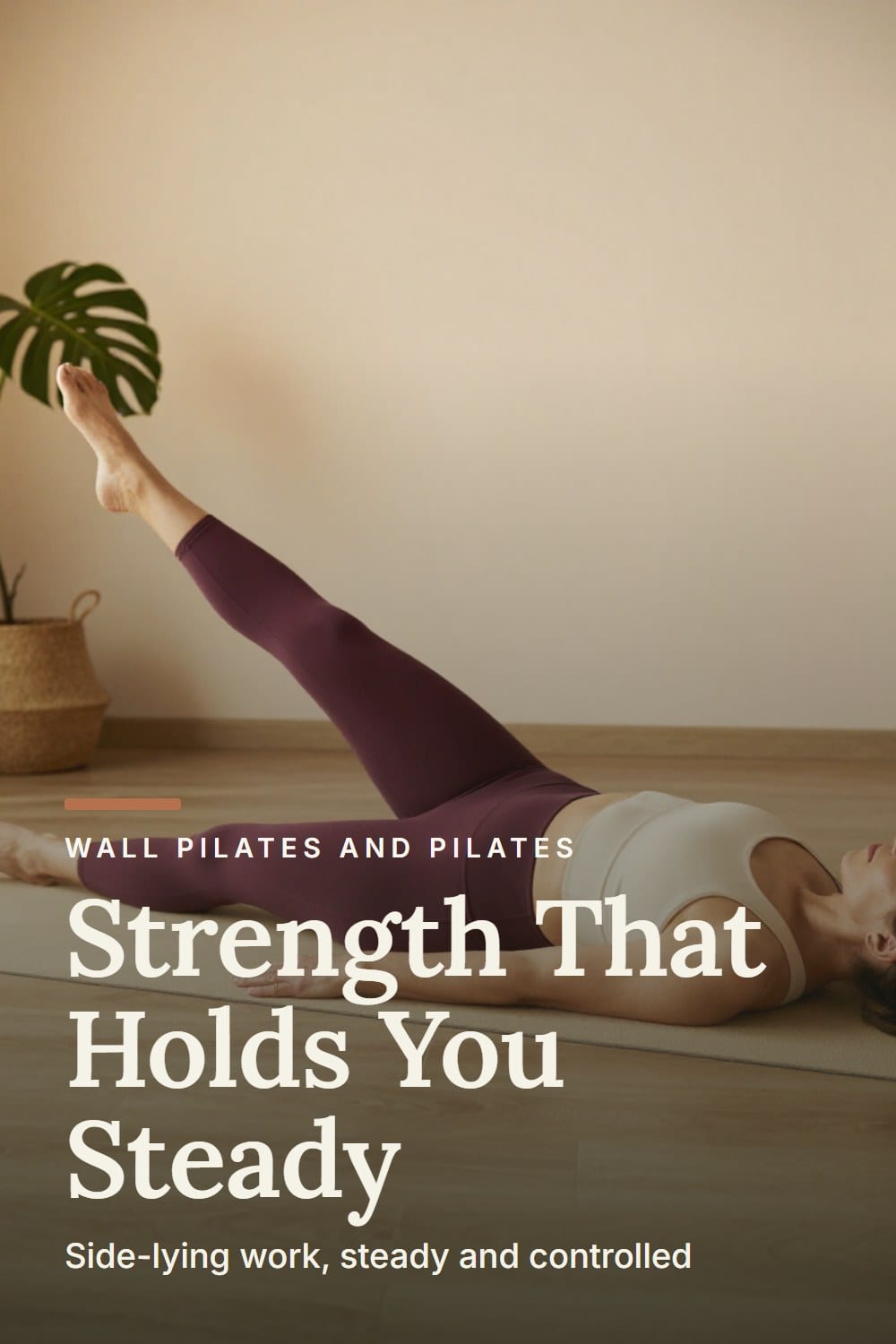
Here's what all of that looks like in practice — six moves built around bracing and holding, not bending, that you can do on a mat at home in about fifteen minutes.
Your Anti-Crunch Core Routine
Move through these in order, resting as needed between them. A slow, well-braced rep counts for more here than a fast one.
| Move | Reps or time | How it should feel | Easier option |
|---|---|---|---|
| Ribcage breathingThis is the foundation everything else is built on — worth taking seriously, not rushing through. | 5 slow breaths | Your ribs widening sideways and back, not your belly popping up | Do it seated in a chair, hands resting on your ribs |
| Dead bugIf your low back arches off the mat, make it easier — that's the honest cue, not a reason to push through. | 6–8 reps per side | Your low back staying flat against the mat, not arching or sinking | Keep both feet on the floor and just slide one heel out at a time |
| Bird-dog | 6–8 reps per side, hold 2–3 seconds | Steady and controlled, like balancing a full cup on your back | Lift just the arm, or just the leg, not both at once |
| Side-lying leg work | 8–10 reps per side | Working along the side of your waist, hips stacked and still | Bend your bottom knee for a kickstand, or hold the position without lifting |
| Standing anti-rotation pressA resistance band anchored in a door works well, or simply press against a wall. | 8 reps per side | Resisting the twist, not doing the twist | Do it seated in a sturdy chair, pressing straight out with both hands |
| Glute bridge | 10 reps, or a 20–30 second hold | A squeeze through the back of your hips and thighs, low back relaxed on the mat | Use a smaller range of motion — lift just a few inches |
None of this is a diagnosis or a promise about your specific spine — only what the general guidance and research support, cited plainly below so you can check it yourself instead of just trusting me.
Where this comes from
Every claim above traces to one of these five.
- 1Why a Strong Core Can Help Reduce Low Back Pain
Cleveland Clinic
Supports: That the core includes the front abdominal muscles (rectus abdominis), the obliques along the sides, a deep wrap-around muscle called the transverse abdominal, the erector spinae and multifidi running along the spine, plus the diaphragm, pelvic floor, hip flexors and glutes — and that when the muscles around the low back are weak, the body relies more on ligaments and spinal discs for stability, which can cause pain.
- 2Why You Should Care About Your Core
Harvard Health / Harvard Medical School
Supports: That well-developed core muscles stabilize the spine and create a firm base of support for virtually all movement, that core strength is linked to improved balance and a lower risk of falls and of muscle strain in the low back, and that everyday actions like reaching up to a shelf or wiping up a spill rely on that same core stability.
- 3Exercising with osteoporosis: Stay active the safe way
Mayo Clinic
Supports: That in people with osteoporosis, bending forward at the waist can raise the risk of a spinal fracture, that toe touches and sit-ups are specifically named among the movements to avoid, along with any activity that forces hard or repeated bending at the waist, and that stability and balance exercises are recommended as safer alternatives.
- 4Strong, steady and straight: UK consensus statement on physical activity and exercise for osteoporosis
British Journal of Sports Medicine · 2022
Supports: That exercise involving sustained, repeated or end-range spinal flexion should be modified or avoided in people with osteoporosis, that any exercise causing the back to curve excessively — especially with an added load — should also be modified or avoided, and that exercises to strengthen the back are recommended to improve posture and support the spine.
- 5Pilates 101: What It Is and Its Health Benefits
Cleveland Clinic
Supports: That Pilates is a low-impact, full-body practice built specifically around core strength — extending beyond the abdomen to the sides, mid-to-lower back, hips and glutes — with real benefits for flexibility and balance, that a strong, aligned core makes good posture easier, and that anyone injured or recovering from surgery should speak with their doctor before starting.
Free, and printable
The free 4-Week Indoor Walking Plan
The plan sign-up is not live yet — the mailing list is still being set up. In the meantime, email hello@strongandrooted.com and Diane will send it to you herself.
One email when there is something worth sending. Unsubscribe whenever you like.
Frequently asked questions
Are crunches bad for me?
Isn't 'core' just another word for abs?
I have osteoporosis (or osteopenia, or a spinal fracture history) — is this routine safe for me?
What if my back already hurts?
Your core's job was never about how you look — it's the quiet system that keeps your spine steady while you live your life. Pilates is a genuinely good, low-impact way to build that, through bracing and breathing rather than bending and crunching. If you have osteoporosis, osteopenia, or a fracture history, get a plan from your doctor or a physical therapist before you start any of it. If you want the fuller picture of low-impact movement after 40, our complete guide is the place to start, and our posture and spinal-extension guide and our guide to loading bone safely are both natural next stops from here.
Free, and printable
The 4-Week Indoor Walking Plan
The plan sign-up is not live yet — the mailing list is still being set up. In the meantime, email hello@strongandrooted.com and Diane will send it to you herself.
One email when there is something worth sending. Unsubscribe whenever you like.
Written by
Diane Marsh
At 49 I was tired, achy, sleeping badly, and being told to do more cardio and eat less — which was making all of it worse. I started walking. Fifteen minutes, indoors, in socks. Three years later I am stronger than I was at forty. I write down exactly what I did, cite the research where it exists, and admit where it doesn't.
Diane is not a doctor, a physical therapist, or a dietitian. She is a woman who rebuilt her own strength after perimenopause, reads the research carefully, cites it, and says so when nobody actually knows.
Keep reading
Stretching the same tight spot for months without any change isn't a discipline problem — it's usually the wrong tool for the job. Here's the honest reframe: why 'tight' often means unsupported, not short, what stretching genuinely does for you, the gentle routine that helps it stick, and the real fix for when stretching alone hasn't worked.
The 5-Minute Morning Mobility Routine for Women Over 40Five minutes, before coffee, in your pajamas, no mat required. Here's the honest, physical reason your mornings feel stiff after 40, the exact minute-by-minute routine I actually do, and the one stretch to swap out if you have osteoporosis.
Low-Impact Exercise and Mobility After 40: The Complete GuidePilates, wall Pilates, gentle yoga, morning mobility and stretching all get filed under 'low-impact' — but they're not the same thing, and none of them is your bone plan. Here's the honest map: what each one is genuinely for, which one to start with, and where low-impact fits next to walking and real strength work.