The 5-Minute Morning Mobility Routine for Women Over 40
Five minutes, before coffee, in your pajamas, no mat required. Here's the honest, physical reason your mornings feel stiff after 40, the exact minute-by-minute routine I actually do, and the one stretch to swap out if you have osteoporosis.

By Diane Marsh··11 min read
Claims on this page are checked against Cleveland Clinic, Harvard Health, Mayo Clinic and the British Journal of Sports Medicine — five sources in total, all linked below.

General education, not medical advice. Talk to your doctor before starting something new.
The short version
- Five minutes, before coffee, in your pajamas — the smallest possible ask, on purpose.
- Morning stiffness after 40 has a real, physical explanation (cited below), not a character flaw.
- The routine: ankles, hips, spine, shoulders, a reach and a few sit-to-stands, minute by minute.
- If you have osteoporosis or a fracture history, skip cat-cow — use the extension-only version and check with your doctor or a PT first.
- This isn't a strength, cardio or posture plan. It's the five minutes that make you willing to do the ones that are.
Before your coffee's ready. Before you've picked an outfit, checked your phone, or decided anything else at all — that's when this happens. Five minutes, still in your pajamas, feet on the rug beside your bed.
If you wake up feeling like your body needs a minute to remember how to move, you're not broken and you're not out of shape. You've been still for about eight hours, and joints that sit still for eight hours feel exactly like joints that sat still for eight hours. That's not a character flaw. It's just what happened overnight.
This isn't a workout, and it isn't trying to be one. It's the smallest thing I've found that actually works — five minutes that make the first hour of your day not hurt, so you're willing to do the walking, the strength work or the yoga that build something real. Here's exactly what to do, minute by minute.
Why mornings are stiffer after 40 (and it really isn't just you)
There's a real, physical reason for this, and it has nothing to do with how fit you are or aren't.
There's also a useful line worth knowing, so you can tell an ordinary morning apart from one that actually needs a phone call to your doctor.
And if your mornings got noticeably stiffer sometime in your 40s or 50s specifically, that's not a coincidence either.
The point of this isn't fitness. It's making the first hour not hurt.
I want to be straightforward about what this routine is and isn't, because plenty of 'morning routine' content out there is really just diet culture wearing a five-minute disguise, promising a different-looking body before your coffee's even brewed. This one isn't making that promise, and I wouldn't tell you it was.
What it does do is smaller, and I'd argue more useful: it buys you an easier first hour. Not a different shape, not a number on anything — just a body that moves more like itself, sooner, so the rest of your morning isn't spent moving carefully around your own stiffness.
It also doesn't replace anything you're already doing, or thinking about starting. If you're building a walking habit, our beginner indoor walking plan is where the real strength-and-cardio work happens. If you want a longer, more complete practice, gentle yoga for women over 40 covers that ground in depth. And if your joints need more than five rushed minutes, our full stretching guide for stiffness and achy joints goes deeper. This routine's only job is getting you out from under your own stiffness fast enough to want to do any of that.
It's one small piece of a much bigger picture — our complete guide to low-impact exercise and mobility after 40 lays out how it all fits together, if you want the whole map.
The habit stack: bathroom, kettle, routine
The reason most 'morning routines' quietly die by week two is that they ask you to add a brand-new decision to a morning that's already full of decisions. This one doesn't ask you to decide anything. It asks you to attach five minutes to something you already do without fail.
For most people, that's the stretch between getting up and being caffeinated: you use the bathroom, you fill the kettle or start the coffee maker, and then you wait. That waiting is free. Do the routine right there, on the rug, still in your pajamas, and it's done before the water's even boiled.
If your mornings don't include a kettle, attach this to whatever does happen every single day without you having to remember it — right after the alarm, right before you brush your teeth, right after the dog's first look at you. The trigger matters more than the exact time of day.
Your 5 minutes, minute by minute
No mat, no app, no decision required — just five minutes, roughly in this order. Adjust the exact seconds however you like; the shape of it matters more than the stopwatch.
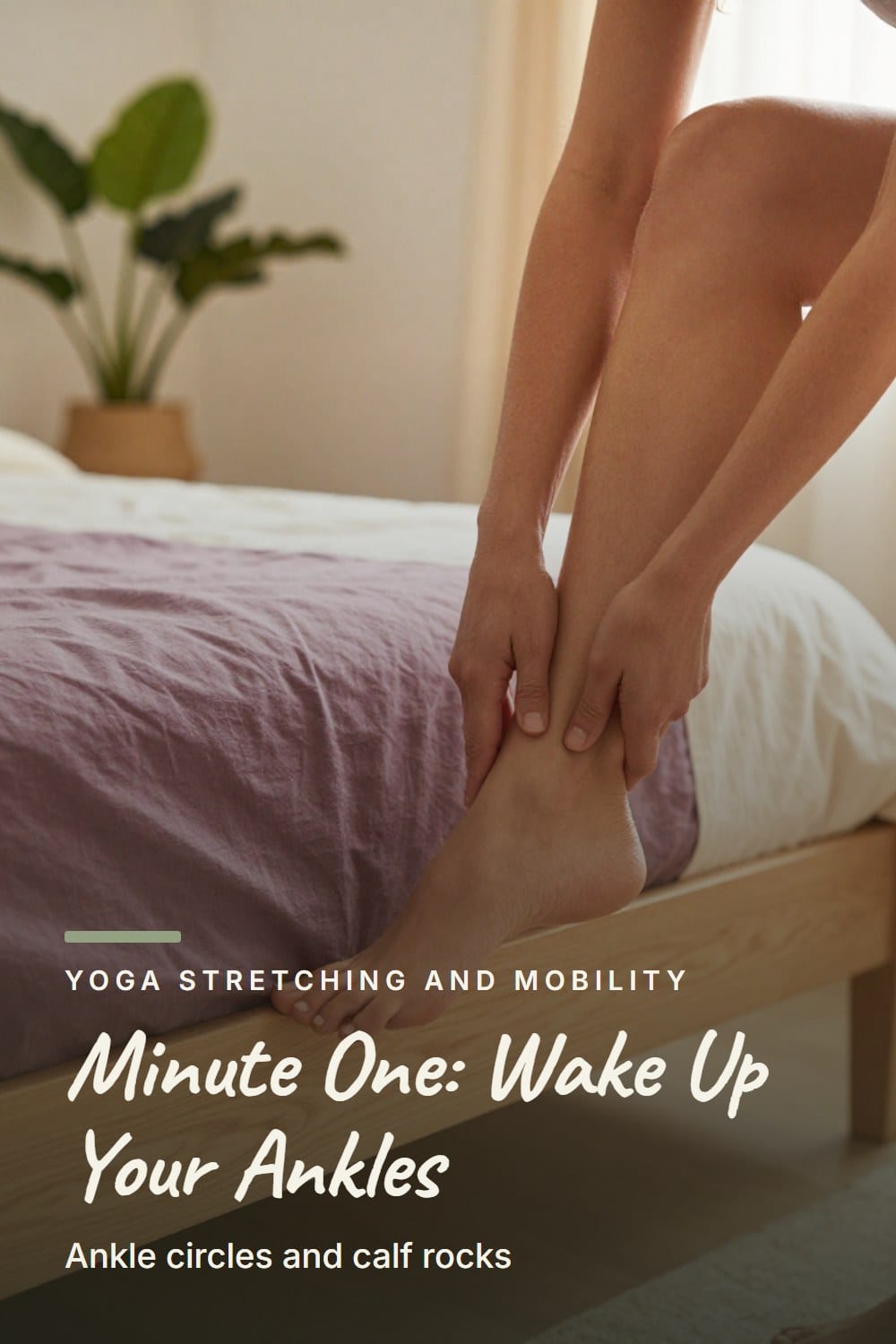
The whole routine, minute by minute
Five rows, five minutes. Nothing here needs equipment or a mat.
| Move | How long | How it should feel | The easier version | |
|---|---|---|---|---|
| Minute 1 — Ankles & calvesThis is the minute that wakes up the part of you that has to hold you up all day. | Ankle circles, 10 each direction per foot, then gentle heel-to-toe calf rocks | About 60 seconds | A little creak, then smoother — like oiling a hinge | Do it seated on the edge of the bed if standing feels unsteady this early |
| Minute 2 — Hips | Standing hip hinges: soft knees, hands on thighs, hinge forward a few inches and rise back up, slow | About 60 seconds, roughly 10 reps | A gentle pull through the back of your hips and thighs, never a strain | Hold a dresser or doorframe with one hand the whole time |
| Minute 3 — SpineRead the note just below this table before you do this one. | Cat-cow on hands and knees, slow — or the extension-only alternative below, if that's you | About 60 seconds, 8–10 slow rounds | A gentle wave through your back, never a pinch or a sharp point | Standing version: hands on thighs, gently round and then straighten your back through a small, easy range |
| Minute 4 — Shoulders & chest | Thoracic opener (clasp hands gently behind you and lift a little, or open both arms wide at chest height) plus slow shoulder rolls | About 60 seconds | Your chest and shoulders loosen — it should feel like unrolling, not stretching hard | Skip the clasp and just roll your shoulders if they're cranky today |
| Minute 5 — Whole bodyThis is the minute that actually gets you moving before the day does it for you. | A slow standing reach overhead and out to each side, then 5–8 sit-to-stands from a sturdy chair | About 60 seconds | Warmer and looser — more like a body you can trust for the next hour | Use your hands on the chair's arms or seat for the sit-to-stands |
What five minutes honestly won't do
I'd be doing you a disservice if I let this sound like more than it is. Five minutes of mobility work will not build meaningful strength, meaningfully change your cardiovascular fitness, or fix your posture on its own — and if a post ever tells you it will, that's the marketing talking, not the evidence.
What it can do is remove the friction that keeps the bigger stuff from happening. It's a lot easier to lace up your shoes for a walk when your hips and spine already feel like they belong to you. That's the trade: five minutes of ease, for a body more willing to do the things that actually build strength over months, not the things promising everything in a week.
If posture specifically is what's bothering you — the rounded-shoulders, chin-forward feeling — that's its own topic with its own dedicated fixes, covered in depth in our posture guide for midlife women. This routine touches your shoulders and spine, but it isn't trying to correct your posture by itself.
None of this is a diagnosis or a promise about your specific spine or joints — only what the general research supports, cited plainly below so you can check it yourself instead of just trusting me.
Where this comes from
Every claim above traces to one of these five.
- 1What Causes Stiff Joints in the Morning?
Cleveland Clinic
Supports: That joints rely on synovial fluid for smooth movement, that this fluid thickens and circulates less while the body is still overnight (the 'gel phenomenon'), and that moving again after waking helps the fluid recirculate and the stiffness ease.
- 2What makes my joints stiff in the morning?
Harvard Health / Harvard Medical School
Supports: That ordinary, age-related morning joint stiffness — from worn joints, muscle tightness and reduced lubricating fluid — typically resolves within about 10 to 15 minutes of movement, unlike the longer-lasting stiffness (over an hour) associated with rheumatoid arthritis, and that being more physically active is one way to reduce how often and how severely it happens.
- 3Musculoskeletal Syndrome of Menopause: When Menopause Makes You Ache All Over
Harvard Health / Harvard Medical School · 2026
Supports: That estrogen helps support tissue throughout the musculoskeletal system, so its decline at midlife can affect joints, ligaments and tendons and contribute to more aches and stiffness, and that regular activity — including gentle stretching and yoga — is recommended to help keep joints flexible.
- 4Exercising with Osteoporosis: Stay Active the Safe Way
Mayo Clinic
Supports: That for people with osteoporosis, bending or rounding forward at the waist can raise the risk of a spinal fracture, that stretches which flex the spine (such as touching your toes) are generally on the list to avoid, and that a health care provider should confirm which stretches are safe for a given person.
- 5Strong, Steady and Straight: UK Consensus Statement on Physical Activity and Exercise for Osteoporosis
British Journal of Sports Medicine · 2022
Supports: That movements involving sustained, repeated or end-range spinal flexion should be modified or avoided for people with osteoporosis, that this applies especially when the movement is loaded, and that strengthening the back to support a straighter posture ('think straight') plus spinal extension exercise is recommended instead.
Free, and printable
The free 4-Week Indoor Walking Plan
The plan sign-up is not live yet — the mailing list is still being set up. In the meantime, email hello@strongandrooted.com and Diane will send it to you herself.
One email when there is something worth sending. Unsubscribe whenever you like.
Frequently asked questions
Is five minutes really enough to make a difference?
Do I need a mat, workout clothes, or an app?
Is it normal to feel this stiff every morning after 40?
Can I still do this if I have arthritis, osteoporosis, or a joint replacement?
Five minutes, before coffee, in your pajamas, on the rug — that really is the whole routine. It isn't a workout and it doesn't need to be one; its only job is making the first hour of your day not hurt, so you're willing to do the rest. If you don't have a walking habit yet, start with the free 4-week plan — it asks for fifteen minutes instead of five, but it's built on the same idea. And if you liked how this felt, gentle yoga for women over 40 is a natural next stop once you're ready for more than five minutes.
Free, and printable
The 4-Week Indoor Walking Plan
The plan sign-up is not live yet — the mailing list is still being set up. In the meantime, email hello@strongandrooted.com and Diane will send it to you herself.
One email when there is something worth sending. Unsubscribe whenever you like.
Written by
Diane Marsh
At 49 I was tired, achy, sleeping badly, and being told to do more cardio and eat less — which was making all of it worse. I started walking. Fifteen minutes, indoors, in socks. Three years later I am stronger than I was at forty. I write down exactly what I did, cite the research where it exists, and admit where it doesn't.
Diane is not a doctor, a physical therapist, or a dietitian. She is a woman who rebuilt her own strength after perimenopause, reads the research carefully, cites it, and says so when nobody actually knows.
Keep reading
Stretching the same tight spot for months without any change isn't a discipline problem — it's usually the wrong tool for the job. Here's the honest reframe: why 'tight' often means unsupported, not short, what stretching genuinely does for you, the gentle routine that helps it stick, and the real fix for when stretching alone hasn't worked.
Pilates for Your Back and Core After 40 (Without the Crunches)Core work doesn't mean crunches — and after 40, that distinction actually matters. Here's what your core really is, why the sit-ups you learned may be the least useful (and, for some of us, the riskiest) exercise on the list, and what Pilates offers instead: bracing, breathing, and learning to hold still.
Low-Impact Exercise and Mobility After 40: The Complete GuidePilates, wall Pilates, gentle yoga, morning mobility and stretching all get filed under 'low-impact' — but they're not the same thing, and none of them is your bone plan. Here's the honest map: what each one is genuinely for, which one to start with, and where low-impact fits next to walking and real strength work.