Stretching for Midlife Stiffness and Achy Joints
Stretching the same tight spot for months without any change isn't a discipline problem — it's usually the wrong tool for the job. Here's the honest reframe: why 'tight' often means unsupported, not short, what stretching genuinely does for you, the gentle routine that helps it stick, and the real fix for when stretching alone hasn't worked.
By Diane Marsh··11 min read
Claims on this page are checked against Mayo Clinic, Cleveland Clinic, and a 2022 UK expert guide on physical activity and exercise for osteoporosis published in the British Journal of Sports Medicine — all four sources are linked below.
This post contains affiliate links. As an Amazon Associate I earn from qualifying purchases — at no extra cost to you.
General education, not medical advice. Talk to your doctor before starting something new.
The short version
- Stretching usually isn't what fixes midlife stiffness — a muscle that feels tight is often unsupported, not short.
- Perimenopause and menopause are genuinely linked to more joint stiffness — that's physiology, not something you're imagining.
- Stretching still does something real: more comfort and more usable range, right now — it's just not the long-term fix.
- What tends to help most with stubborn, months-long tightness is getting stronger, not stretching harder or longer.
- A folded towel, a wall and a tennis ball cover most of this routine — nothing here requires a purchase.
You've stretched your hamstrings most mornings for close to a year now. They still feel exactly the same — tight the second your feet hit the floor, like the last three hundred-odd stretches never happened.
Here's the honest correction almost nobody makes out loud: stretching usually isn't what fixes midlife stiffness. That doesn't mean it's useless — it means it's been asked to do a job it was never built for. Let's talk about what's actually going on, what stretching genuinely is good for, and the small, doable routine that finally makes sense of why nothing's changed.
One thing before we go further: a folded bath towel, a wall and a tennis ball do most of what's in this article. We'll get to a couple of small, optional upgrades later, but nothing here requires a trip to the store first.
Why 'Tight' Doesn't Always Mean Short
A muscle that feels tight isn't automatically a short muscle. Often, it's a muscle that's bracing — quietly working overtime because something nearby, a joint, a neighboring muscle, an old ache, isn't stable enough yet for your body to fully trust.
Your nervous system responds to that lack of support the way it responds to most things it perceives as a threat: it tightens up, on purpose, to protect you. No amount of stretching that one spot convinces it to stand down, because stretching was never the thing making it brace in the first place.
That's the honest answer to a year of hamstring stretches that never felt any different. The stretch itself wasn't wrong. It just wasn't aimed at whatever was actually making the muscle brace.
So What Does Stretching Actually Do For You?
None of this makes stretching a waste of your morning. It's just not the fix you've been hoping for — it's something else, and that something else is genuinely worth keeping.
A good stretch gives you more comfort right now and more range you can actually use today: an easier reach to tie your shoes, a smoother turn to check your blind spot, a little less creak getting up off the floor. That's a real, immediate return, even on a day when nothing about your underlying stiffness has changed.
For a lot of women, a slow stretch also comes with a calmer few minutes — the kind of unhurried, breathe-through-it pause that's genuinely hard to find elsewhere in a busy morning. That's worth something on its own, separate from any physical change at all.
If you want a practice that blends this kind of stretching with balance and a little gentle strength in one session, gentle yoga for women over 40 is a good next stop — same honest, no-hype approach, just more moving parts.
Your Joints Are Not Betraying You
If your joints have gotten noticeably stiffer or achier sometime in your 40s or 50s, and you've quietly wondered whether something's wrong with you specifically — it isn't, and you're not imagining it.
Your joints are not betraying you, and your body isn't falling apart on some accelerated schedule that skipped everyone else. This is a documented, physiological part of this stretch of life — which is exactly why a small, doable routine matters more right now, not less.
If mornings are when it's worst, the 5-minute morning mobility routine is built for precisely that window.
How to Stretch So It Actually Sticks
If you're going to spend the five or ten minutes anyway, a few small changes make an ordinary stretch actually worth doing.
- Move through the range first. Before you hold anything still, ease slowly in and out of the stretch a few times. It tells your nervous system the movement is safe before you ask it to relax into a hold.
- Hold what genuinely needs holding. A slow 20–30 seconds on the one or two spots that actually feel stuck does more than rushing through ten stretches you don't need.
- Do it warm. A cold muscle resists a stretch the same way a cold rubber band resists a pull. A short walk, a warm shower, or even two minutes of easy marching in place first makes the same stretch feel completely different.
- Breathe through it, not past it. A stretch that makes you hold your breath is asking for more than your body wants to give today. Back off until the breath comes easily.
A short, easy walk works well as your warm-up here — even a gentle indoor lap or two is enough to loosen things up before you stretch.
A Gentle Stretching Routine for Stiff, Achy Joints
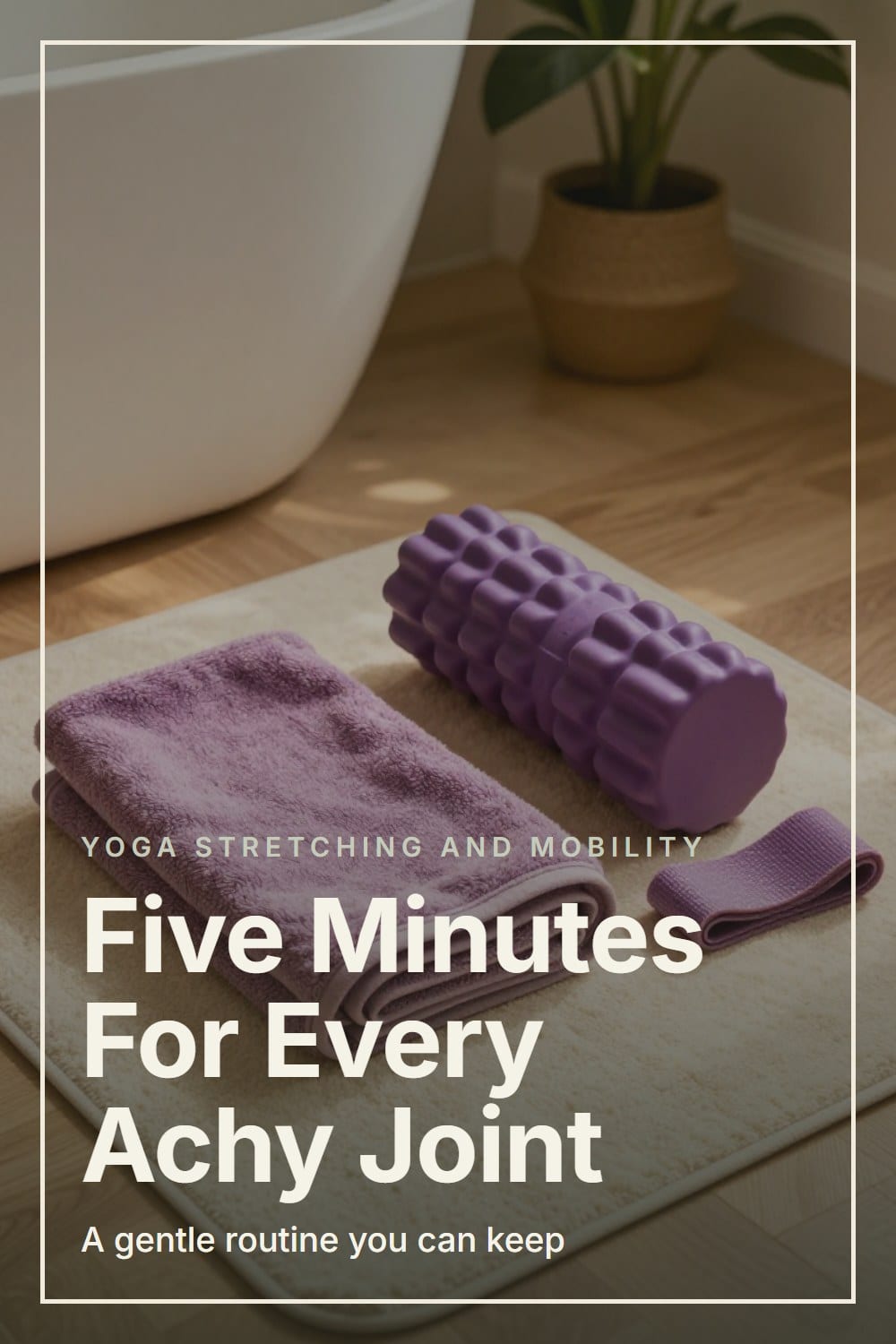
Five areas, about eight to ten minutes total. Do it after you're already a little warm — not as the very first thing you do out of bed.
| Area | What to Do | How Long | How It Should Feel |
|---|---|---|---|
| Calves & anklesSit this one out if a sharp pain shows up at the front of the ankle instead of a stretch through the calf. | Heel-down calf stretch at a wall, plus a few slow ankle circles | 20–30 seconds each side | A gentle pull through the back of the lower leg, never sharp |
| HamstringsA slightly bent knee almost always feels better than a straight one — that's not cheating. | Lying on your back, loop a strap or towel around one foot and ease the leg up with a soft knee | 20–30 seconds each side | A mild pull down the back of the thigh, knee relaxed, never locked |
| HipsKeep your back long instead of rounding forward hard to chase a deeper stretch. | Seated figure-4: ankle resting gently across the opposite knee, easing forward from the hips | 20–30 seconds each side | A stretch through the outer hip and glute, nothing pinching inside the joint itself |
| Upper back & shouldersMove through it slowly first, then hold — don't drop straight into the deepest position. | Doorway chest opener, hands on the frame, easing your chest gently forward | 20–30 seconds, 2 rounds | An open, easy stretch across the chest and front shoulders |
| Whole-body wind-downThis is the part that actually invites the wind-down — don't skip it for time. | A minute of easy, unhurried movement: gentle marching, arm circles, slow neck turns | 60–90 seconds | Loose, and a little calmer than when you started |
Stretch for Comfort. Get Strong for the Fix.
Here's the honest, whole-picture version: stretch for the comfort and the range you can use today — that part is real, and it's worth keeping exactly as it is. But if a spot has felt tight for months or years despite regular stretching, what tends to help is building strength around it, not adding more stretching on top of what you're already doing.
Strength training for beginners over 40 is the honest next step if that's you — simple, doable, and built for exactly this. Stretching didn't fail you. It was just never the tool for this particular job.
If you want the fuller picture of how stretching fits alongside wall Pilates, yoga and walking, the complete low-impact and mobility guide lays out how all of it works together.
What You Actually Need (Probably Less Than You Think)
As promised: a folded bath towel stands in for a stretching strap, a wall does most of what a foam roller does for a calf stretch, and a tennis ball from the closet works almost as well as a dedicated massage ball for a sore foot arch. If you already own these three things, feel free to skip the rest of this section.
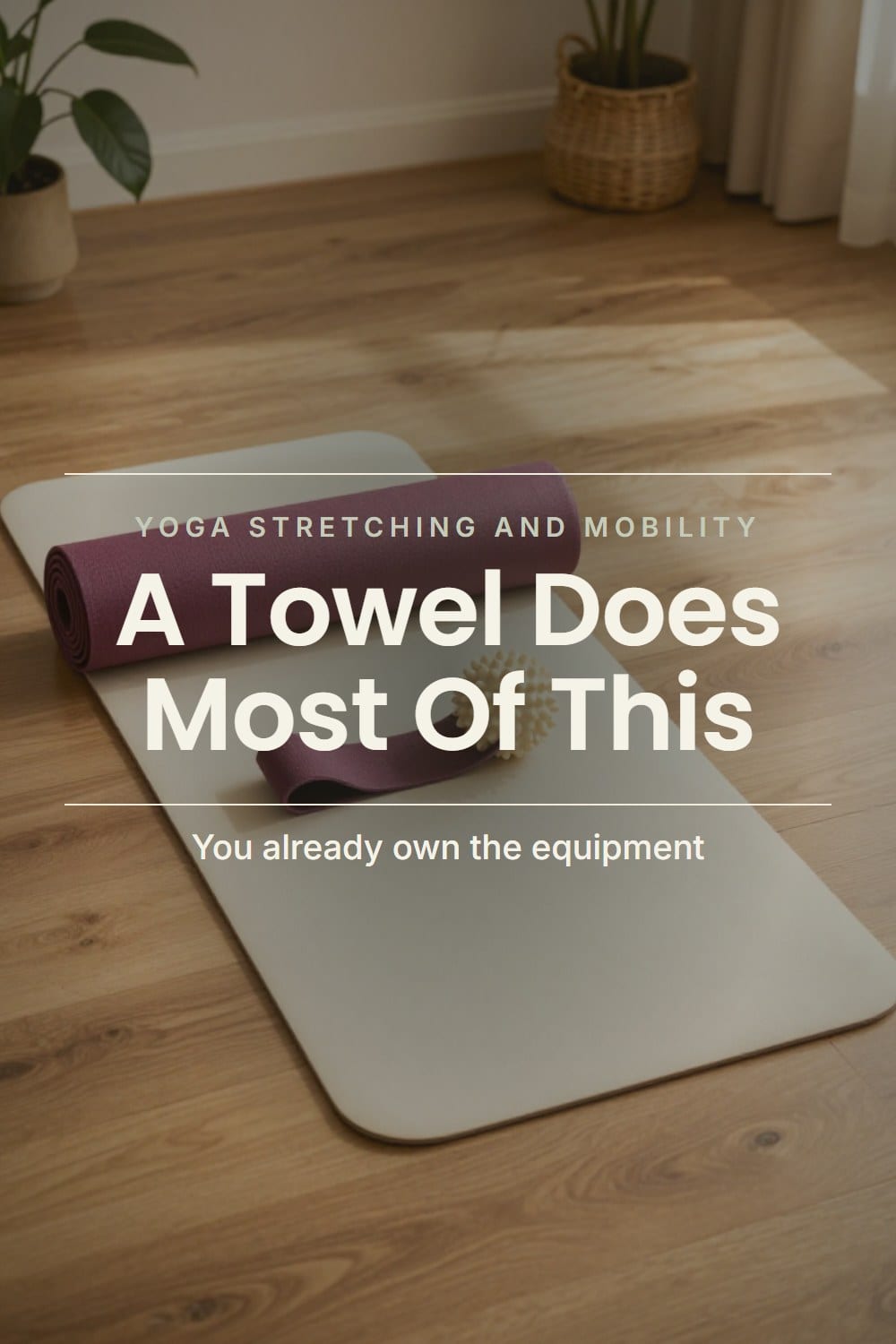
If you'd rather have a couple of purpose-built versions — a little more comfortable, a little more durable for daily use — here are honest options worth comparing, not a single 'best' pick, since a lot of this comes down to personal preference.
A few small tools that make this routine more comfortable. None of them are required to do it.
| What it is | Best for | Why I'd pick it |
|---|---|---|
| Stretching Strap With Loops The loops let you ease into a stretch gradually instead of yanking your leg into position — gentler on the exact joints this routine is trying to help. | Hamstring and calf stretches without straining to reach your foot | The loops let you ease into a stretch gradually instead of yanking your leg into position — gentler on the exact joints this routine is trying to help. |
| Soft-Density Foam Roller A softer roller is a kinder starting point for midlife joints than the dense, ridged rollers built for younger athletes. | Calves and thighs, especially if a firm roller has always felt like too much | A softer roller is a kinder starting point for midlife joints than the dense, ridged rollers built for younger athletes. |
| Massage Ball for Feet and Hips Small enough to keep by the couch, and more precise than a foam roller for one specific stubborn spot. | A sore foot arch or a tight spot in the hip a towel can't quite reach | Small enough to keep by the couch, and more precise than a foam roller for one specific stubborn spot. |
| Extra-Thick Yoga Mat A thin mat is honestly uncomfortable on knees and hips within a couple of minutes — extra thickness solves that outright. | Kneeling or lying stretches on a hard floor | A thin mat is honestly uncomfortable on knees and hips within a couple of minutes — extra thickness solves that outright. |
| Yoga Block, Set of Two A block under a hip or a hand turns a stretch you can't quite settle into into one you actually can. | Bringing the floor closer when a stretch is just out of comfortable reach | A block under a hip or a hand turns a stretch you can't quite settle into into one you actually can. |
No prices here — Amazon requires them to be live, so click through to see what something costs today. Equipment helps; it is never the thing that makes a plan work.
None of this is a diagnosis or a promise about your specific joints — only what the general research supports, cited plainly below, so you can check it yourself instead of just trusting me.
Where this comes from
Every claim above traces to one of these four.
- 1Stretching Your Hamstring
Mayo Clinic · 2021
Supports: That persistent muscle tightness is often a protective signal from the nervous system about the body's current state rather than proof of a true flexibility deficit, that the feeling of stiffness doesn't reliably correlate with an actual lack of mobility in that area, that stretching alone typically provides only short-term relief for ongoing tightness, and that stability and strengthening exercise often provide more lasting relief than stretching alone.
- 229 Perimenopause Symptoms You May Not Know About
Cleveland Clinic
Supports: That estrogen helps protect the joints, so declining estrogen levels in perimenopause and menopause can bring joint pain or discomfort throughout the body, and that the same hormonal decline is linked to muscles feeling tighter and less comfortable than before.
- 3Strong, Steady and Straight: UK Consensus Statement on Physical Activity and Exercise for Osteoporosis
British Journal of Sports Medicine · 2022
Supports: That people with osteoporosis are advised to modify or avoid movements involving sustained, repeated or end-range spinal flexion, and to avoid postures with a high degree of spinal flexion during exercise or daily life, as a precaution around vertebral fracture risk — prioritizing spinal-extension exercise for posture instead.
- 4Adverse Events and Safety Issues Associated With Physical Activity and Exercise for Adults With Osteoporosis and Osteopenia
Journal of Frailty, Sarcopenia and Falls · 2018
Supports: That in observational research, activities involving spinal flexion — including certain yoga movements and sit-ups — were associated with a greater risk of vertebral fractures, though such events were reported as rare.
Free, and printable
The free 4-Week Indoor Walking Plan
The plan sign-up is not live yet — the mailing list is still being set up. In the meantime, email hello@strongandrooted.com and Diane will send it to you herself.
One email when there is something worth sending. Unsubscribe whenever you like.
Frequently asked questions
Why does stretching never seem to help?
Is it normal for joints to feel stiffer during perimenopause and menopause?
Can stretching help with arthritis or a diagnosed joint condition?
Is stretching safe if I have osteoporosis?
Stretching isn't the villain here, and it isn't the fix either — it's a small, genuinely useful habit for comfort and range, sitting right next to the thing that actually changes stubborn tightness: getting stronger. If that's the piece you've been missing, strength training for beginners over 40 is where to go next. And if you want the honest, full picture of every low-impact option available to you, the complete low-impact and mobility guide ties all of it together. Either way — a towel, a wall and a few gentle minutes are already enough to start today.
Free, and printable
The 4-Week Indoor Walking Plan
The plan sign-up is not live yet — the mailing list is still being set up. In the meantime, email hello@strongandrooted.com and Diane will send it to you herself.
One email when there is something worth sending. Unsubscribe whenever you like.
Written by
Diane Marsh
At 49 I was tired, achy, sleeping badly, and being told to do more cardio and eat less — which was making all of it worse. I started walking. Fifteen minutes, indoors, in socks. Three years later I am stronger than I was at forty. I write down exactly what I did, cite the research where it exists, and admit where it doesn't.
Diane is not a doctor, a physical therapist, or a dietitian. She is a woman who rebuilt her own strength after perimenopause, reads the research carefully, cites it, and says so when nobody actually knows.
Strong & Rooted is a participant in the Amazon Services LLC Associates Program, an affiliate advertising program designed to provide a means for sites to earn advertising fees by advertising and linking to Amazon.com. As an Amazon Associate I earn from qualifying purchases. If you click a link and buy something, I may receive a small commission at no additional cost to you. I recommend only equipment I have used myself or would hand to a friend, and commission never decides the order of a list. Prices are never shown here because Amazon requires displayed prices to be live — click through to see what something costs today.
Keep reading
Five minutes, before coffee, in your pajamas, no mat required. Here's the honest, physical reason your mornings feel stiff after 40, the exact minute-by-minute routine I actually do, and the one stretch to swap out if you have osteoporosis.
Pilates for Your Back and Core After 40 (Without the Crunches)Core work doesn't mean crunches — and after 40, that distinction actually matters. Here's what your core really is, why the sit-ups you learned may be the least useful (and, for some of us, the riskiest) exercise on the list, and what Pilates offers instead: bracing, breathing, and learning to hold still.
Low-Impact Exercise and Mobility After 40: The Complete GuidePilates, wall Pilates, gentle yoga, morning mobility and stretching all get filed under 'low-impact' — but they're not the same thing, and none of them is your bone plan. Here's the honest map: what each one is genuinely for, which one to start with, and where low-impact fits next to walking and real strength work.