Indoor Walking Plan for Beginners Over 40 (No Equipment, No Gym)
The advice you've probably been given — eat less, move more, push harder — was never built for the body you have after 40. Here's the four-week indoor walking plan I actually give people: fifteen minutes to start, no equipment, no gym.

By Diane Marsh··10 min read
Claims on this page are checked against the National Institute on Aging (NIH), Cleveland Clinic, The Menopause Society and Mayo Clinic — all four are linked below.
General education, not medical advice. Talk to your doctor before starting something new.
The short version
- Start with fifteen minutes of indoor walking, five days a week — that's the entire first week.
- Add time, not intensity. Fifteen minutes becomes forty across four weeks, with nothing to jump on.
- Muscle and bone quietly decline after 40, and the decline speeds up around menopause — which is why eating less and pushing harder tends to backfire.
- There's a free printable version of this exact plan, with boxes to check off as you go.
- If it hurts, stop. Soreness isn't proof that something worked.
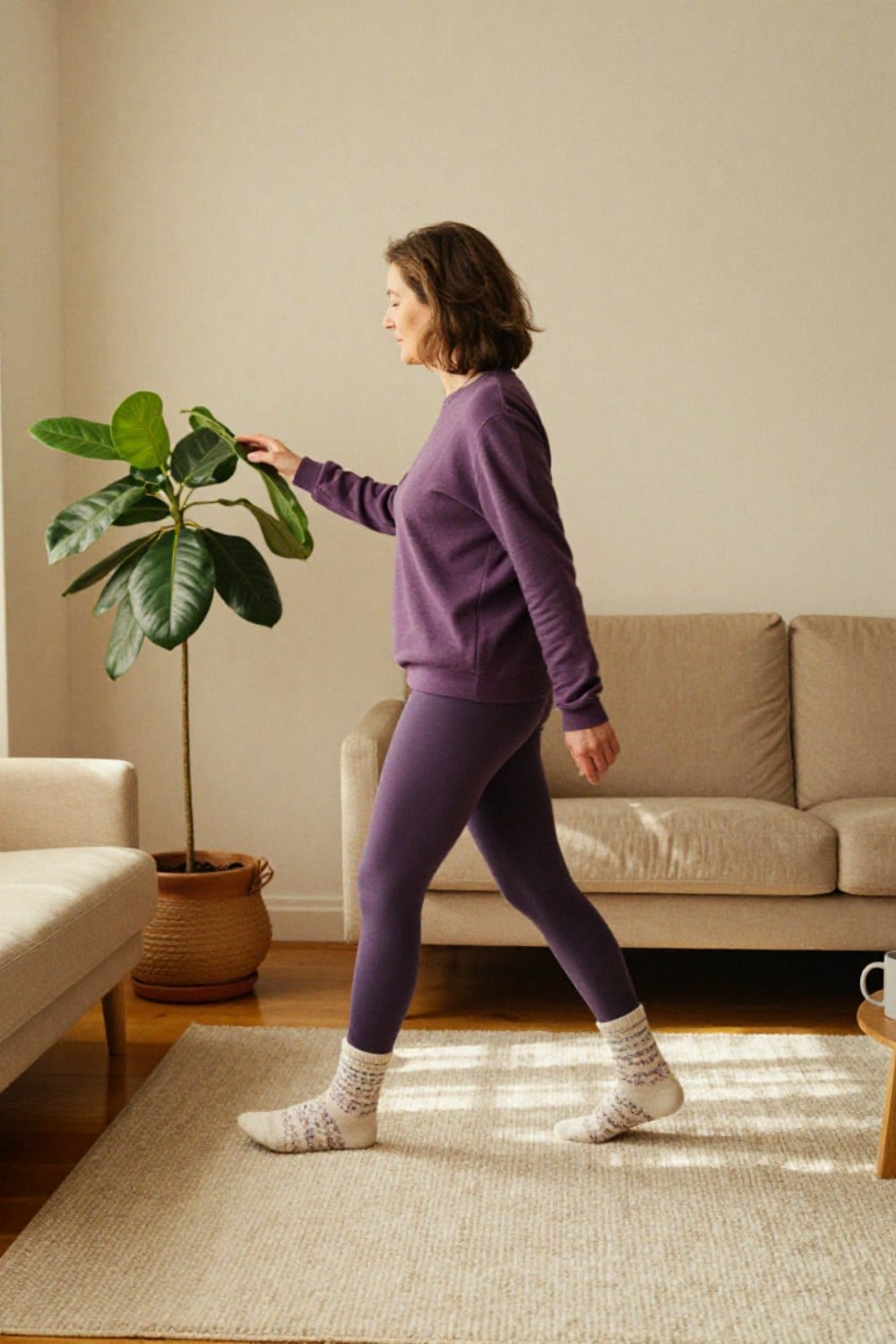
You don't need a gym membership, a treadmill, or a single new piece of exercise equipment to start walking your way back to feeling steady and capable again. You need about fifteen minutes, comfortable shoes or just socks, and your own living room floor.
If you're over 40 and the advice you've been handed so far — eat less, move more, push harder — has left you more tired and no stronger, you are not doing it wrong. That advice was built for a body you don't have anymore, and pushing harder against the wrong plan tends to backfire.
Here is the plan I actually give people. Start at fifteen minutes, indoors, five days a week. Build slowly to about forty minutes by week four. No equipment, no gym, no weather to plan around, and no one watching. Just a room to walk back and forth in, and four weeks to let it turn into a habit instead of a daily decision.
What changes after 40 — and why 'more cardio, less food' backfires
Somewhere in your forties, without asking permission, your body starts doing two quiet things: it lets go of a little muscle, and it lets go of a little bone density. Both trends speed up around perimenopause and menopause.
Neither one is solved by eating less and moving harder. If anything, that combination asks nothing of the muscle and bone you're trying to hold onto — it just adds fatigue on top of a body that's already losing ground.
Bone follows a similar pattern. For most women, bone density drops fastest in the five to ten years around the menopause transition, largely because of the drop in estrogen — which is exactly the stretch of life this plan is written for.
None of this is a reason to panic, and it isn't a reason to train like you're twenty-five again either. It's a reason to move — gently, and often — starting today, in whatever room you're standing in right now.
The 4-week indoor walking plan
This is the whole plan. Five days a week, in whatever shoes or socks are comfortable, walking back and forth across a room, in loops around your house, or in place if that's all the space you have. The only thing that changes from week to week is the clock.
Your 4-week indoor walking plan
Five days a week. Whatever shoes or socks are comfortable. The only thing that changes from week to week is the clock.
| Week | Walk time | How it should feel | Optional add-on |
|---|---|---|---|
| Week 1If fifteen minutes feels like a lot today, do eight. Eight minutes done beats thirty minutes planned. | 15 minutes | Easy — you could hold a conversation the whole time | None. Just the walk. |
| Week 2Splitting it into two 10-minute walks counts exactly the same. | 20 minutes | Still easy, maybe a little warm by the last few minutes | A few gentle arm circles or ankle rolls before you start |
| Week 3Two 15-minute walks work just as well as one 30-minute walk here. Consistency matters more than the shape of it. | 30 minutes | Comfortable, breathing a little deeper than week one | One easy resistance-band session on a non-walking day, if you're curious — not required yet |
| Week 4Not quite there yet? Stay at 30 minutes for another week. There's no clock running against you. | 40 minutes | Steady — you should finish feeling better than you started, not wiped out | Two short band or bodyweight sessions, once walking feels automatic rather than effortful |
What you need for week one
- Comfortable shoes, or just socks on a floor that isn't slippery
- Clothes you can move in easily
- A cleared path — even a short one, back and forth
- A glass of water nearby
- A clock or timer, so you're not guessing at fifteen minutes
That's the entire list. No mat, no resistance band, no subscription, and nothing more complicated than this page. Those things can come later, if you want them — nothing in week one is waiting on them.
Please be careful
Why four weeks, not one
Four weeks isn't an arbitrary number. It's roughly how long it takes for a new action to stop feeling like a decision and start feeling automatic — the difference between deciding to walk every single morning and just walking, the way you don't decide to brush your teeth.
That's why the plan adds time so slowly. The goal of week one was never fitness. It was proving to yourself that you'd do it again on Tuesday.
Morning, evening, or whenever you'll actually do it
There's no required hour. Some women walk before coffee because it's the only time that's reliably theirs. Others walk after dinner because midday is chaos and mornings are worse. The right time is whichever one you'll actually repeat on a Tuesday when you don't feel like it.
If you're not sure, start in the morning for the first week. It's easier to protect fifteen minutes before the day has had a chance to fill up around it — but if evenings work better for your life, evenings are just as real.
Why walking counts as real exercise
Walking gets dismissed because it's easy to do and hard to sell. But regular brisk walking is linked to real, meaningful benefit for your heart, your blood pressure and your blood sugar — and it strengthens the same bones and muscles you're working to protect.
If your knees, hips or feet are the actual reason you've been putting this off, the plan above doesn't need to change — the pace and the surface do. We've written a gentler, joint-friendly version of this same plan for exactly that.
Small space, bad weather, or nowhere to pace
You don't need room for long laps. A hallway, a rug, or the strip of floor beside your bed is enough. Walking in place works the same muscles and counts the same minutes — it's often the easiest way to start when an apartment, the weather, or a cranky hip says no to anything longer.
Once this feels like a habit
Somewhere around week three or four, the walk stops being a decision you make every morning and starts being a thing you just do. That's the actual goal of these four weeks, more than any number on the clock.
Some women want more structure than a table on a page gives them — an actual calendar, a box to check every day. Our 28-day indoor walking challenge takes this same progression and turns it into exactly that.
The one piece of gear worth considering
You need shoes or socks, comfortable clothes, and somewhere to walk back and forth for fifteen minutes. That's the entire list for week one, and it doesn't change through week four.
If you keep going past this plan and want a dedicated surface for bad-weather days or a small apartment, a walking pad is the one piece of gear worth actually comparing — but it's optional, and nothing in this plan required it to work.
Where this comes from
Every claim above is backed by one of these four sources.
- 1How Can Strength Training Build Healthier Bodies as We Age?
National Institute on Aging (NIH)
Supports: That muscle mass and strength (sarcopenia) decline with age, and that resistance and strength exercise are the approaches shown to help protect against that decline.
- 2Sarcopenia: What It Is and What Causes It
Cleveland Clinic · 2024
Supports: That age-related muscle loss (sarcopenia) is a real, well-documented condition, and that you can lose as much as 8% of your muscle mass per decade beginning in your 30s and 40s.
- 3Osteoporosis Could Prove Deadly in Postmenopausal Women
The Menopause Society
Supports: That bone density drops fastest in the five to ten years around the menopause transition, largely because of the drop in estrogen.
- 4Walking: Trim Your Waistline, Improve Your Health
Mayo Clinic · 2024
Supports: That regular walking is linked to real cardiovascular, metabolic, bone and muscle benefit, and that it counts as genuine exercise.
- 5Premature Menopause Linked to Increased Musculoskeletal Pain and Likelihood of Sarcopenia
The Menopause Society
Supports: That the accelerated muscle loss and musculoskeletal change women notice around the menopause transition is linked to hormonal change — the decline in estrogen — rather than to chronological age alone.
Free, and printable
The free 4-Week Indoor Walking Plan
The plan sign-up is not live yet — the mailing list is still being set up. In the meantime, email hello@strongandrooted.com and Diane will send it to you herself.
One email when there is something worth sending. Unsubscribe whenever you like.
Frequently asked questions
Is walking indoors actually enough, or do I need to go outside eventually?
Will this help me lose weight?
I'm already achy. Should I wait until I feel better to start?
What if I can't manage the full fifteen minutes on day one?
Four weeks from today, this can be a habit instead of a daily decision — and from there, you have options. Walk in place on the days a longer loop isn't possible. Follow the 28-day challenge if you want more structure than a table gives you. Ease into the low-impact version if your joints need it. Or look at walking pads once you know you want a dedicated surface. For today, though, just start with fifteen minutes. That's the only step that actually matters right now.
Free, and printable
The 4-Week Indoor Walking Plan
The plan sign-up is not live yet — the mailing list is still being set up. In the meantime, email hello@strongandrooted.com and Diane will send it to you herself.
One email when there is something worth sending. Unsubscribe whenever you like.
Written by
Diane Marsh
At 49 I was tired, achy, sleeping badly, and being told to do more cardio and eat less — which was making all of it worse. I started walking. Fifteen minutes, indoors, in socks. Three years later I am stronger than I was at forty. I write down exactly what I did, cite the research where it exists, and admit where it doesn't.
Diane is not a doctor, a physical therapist, or a dietitian. She is a woman who rebuilt her own strength after perimenopause, reads the research carefully, cites it, and says so when nobody actually knows.
Keep reading
Everything this site knows about walking after 40, in one place — what actually changes in your body, the honest version of every trending method, and exactly which article to read next for where you are right now.
Is Walking Enough for Your Bones and Joints After 40?Walking really is linked to stronger hips — the research on this is genuinely encouraging. But if bone density and joint health are what you're after, walking is the first chapter, not the whole book. Here's the honest, cited version of what to add.
What Walking Really Does for a Midlife Metabolism (An Honest Answer)You've probably been told a walk will change everything menopause does to your body. It won't, not on its own — but here's the honest mechanism instead: what actually changes after 40, why it matters for your heart and blood sugar rather than your mirror, and what genuinely helps more than walking alone.