Walking in Place at Home: The No-Equipment Indoor Walk for Women Over 40
Bad weather, a dark evening, or just not wanting an audience — none of it has to cost you a walk. Here's a real, follow-along way to do the whole thing standing in one spot, indoors, in twenty to thirty minutes.

By Diane Marsh··11 min read
Claims on this page are checked against Cleveland Clinic, the National Institutes of Health, the CDC and Mayo Clinic — all four are linked below.
General education, not medical advice. Talk to your doctor before starting something new.
The short version
- A 20 to 30 minute walk you do standing in one spot — no treadmill, no equipment, no weather to check first.
- Marching, step-touches and gentle knee lifts, done with enough energy to raise your heart rate, count as real moderate-intensity cardio.
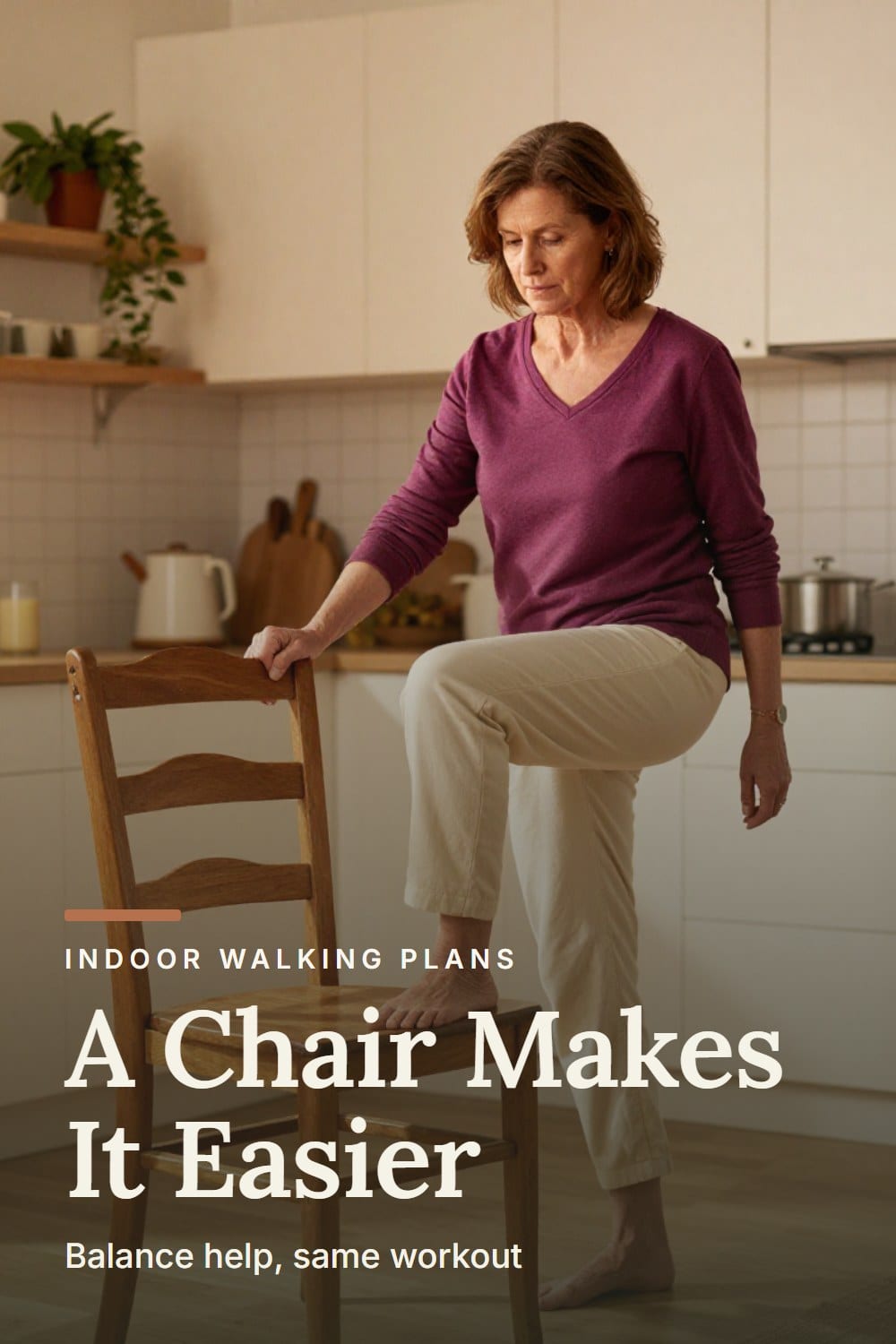
- Chair-supported and lower-impact versions of every move are built in — you adjust the range, and it all still counts.
- Pairs with the indoor walking plan for beginners over 40 for the days you can't get outside.
- If something hurts sharply or inside a joint, stop that move and talk to your doctor.
Some days it's the weather — sleet, or a heat advisory, or wind that makes your eyes water two steps out the door. Some days it's a fourth-floor apartment with nowhere close by to walk. And some days, if you're honest, it's that you just don't want to be looked at while you're moving your body. Any one of those is a good enough reason to skip a walk outside. None of them has to be a reason to skip a walk.
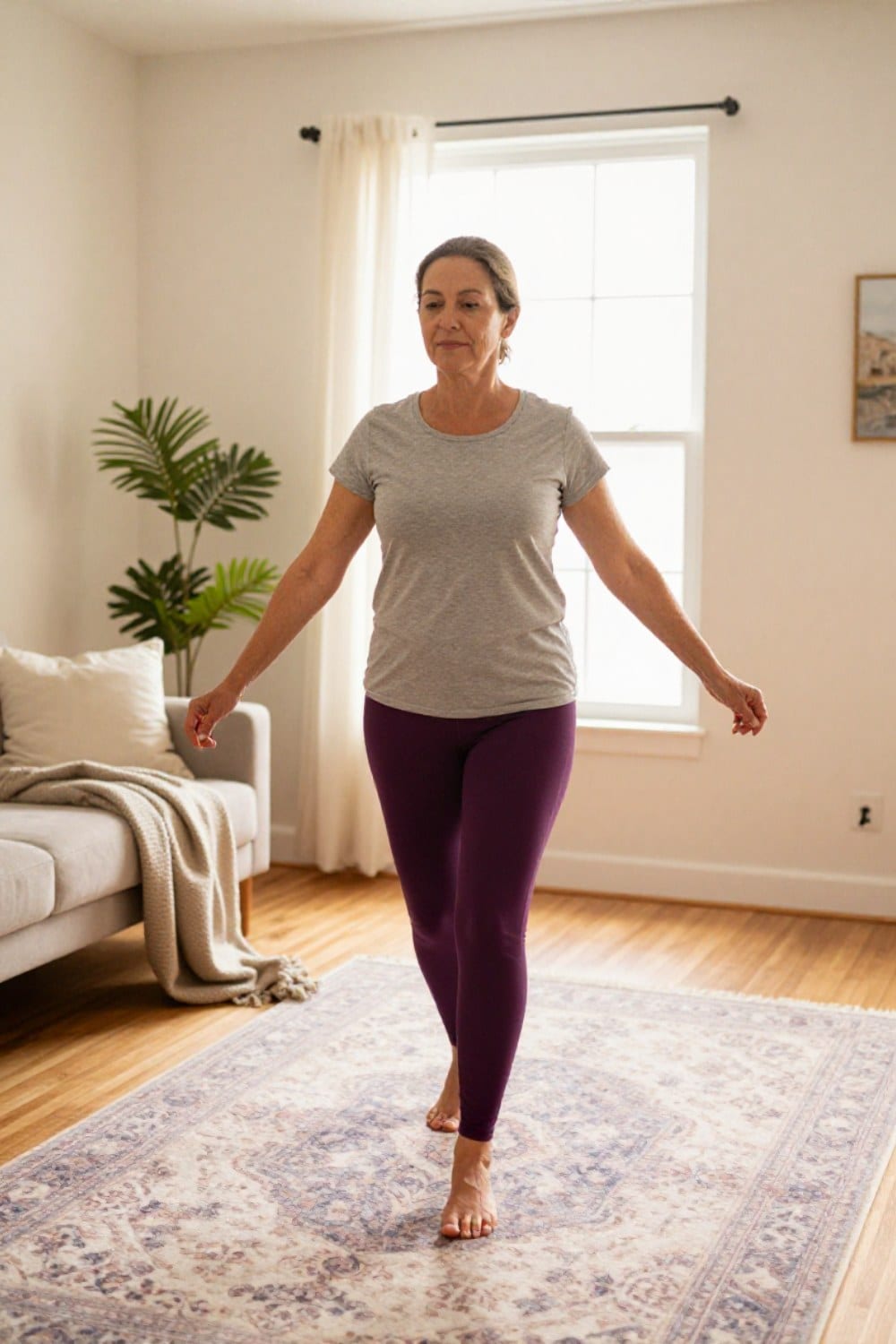
You can do this entire workout standing in one spot, in your living room, in whatever you're already wearing. Marching, a handful of step-touches, a few gentle knee lifts, your arms doing real work the whole time — twenty to thirty minutes, and it counts as a genuine walk.
This is the version I reach for on hotel-room nights, on the days the sidewalk is ice, and on the mornings I'd rather nobody saw me yet. It's also the one people are most surprised to hear actually works.
Why Walking in Place Actually Counts as a Workout
It's easy to assume a real walk needs distance — a block to cover, a trail, somewhere to arrive. Your heart doesn't measure it that way. What raises your heart rate and keeps it there is effort: a steady pace you can sustain, breathing a little harder than resting, your arms and legs moving rhythmically for a sustained stretch of time. Marching in place, done with a bit of real energy behind it, produces exactly that — your living room floor doesn't know the difference between six feet and six blocks.
The activity guideline most doctors point to asks for around 150 minutes a week of moderate-intensity movement — the kind where you can hold a conversation but wouldn't want to sing along to the radio. It doesn't ask where you did it. It doesn't ask whether the blinds were open or closed. Twenty minutes a day, five days a week, gets you most of the way there before you've finished your coffee, and it adds up the same whether you walked to get it or marched while you waited for it to brew.
Who This Is Actually For
This session was built for three specific mornings: the one where the forecast makes an outdoor walk a bad idea, the one where your building doesn't back onto anywhere walkable, and the one where you'd simply rather not have an audience yet. All three are common, and none of them are a character flaw. A body that walks twenty minutes indoors gets essentially the same cardiovascular signal as one that walks twenty minutes outdoors at the same effort — the only thing missing is the scenery.
What You Actually Need (Almost Nothing)
A few feet of open floor. Shoes, if your floor is hard on bare feet — socks or nothing at all, if it isn't. A rug helps your footing but isn't required, and neither is a mirror, a mat, or a single piece of equipment. That's the entire list, and it's short on purpose: the fewer things standing between you and starting, the more likely you are to actually do this on a Tuesday.
If you're starting from a complete stop, our indoor walking plan for beginners over 40 lays out the full four-week build, from a first fifteen minutes to a steady forty. This in-place version is the companion for the days you can't get outside, or would rather not — it slots into that same plan without missing a beat, and you can move back and forth between the two as the week demands.
The 20–30 Minute In-Place Walk
Here's the session, start to finish. Run it in order the first handful of times so the rhythm becomes familiar, then rearrange the middle rows however you like once it is. Stop at the twenty-minute mark for the shorter version on a tired day — it counts exactly the same as finishing all thirty.
Your 20–30 Minute Session
Five days a week is plenty to start. Follow the order below the first few times, then mix the middle rows however you like.
| Minutes | Move | How it feels |
|---|---|---|
| 0:00–3:00 | Warm march in place | Easy — find your rhythm |
| 3:00–7:00 | March + big arm swings | Slightly warmer, breathing picks up |
| 7:00–11:00 | Step-touch side to side | Light in the hips, still easy |
| 11:00–15:00Keep the lifts low if a hip or knee needs it today. | Gentle knee lifts, alternating | A little more effort, still conversational |
| 15:00–19:00 | March + reach overhead | Warm, steady breathing |
| 19:00–23:00 | Step-touch + shoulder rolls | Easing down, unhurried |
| 23:00–27:00 | Slow march, arms low | Cooling, breath settling |
| 27:00–30:00 | Standing stretch, feet planted | Calm, finished |
The Moves, One at a Time
Nothing here is complicated, and nothing requires coordination you don't already have. If you can stand and shift your weight from one foot to the other, you can do a version of all four.
- March in place: Lift your knees to a comfortable height — ankle-high counts — and swing your arms like you're actually going somewhere, because for the next few minutes, you are.
- Step-touch: Step one foot out to the side, tap the other foot in to meet it, then switch and lead with the other side. It's easy on the knees, and it quietly builds the kind of side-to-side balance that stairs and curbs ask for.
- Gentle knee lifts: Lift one knee toward waist height, lower it, alternate sides at an easy pace. Keep the lift low if a hip or knee feels cranky today — the height is optional, the movement isn't.
- Arm work: Reach overhead and pull back down, swing your arms side to side, or simply pump them the way you would walking briskly outside. This is the single biggest lever for turning 'standing and moving' into a real cardio effort.
Please be careful
Why 'Just Standing in One Spot' Still Works
There's a version of this where a woman does eight minutes, decides it doesn't feel like 'real' exercise because she never left the rug, and quietly stops. I'd rather you didn't. The research on walking doesn't ask about scenery, distance, or whether anyone saw you do it — it asks about heart rate, duration and how consistently you show up. Twenty minutes of marching with genuine intention behind it meets that bar the same way a lap around the neighborhood does.
It also means this version travels in a way an outdoor walk can't. A hotel room with six feet of clear carpet. A guest bedroom over the holidays. Fifteen minutes before the rest of the house is awake, in whatever you slept in. The walk stops needing permission from the weather, the sidewalk, your building's layout, or anyone else's schedule — which, in practice, is exactly why it's the version that survives a bad week.
Ready for More Structure?
Once this feels like something you simply do, rather than something you're deciding about fresh every morning, a written calendar tends to help more than willpower does — it turns a daily debate into a box you check. Our 28-day indoor walking challenge builds on exactly this session, with a specific plan for each day and a box to check off when it's done.
Where this comes from
Every physiological claim on this page ties back to one of these four, linked in full below.
- 17 Reasons to Start Walking in Place
Cleveland Clinic
Supports: That walking in place is a legitimate form of moderate-intensity cardio that raises heart rate and works the legs, and that it pairs well with simple strength work to help protect muscle and bone.
- 2Health Benefits of Exercise and Physical Activity
National Institutes of Health — National Institute on Aging
Supports: That regular physical activity protects against age-related muscle loss and bone loss, supports cardiovascular health, and counts toward benefit even in shorter, accumulated sessions.
- 3Adult Activity: An Overview
Centers for Disease Control and Prevention
Supports: That adults benefit from about 150 minutes of moderate-intensity activity a week, that the time can be broken into smaller chunks, and what counts as moderate intensity.
- 4Walking: Trim your waistline, improve your health
Mayo Clinic
Supports: That regular brisk walking is associated with meaningful cardiovascular and metabolic benefit, and that it counts as real exercise.
Free, and printable
The Free 4-Week Indoor Walking Plan
The plan sign-up is not live yet — the mailing list is still being set up. In the meantime, email hello@strongandrooted.com and Diane will send it to you herself.
One email when there is something worth sending. Unsubscribe whenever you like.
Frequently asked questions
Does walking in place really count as a workout?
How long before I notice a difference?
What if my knees or hips ache the next day?
Can I do this every single day?
None of this asks you to wait for better weather, a gym membership, or a version of yourself that feels more ready than you do right now. Clear a few feet of floor, and start marching. For the full four-week structure behind it, start with the indoor walking plan for beginners over 40 — this in-place session is the room-sized version of that same plan, and on the days you need it, it counts exactly the same.
Free, and printable
The 4-Week Indoor Walking Plan
The plan sign-up is not live yet — the mailing list is still being set up. In the meantime, email hello@strongandrooted.com and Diane will send it to you herself.
One email when there is something worth sending. Unsubscribe whenever you like.
Written by
Diane Marsh
At 49 I was tired, achy, sleeping badly, and being told to do more cardio and eat less — which was making all of it worse. I started walking. Fifteen minutes, indoors, in socks. Three years later I am stronger than I was at forty. I write down exactly what I did, cite the research where it exists, and admit where it doesn't.
Diane is not a doctor, a physical therapist, or a dietitian. She is a woman who rebuilt her own strength after perimenopause, reads the research carefully, cites it, and says so when nobody actually knows.
Keep reading
Everything this site knows about walking after 40, in one place — what actually changes in your body, the honest version of every trending method, and exactly which article to read next for where you are right now.
Is Walking Enough for Your Bones and Joints After 40?Walking really is linked to stronger hips — the research on this is genuinely encouraging. But if bone density and joint health are what you're after, walking is the first chapter, not the whole book. Here's the honest, cited version of what to add.
What Walking Really Does for a Midlife Metabolism (An Honest Answer)You've probably been told a walk will change everything menopause does to your body. It won't, not on its own — but here's the honest mechanism instead: what actually changes after 40, why it matters for your heart and blood sugar rather than your mirror, and what genuinely helps more than walking alone.