Pilates for Beginners in Midlife (Start Here, Not on the Floor)
You've never done Pilates, and you're quietly worried you'll be the stiffest person in the room. Here's what it actually is, what a first session honestly feels like, and a real beginner routine — no floor roll-ups required on day one.
By Diane Marsh··11 min read
Claims on this page are checked against Cleveland Clinic, Harvard Health, Mayo Clinic, and 2022 UK guidelines on osteoporosis and exercise published in the British Journal of Sports Medicine — all four sources are linked below.
This post contains affiliate links. As an Amazon Associate I earn from qualifying purchases — at no extra cost to you.
General education, not medical advice. Talk to your doctor before starting something new.
The short version
- Pilates is low-impact strength and core-control work — not a stretching class, and not yoga under a different name.
- Your first session will feel awkward and shaky in places that looked like nothing was happening on video — that's normal, not a sign you're unfit.
- If you have osteoporosis, osteopenia or a fracture history, talk with your doctor or a physical therapist before roll-ups or forward folds — published guidance links spinal flexion to a higher fracture risk for that group.
- You can start tonight with a folded towel and a wall. Nothing on this page is required to begin.
- Progress is quiet and cumulative — nobody reasonable is promising you a new shape in 28 days.
You've watched the videos. A woman moves through some slow, controlled sequence — one leg extended, her spine curling and uncurling like a wave — and it looks equal parts calm and demanding. Some part of you has thought, I could probably use that.
And then another part of you pictures walking into an actual class — unrolling a mat next to women who've clearly done this a hundred times, hoping nobody notices you don't know where your hips are supposed to go. That part usually wins, and keeps you on the couch.
So let's start here instead. Not on a studio floor, not on a phone screen, and not with a promise that you'll look different in a month. Just an honest picture of what Pilates actually is, what a first session honestly feels like, the words that make it sound like a private club, and a genuine first routine you can try tonight, near a wall, with nothing you don't already own.
What Pilates Actually Is (and What It Isn't)
Here's the confusion worth clearing up first, because it changes how you walk in. Pilates isn't a stretching class, and it isn't yoga wearing a different name. It's its own form of strength training — controlled, precise, and built around your core.
That distinction matters for a beginner, because it resets what you should expect. You're not there to become bendy — you're there to learn to control your own body with more precision than you're used to. That's a lot less dramatic than 'a new you,' and a far more useful skill at this stage of your life.
If most of what you've seen has come through 'wall Pilates' videos on your phone, I've written an honest look at that specific trend — short version, the wall is a genuinely useful support and feedback tool, not a separate exercise. Real Pilates, wall or mat, is the same practice underneath the packaging.
What Your First Session Actually Feels Like
Nobody puts this part in the promotional video, so I will. Your first class, or your first attempt at home, is not going to feel like a workout in the sweaty, breathless sense. It's going to feel like trying to follow three instructions at once — where your spine is, where your ribs are, whether you're actually using your abdominal muscles or just holding your breath and hoping for the best.
Your legs will probably shake doing something that looked like nothing was happening in the video. A movement that looked simple will turn out to be much harder to control. None of that means you're unfit — it means you're using your muscles in a specific, coordinated way for the first time, a different skill from being strong, and a different one again from being flexible.
And here's the thing you were actually worried about: you will almost certainly not be the stiffest or the oldest person doing it. Women in their 40s, 50s and 60s are, by a wide margin, exactly who shows up to a Pilates class or a Pilates video. If that fear is the only thing keeping you on the couch, you can let it go.
If your joints do feel stiffer than they used to, that's worth naming honestly too — and it's very likely not really about Pilates at all.
That's a general pattern, not a diagnosis of your specific joints. If you have ongoing joint pain, swelling, or a diagnosed condition like arthritis, that's a conversation for your doctor or a physical therapist — not something a beginner Pilates video is meant to sort out.
The Words That Make It Sound Like a Secret Language
Part of what makes Pilates intimidating from the outside is the vocabulary. It genuinely sounds like a private language the first time you hear it. Here's the plain-English version of the phrases that come up most.
- Neutral spine — your lower back's natural, slight curve, not pressed flat against the floor and not arched. It's the position your spine already prefers; you're just learning to notice it.
- The powerhouse — the old Pilates word for your center: deep abdominal muscles, lower back and hips working together, not just the muscles you can see.
- Roll-down / roll-up — moving through your spine one section at a time, chin first, then upper back, then lower back, instead of folding forward all at once from your hips.
- Scoop, or imprint — gently drawing your lower abdomen in and slightly down, the specific way Pilates asks you to engage before you move.
- C-curve — a rounded, C-shaped position through the spine, used in certain seated and rolling movements.
None of it is complicated once someone translates it — it just sounds like code the first time. One more thing worth naming plainly while we're here: a lot of Pilates marketing promises to reshape one part of your body in a few weeks. Muscle doesn't work that way. It gets stronger, or it doesn't — there's no separate setting for reshaping a single spot on command. What a beginner practice actually builds is core strength, control and steadiness, a more honest goal you can actually feel and measure, week to week.
One Safety Note Before You Roll Anything
Beginner Pilates is full of roll-downs, roll-ups and forward folds. Moving your spine through that kind of flexion is a normal, central part of the practice, and for most people, that's simply how Pilates works. But if you have osteoporosis, osteopenia, or a history of a spinal fracture, I want to be very direct with you here.
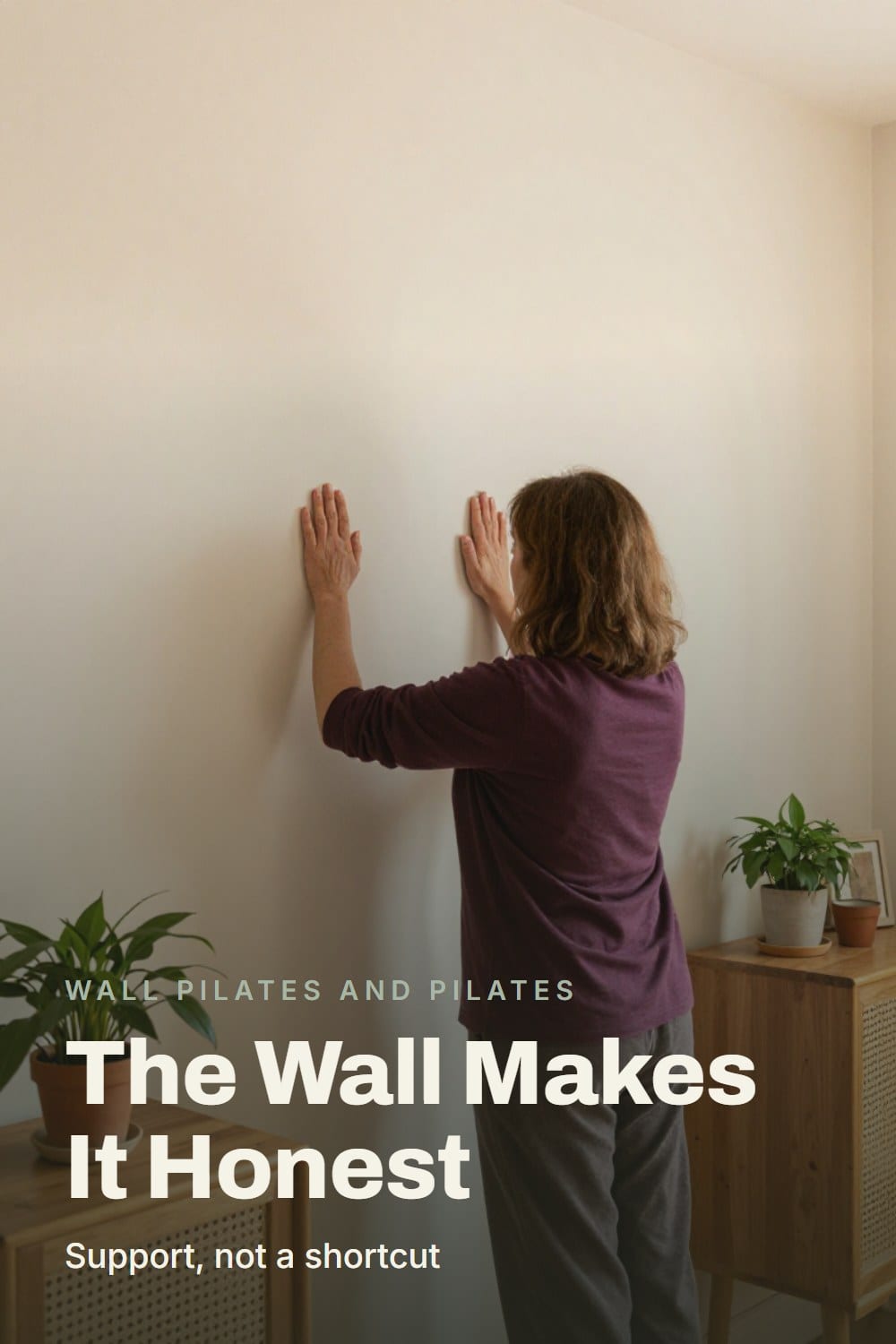
The good news is you don't have to skip Pilates entirely while you sort that out. Wall Pilates uses a wall for support and feedback instead of the floor, which naturally limits how far you fold forward and gives you something solid to hold onto. It's a genuinely gentler entry point, not a lesser version of the real thing.
Your First Real Pilates Routine
This isn't a full class. It's six moves you can do in about fifteen minutes, near a wall or a sturdy chair, with nothing you don't already own. Go slowly. Slow is the entire point here, not a compromise.
Your first Pilates session
Work through these in order, resting whenever you need to. This is meant to feel manageable, not exhausting.
| Move | Reps | How It Should Feel | Easier Option |
|---|---|---|---|
| Pelvic tilts (finding neutral spine)This one is about noticing, not exercising. | 8–10 slow tilts | Subtle, almost boring — a gentle rock through your hips | Do it seated in a chair, hands resting on your thighs |
| Standing wall roll-downThis is the beginner-friendly stand-in for a full floor roll-up. | 5 slow rolls | A stretch through your spine and the back of your legs, never a strain | Roll down just a few inches, one hand on the wall the whole time |
| Tabletop toe taps | 6–8 taps per side | Your lower back staying still while one leg moves — that stillness is the actual work | Tap lightly and lift right back up instead of lowering all the way |
| Bridge lifts | 8–10 lifts | Your glutes and hamstrings doing the work, not your lower back | Lift only halfway |
| Side-lying leg lifts | 8 per side | A light effort along your outer hip by the last few reps | Bend your bottom knee for more support on the floor |
| Standing arm circles with breath | 30 seconds each direction | Calm and controlled, almost meditative | Make the circles smaller |
What You Actually Need to Start (Almost Nothing)
Before you look at a single product, here's the truth: a folded bath towel and a clear stretch of wall are enough for your first session tonight, for free. Nothing below is required to begin.
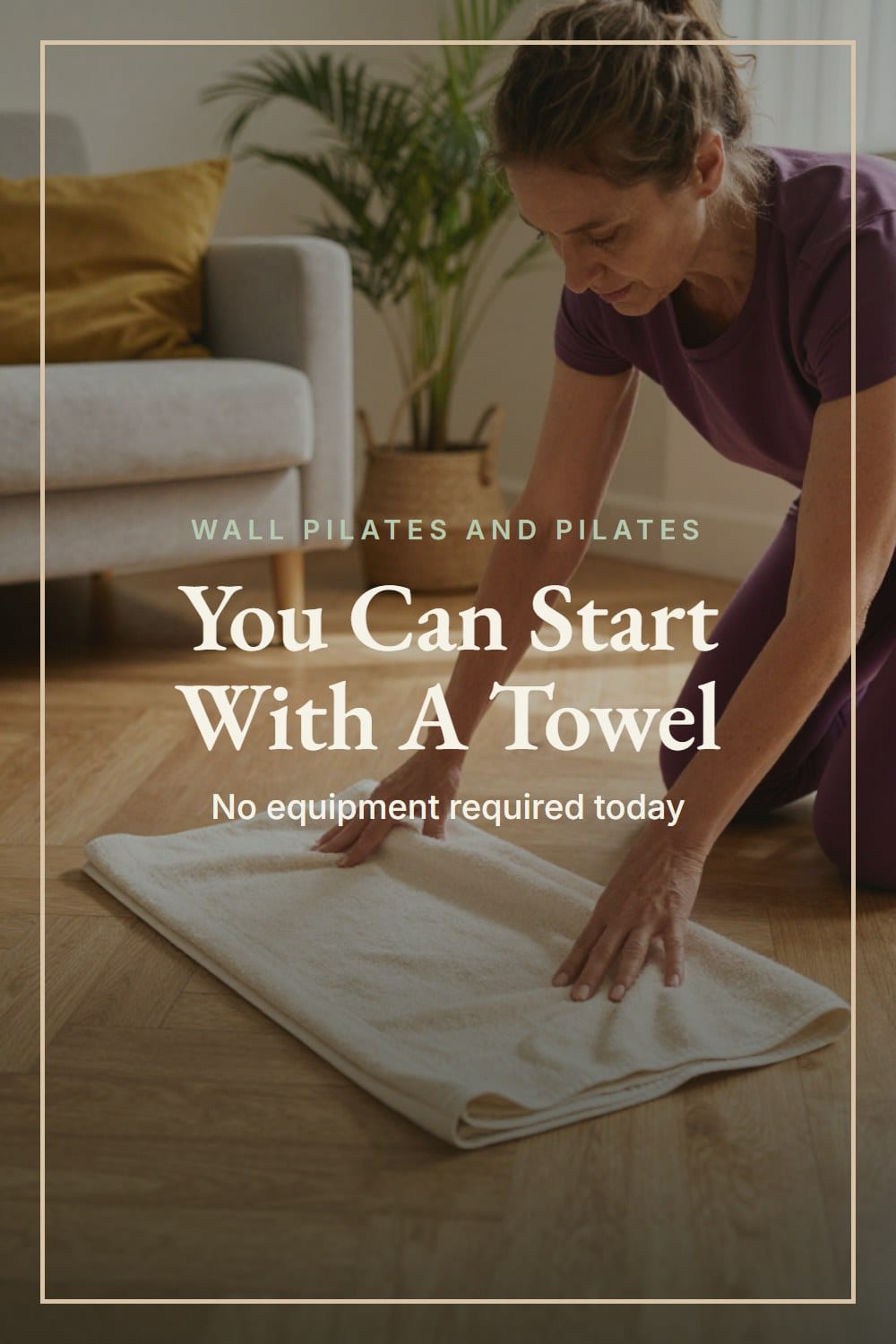
Once you know you like it, a few small things make it more comfortable — not more effective, just easier on a pair of knees and shoulders that have earned the right to be picky. Here's what I'd actually consider, roughly in the order I'd buy them.
A short, honest list — check current thickness, sizing and reviews before you decide, since specifics shift from listing to listing.
| What it is | Best for | Why I'd pick it |
|---|---|---|
| Thicker Exercise Mat for Sensitive Joints Extra padding matters more than almost anything else on this list once you're kneeling or lying down regularly. | Knees, hips or a lower back that complain on a thin mat | Extra padding matters more than almost anything else on this list once you're kneeling or lying down regularly. |
| Small Pilates Ball (8–10 Inch) A small ball gives your muscles something to press against without adding real load to your joints. | Adding light resistance to core and inner-thigh moves | A small ball gives your muscles something to press against without adding real load to your joints. |
| Light Resistance Ring or Loop A light ring gives beginners feedback you often can't feel on your own yet — useful for the exact coordination this article talks about. | Feeling exactly which muscle is supposed to be working | A light ring gives beginners feedback you often can't feel on your own yet — useful for the exact coordination this article talks about. |
| Pilates Strap or Long Stretch Band A strap does the reaching for you, so you can keep the position you're actually trying to practice. | Reaching your foot without rounding your whole back to get there | A strap does the reaching for you, so you can keep the position you're actually trying to practice. |
| Grippy Non-Slip Socks Small and grippy, and the difference between feeling steady and feeling like you're skating. | Sliding on a hard floor or a slick mat | Small and grippy, and the difference between feeling steady and feeling like you're skating. |
No prices here — Amazon requires them to be live, so click through to see what something costs today. Equipment helps; it is never the thing that makes a plan work.
None of this is a diagnosis or a promise about your body specifically. It's what the research and my own tracked experience actually support, cited plainly below so you can check every bit of it yourself.
Where this comes from
Every claim above traces to one of these four.
- 1Pilates 101: What It Is and Its Health Benefits
Cleveland Clinic
Supports: That Pilates is a low-impact, full-body form of strength training built around core strength, that a stronger, well-aligned core makes balance and posture easier to hold, and that it's a good idea to talk with a doctor before starting a new workout routine, especially after an injury or surgery.
- 2Musculoskeletal syndrome of menopause: When menopause makes you ache all over
Harvard Health · 2026
Supports: That estrogen receptors are found throughout the joints, ligaments, tendons and bones, that the drop in estrogen around midlife can affect the musculoskeletal system and cause menopause-related body aches, and that regular activity — walking, swimming, gentle stretching or yoga — helps keep joints flexible, with strength training also supporting joints.
- 3Exercising with osteoporosis: Stay active the safe way
Mayo Clinic
Supports: That in people with osteoporosis, bending forward at the waist can increase the risk of a broken bone in the spine, and that exercises requiring forceful or repeated bending — toe touches, sit-ups, and some yoga poses among them — are ones to avoid.
- 4Strong, steady and straight: UK consensus statement on physical activity and exercise for osteoporosis
British Journal of Sports Medicine · 2022
Supports: That movements or exercise involving sustained, repeated or end-range spinal flexion should be modified or avoided, that exercise causing the back to curve excessively — especially with added load — should be modified or avoided, and that individualized advice from a physiotherapist is recommended for anyone with a vertebral fracture to ensure correct technique.
Free, and printable
The free 4-Week Indoor Walking Plan
The plan sign-up is not live yet — the mailing list is still being set up. In the meantime, email hello@strongandrooted.com and Diane will send it to you herself.
One email when there is something worth sending. Unsubscribe whenever you like.
Frequently asked questions
Do I need to be flexible before I start Pilates?
Is Pilates the same thing as yoga?
I have osteoporosis, osteopenia, or a spinal fracture history. Can I still do Pilates?
How long until I actually notice a difference?
Pilates, done honestly, is a low-impact way to build real strength and control — not a stretching class, and not something that needs a studio or a flexible body first. If today is day one, start at the wall and give yourself three unglamorous weeks before judging how it's going. If your back and core brought you here, this is the next stop; if you're still deciding between Pilates and something gentler, here's the honest yoga comparison. The complete low-impact guide ties every option together, and if plain strength training suits you better than mat work, the beginner strength plan is waiting.
Free, and printable
The 4-Week Indoor Walking Plan
The plan sign-up is not live yet — the mailing list is still being set up. In the meantime, email hello@strongandrooted.com and Diane will send it to you herself.
One email when there is something worth sending. Unsubscribe whenever you like.
Written by
Diane Marsh
At 49 I was tired, achy, sleeping badly, and being told to do more cardio and eat less — which was making all of it worse. I started walking. Fifteen minutes, indoors, in socks. Three years later I am stronger than I was at forty. I write down exactly what I did, cite the research where it exists, and admit where it doesn't.
Diane is not a doctor, a physical therapist, or a dietitian. She is a woman who rebuilt her own strength after perimenopause, reads the research carefully, cites it, and says so when nobody actually knows.
Strong & Rooted is a participant in the Amazon Services LLC Associates Program, an affiliate advertising program designed to provide a means for sites to earn advertising fees by advertising and linking to Amazon.com. As an Amazon Associate I earn from qualifying purchases. If you click a link and buy something, I may receive a small commission at no additional cost to you. I recommend only equipment I have used myself or would hand to a friend, and commission never decides the order of a list. Prices are never shown here because Amazon requires displayed prices to be live — click through to see what something costs today.
Keep reading
Stretching the same tight spot for months without any change isn't a discipline problem — it's usually the wrong tool for the job. Here's the honest reframe: why 'tight' often means unsupported, not short, what stretching genuinely does for you, the gentle routine that helps it stick, and the real fix for when stretching alone hasn't worked.
The 5-Minute Morning Mobility Routine for Women Over 40Five minutes, before coffee, in your pajamas, no mat required. Here's the honest, physical reason your mornings feel stiff after 40, the exact minute-by-minute routine I actually do, and the one stretch to swap out if you have osteoporosis.
Pilates for Your Back and Core After 40 (Without the Crunches)Core work doesn't mean crunches — and after 40, that distinction actually matters. Here's what your core really is, why the sit-ups you learned may be the least useful (and, for some of us, the riskiest) exercise on the list, and what Pilates offers instead: bracing, breathing, and learning to hold still.