Wall Pilates for Women Over 40: An Honest Look at the Trend
Wall Pilates is suddenly everywhere — the videos, the apps, the 28-day promises. I looked at what the evidence actually supports, and it's a genuinely useful, low-impact way to move... just not for the reason most of the marketing gives you. Here's the honest picture, plus a real wall routine you can try today.
By Diane Marsh··10 min read
Claims on this page are checked against Cleveland Clinic, Harvard Health (Harvard Medical School), 2022 guidelines in the British Journal of Sports Medicine, and NIAMS (NIH) — all four sources are linked below.
General education, not medical advice. Talk to your doctor before starting something new.
The short version
- Pilates itself has real evidence behind it — strength, balance, posture and mobility — cited below.
- The wall is a genuinely useful support and feedback surface, but it isn't a special ingredient on its own.
- Most of what's written about "Wall Pilates" specifically comes from an app or program with a subscription to sell.
- It's a low-impact, beginner-friendly place to start — not a bone-density plan, and not a replacement for strength training.
- Classic Pilates includes forward folds — if you have osteoporosis, osteopenia or a fracture history, get your doctor's or a PT's go-ahead first.
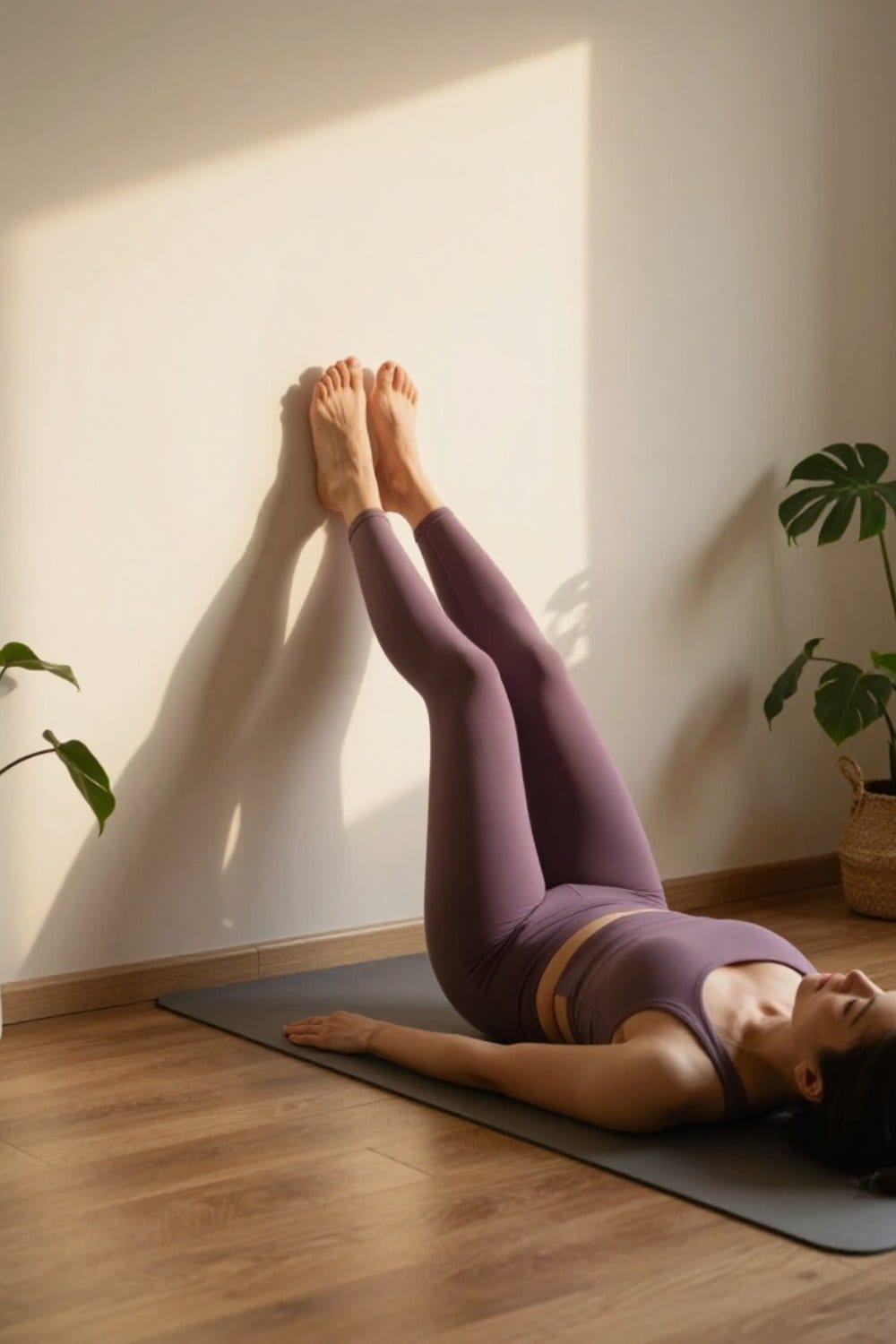
Open Pinterest for five minutes right now and you'll see her: a woman about your age, lying on her back with her feet pressed flat against a wall, captioned like she's found the missing piece for your forties. The videos promise a 28-day transformation. The apps promise the same thing, just behind a subscription.
I want to give you the honest version of that trend, not the exciting one. Here it is, up front: Pilates itself has real, solid evidence behind it — strength, balance, posture and mobility, all of it, cited below. The wall is a genuinely useful support. But "Wall Pilates" as a branded 28-day transformation? That part is packaging, and I'd rather you know it before you download anything.
Wall Pilates is everywhere right now — and that part isn't hype
This isn't just your feed playing tricks on you. ClassPass, which tracks millions of real class bookings worldwide, has named Pilates one of the most-booked workouts on its platform, and mat-style Pilates, the style most wall routines borrow their moves from, has been part of that growth.
I can't hand you a clean number on exactly how much of that boom is women in their 40s, 50s and 60s specifically. But based on who actually emails me asking about this, it's a lot — and I don't think that's an accident. This is low-impact, it doesn't demand a lot of getting down to the floor and back up, and it doesn't ask you to be anyone you're not.
The honest split: the evidence backs Pilates. It doesn't say much about "the wall."
Here's where a lot of what you'll read online quietly stops being straight with you. Pilates, the actual practice, has real support behind it as a low-impact way to build strength, balance, posture and mobility. "Wall Pilates" specifically — the branded version, the 28-day programs, the app subscriptions — is a different thing, and almost everything written about it comes from a company that's selling you access to it.
That doesn't make it useless. It makes it marketing wearing exercise science as a costume. The moves themselves are often perfectly reasonable Pilates fundamentals. The claims stacked on top of them — the countdowns, the vague promises about how different you'll look — aren't coming from research. They're coming from whoever needs you to keep paying monthly.
So what does the wall actually do?
That's genuinely useful, and worth owning without apology. A wall means no floor transfer if your knees complain about getting up and down. It means you can do this in a hallway, a hotel room, or a living room with no equipment to buy or store. And it means instant, honest feedback on your form — the wall doesn't let you fake a position the way an open floor sometimes does.
Why gentler movement gets more appealing after 40
That's worth knowing for its own sake: if your joints have gotten louder over the last few years, that's not you falling apart. It's a documented, hormonal reason low-impact movement — the kind Pilates is built on — tends to get more appealing right around now, not a personal failing to feel that way.
What wall Pilates won't do
It won't build bone density. Wall Pilates is a bodyweight, low-impact practice, and the research on bone specifically points toward resistance and impact loading — a different kind of work, covered in depth in our guide to exercises for bone density after 40. If bone health is your main goal, this isn't the right tool for that job, and it was never fair of any app to imply otherwise.
It also won't replace strength training. Pilates builds real core strength and control, but it isn't loaded the way a beginner dumbbell or resistance-band routine is, and your muscles need that kind of progressive load too. Our beginner strength plan is the piece wall Pilates was never meant to replace — the two work well side by side, not as substitutes for each other.
One important safety note before you start
A real wall routine you can try today
This isn't a 28-day program, and I'm not going to pretend fifteen minutes will transform anything. It's five ordinary moves, done against an ordinary wall, that add up to a genuinely useful low-impact session.
Your first wall Pilates session
Go slowly through all five the first time, mostly to feel out the moves — you can add reps and rounds from there.
| Move | Reps or time | How it should feel | Easier option |
|---|---|---|---|
| Wall sitKeep your back flat against the wall the whole time. | 20–30 seconds, twice | Thighs working, not shaking | Slide down only a few inches instead of a full seated angle |
| Feet-on-wall bridgeKeep the motion slow — this isn't about how high you go. | 8–10 slow lifts | Glutes and hamstrings working, lower back relaxed | Lift halfway instead of all the way up |
| Standing wall roll-downNever force the reach — a soft bend beats a straight-leg strain. | 5 slow reps | A gentle stretch through your back and the back of your legs | Bend your knees generously and stop halfway down |
| Wall-supported single-leg balanceThis is about steadiness, not about how long you can hold it. | 20–30 seconds each side | A light wobble is normal and expected | Keep fingertips on the wall the entire time |
| Feet-on-wall knee foldsIf your neck is working harder than your middle, rest your head down and try again. | 8 per side, slow | Gentle engagement through your center, no strain in your neck | Support your lower back with your hands |
None of this needs to be perfect. If a move doesn't feel right in your body today, skip it — a wall isn't going anywhere tomorrow.
None of this is a diagnosis or a promise about your particular body — only what the general research supports, cited plainly below, so you can check it yourself instead of just trusting me.
Where this comes from
Every claim above traces to one of these four.
- 1Pilates 101: What It Is and Its Health Benefits
Cleveland Clinic
Supports: That Pilates builds core strength that supports better balance and posture, improves flexibility through its emphasis on stretching, works as a low-impact full-body practice, and is customizable to any age, sex, health status and fitness level — though it recommends talking with a doctor first if you're injured or recovering from surgery.
- 2Strong, Steady and Straight: UK Consensus Statement on Physical Activity and Exercise for Osteoporosis
British Journal of Sports Medicine · 2022
Supports: That for people with osteoporosis or a vertebral fracture, movements involving sustained, repeated or end-range spinal flexion should be modified or avoided, that vertebral fractures have been reported with loaded or extreme flexion exercises including sit-ups and some yoga positions, and that rotation movements should be safe if performed smoothly and comfortably.
- 3Musculoskeletal Syndrome of Menopause: When Menopause Makes You Ache All Over
Harvard Health / Harvard Medical School
Supports: That estrogen receptors exist throughout the joints, ligaments, tendons and bones, that the estrogen decline of midlife can affect the whole musculoskeletal system and contribute to body aches, and that this musculoskeletal syndrome of menopause affects an estimated 70% of women during the menopause transition.
- 4Osteoporosis Causes, Risk Factors, & Symptoms
NIAMS (National Institutes of Health)
Supports: That low estrogen levels after menopause are a major driver of rising osteoporosis risk, and that for many women, the disease can begin developing even before their final menstrual period.
Free, and printable
The free 4-Week Indoor Walking Plan
The plan sign-up is not live yet — the mailing list is still being set up. In the meantime, email hello@strongandrooted.com and Diane will send it to you herself.
One email when there is something worth sending. Unsubscribe whenever you like.
Frequently asked questions
Is wall Pilates actually better than regular Pilates?
Do I need any equipment to get started?
Can wall Pilates help with bone density or osteoporosis?
Is wall Pilates safe if I have achy knees or back pain?
Wall Pilates is a fine, low-impact way to build real strength, balance and mobility — the wall just makes it easier to start, and easier to stay honest with yourself about your form. What it isn't is a 28-day transformation, and you don't need a subscription to find that out for yourself. If you're brand new to any of this, Pilates for beginners in midlife is a good next stop, and if your back and core are the priority, Pilates for your back and core after 40 goes deeper on that. Curious how this fits with everything else low-impact? Our complete guide to low-impact exercise and mobility after 40 is the place to see the whole picture.
Free, and printable
The 4-Week Indoor Walking Plan
The plan sign-up is not live yet — the mailing list is still being set up. In the meantime, email hello@strongandrooted.com and Diane will send it to you herself.
One email when there is something worth sending. Unsubscribe whenever you like.
Written by
Diane Marsh
At 49 I was tired, achy, sleeping badly, and being told to do more cardio and eat less — which was making all of it worse. I started walking. Fifteen minutes, indoors, in socks. Three years later I am stronger than I was at forty. I write down exactly what I did, cite the research where it exists, and admit where it doesn't.
Diane is not a doctor, a physical therapist, or a dietitian. She is a woman who rebuilt her own strength after perimenopause, reads the research carefully, cites it, and says so when nobody actually knows.
Keep reading
Stretching the same tight spot for months without any change isn't a discipline problem — it's usually the wrong tool for the job. Here's the honest reframe: why 'tight' often means unsupported, not short, what stretching genuinely does for you, the gentle routine that helps it stick, and the real fix for when stretching alone hasn't worked.
The 5-Minute Morning Mobility Routine for Women Over 40Five minutes, before coffee, in your pajamas, no mat required. Here's the honest, physical reason your mornings feel stiff after 40, the exact minute-by-minute routine I actually do, and the one stretch to swap out if you have osteoporosis.
Pilates for Your Back and Core After 40 (Without the Crunches)Core work doesn't mean crunches — and after 40, that distinction actually matters. Here's what your core really is, why the sit-ups you learned may be the least useful (and, for some of us, the riskiest) exercise on the list, and what Pilates offers instead: bracing, breathing, and learning to hold still.