Exercises That Support Bone Density After 40 (What the Guidelines Actually Say)
Bone is living tissue, and it responds to real load — that's the hopeful, honest mechanism behind this entire guide. Here's what the guidelines actually recommend for bone density after 40: the loading intensity almost nobody explains honestly, the real limits of walking and a weighted vest, and the one thing to skip entirely if you already have a diagnosis.
By Diane Marsh··12 min read
Claims on this page are checked against The Menopause Society, NIAMS (NIH), 2022 UK guidelines in the British Journal of Sports Medicine, a 2025 review of the research in the Journal of Orthopaedic Surgery and Research, the CDC, a Cochrane review, and guidance in the Journal of Bone Metabolism — all seven are linked below.
General education, not medical advice. Talk to your doctor before starting something new.
The short version
- Bone is living tissue, and estrogen decline around menopause speeds up how fast it breaks down — that's genuinely true, not marketing.
- The guidelines are specific: resistance training 3 times a week, at a genuinely challenging intensity (70% of your one-rep max or higher), gave the most consistent bone-density results in the research — a light dumbbell rarely gets there.
- Walking and a weighted vest both do real things for you, but neither has been shown to be enough of a load for bone density on its own.
- If you have osteoporosis, osteopenia, or a fracture history: skip moves that curl the spine forward under load, like sit-ups, and let your doctor or a physical therapist build your specific plan.
- None of this requires a gym — it requires weight that's genuinely heavy enough, good form, and starting on an ordinary Tuesday.
Here's the hopeful part first, because it tends to get buried under the frightening statistics: bone is living tissue. It's constantly being broken down and rebuilt, your entire life, and it responds to the load you put on it — including right now, whatever your age.
That's not a marketing line — it's the actual mechanism behind everything below. So here's the order that actually matters: what's changing in your bones after 40, what the guidelines say builds it back, the honest limits of walking and a weighted vest, and exactly what to skip if you already have a diagnosis.
Bone is living tissue — here's what's actually changing after 40
Bone tissue is constantly being broken down and rebuilt in a quiet, lifelong cycle most of us never think about. For most of your adult life, that cycle stays roughly balanced. Around menopause, it stops being balanced.
NIAMS adds a detail worth knowing: for many women, this process is already underway a year or two before their last period — so if you're in perimenopause and wondering whether any of this applies to you yet, the honest answer is probably yes. None of it is meant to alarm you. It's the reason movement in your 40s, 50s and beyond does real, measurable work instead of being optional, and the same mechanism that speeds bone loss up is also, encouragingly, the kind that responds to load. That's the rest of this page.
What the guidelines actually recommend: strong, steady and straight
In 2022, UK exercise guidelines gave osteoporosis exercise a simple, memorable shape: strong, steady and straight. Three separate jobs — not one blurry idea of 'exercise is good for your bones.'
This page is mostly about the 'strong' piece, since that's the one almost nobody explains honestly. Steady and straight get real, cited attention too, further down — a bone plan that skips falls is only half a plan.
Strong: the loading intensity almost nobody talks about
Here's the part that usually gets softened into vague, aspirational advice: how much load actually moves the needle.
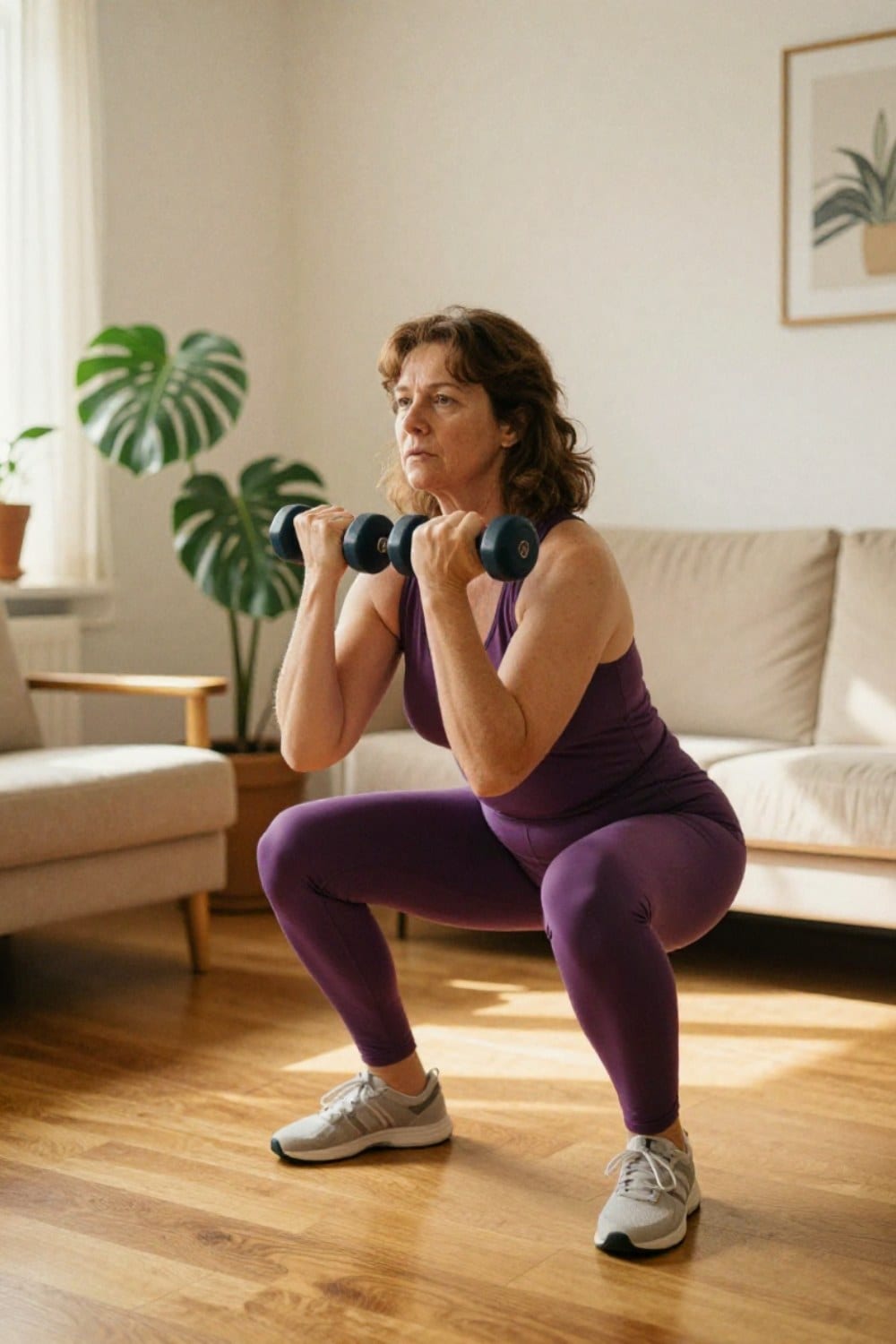
Say that plainly: 70% of your one-rep max is genuinely heavy. If the most you can deadlift once with good form is 50 pounds, that's 35 pounds — not a 3-pound pair of dumbbells, and not a resistance band looped around your ankle a hundred times without much effort. This is, honestly, one of the most misunderstood things in midlife fitness: 'lifting weights' and 'lifting weight that's genuinely challenging' are not the same instruction, and only the second one shows up reliably in this research.
That doesn't mean you show up Tuesday and load a barbell you've never touched — it means the destination is real, challenging weight, and getting there is a gradual process, not something to skip around forever. Our beginner starter plan is exactly that on-ramp, and once bands stop feeling like enough, our three-day dumbbell workout is the natural next step toward the kind of load this research is describing.
Steady: why balance is part of a bone plan, not a separate one
Bone density is half the picture. The other half is simple, and a little uncomfortable to say plainly: a fall is what turns fragile bone into a fracture, so reducing how often you fall does real work toward the same goal. The CDC found that an estimated 14 million older adults — about 1 in 4 — reported falling in a single year, women somewhat more often than men, and nearly 39,000 older adults died as a result of unintentional falls in 2021. That's a genuinely sobering number, and I'm not going to round it down into something smaller than it is.
This is exactly why 'strong, steady and straight' names balance as its own pillar instead of folding it into 'exercise' generally. If balance work isn't already part of your week, we've written a full, honest page on where to start, and posture deserves the same attention — here's ours, since a straighter spine is this framework's third pillar.
The honest limits: what walking and a weighted vest actually do for bone
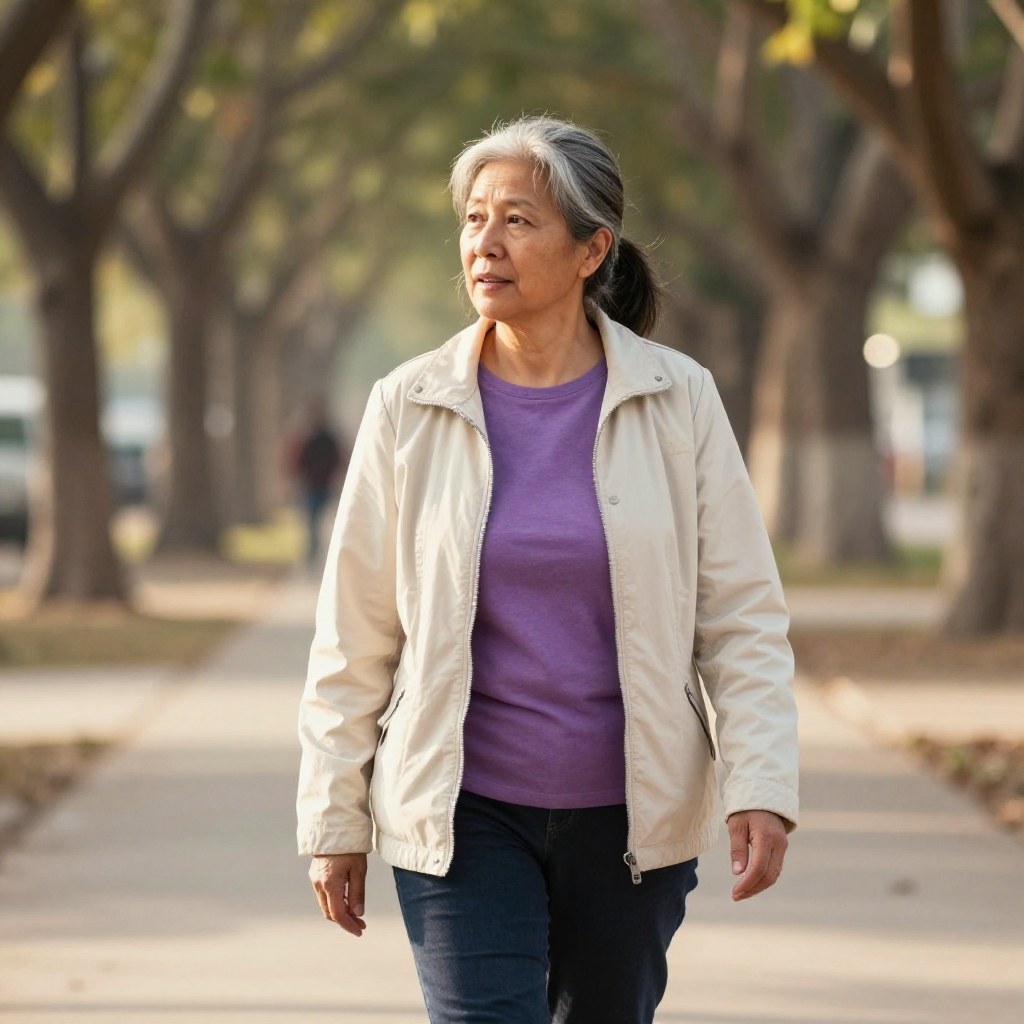
If you've been walking faithfully, you deserve real credit — and the honest next sentence too. Walking is weight-bearing, which is good, but it's a fairly light, repetitive load on your skeleton. We've written a full, cited page on exactly where walking's bone benefit stops — the short version is that it's a genuinely good habit that was never built to be a bone-density plan by itself.
A weighted vest doesn't quietly close that gap either, however often it gets marketed that way. We looked at the actual research on vests and bone density here — walking in one, by itself, hasn't been shown to meaningfully change bone density. A vest adds real cardiovascular effort to a walk, which is worth something — just a different promise than the loading intensity above.
If you have osteoporosis, osteopenia, or a fracture history, read this before anything else
Everything above is general education for a general audience. If you've been diagnosed with osteoporosis, osteopenia, or you have a fracture history, there's a specific safety point that comes before any of it, and burying it would be the wrong call.
A separate set of guidelines, in the Journal of Bone Metabolism, reaches the same conclusion from a different angle: exercise for someone with osteoporosis should start with a careful, individualized evaluation, ideally supervised by a qualified professional. Two independent sources landing in the same place is worth noticing.
What you actually do on Tuesday
If none of the above applies to you, and you've cleared a new exercise routine with your own doctor the way you would any other, here's a real, doable loaded-movement session — not a philosophy, an actual Tuesday.
A bone-focused loaded session
This assumes you already have some strength-training experience. Brand new? Start with our beginner plan first and build toward this.
| Movement | Sets × Reps | How It Should Feel | The Easier Option |
|---|---|---|---|
| Goblet squat or weighted sit-to-standYour main lower-body loading move — the one worth progressing first. | 3 sets of 6–8 reps | The last 2 reps are genuinely hard with good form — not a light finish | Bodyweight sit-to-stand from a sturdy chair, no added weight yet |
| Farmer's carry (two loaded bags, dumbbells, or a weighted backpack)Carrying real weight loads your whole skeleton at once, hips to hands. | 3 sets of 30–40 seconds | Grip and shoulders working, posture staying tall | A shorter distance, or one side at a time instead of both |
| Standing row (band or dumbbell)Part of your upper-body and posture work, not an afterthought. | 3 sets of 8–10 reps | Shoulder blades doing real work by the last few reps | A lighter band, fewer reps, same form |
| Hip hinge with weight (dumbbell deadlift pattern)A neutral spine here matters more than the number on the dumbbell. | 3 sets of 6–8 reps | Hamstrings and glutes working hard, back staying neutral, never rounded | A lighter weight, or the same hinge with no added weight while you learn it |
| Single-leg balance reach or step-upThis is your 'steady' pillar, in the same session as your 'strong' one. | 2 sets of 6–8 per side | Genuinely wobbly is fine — that's the balance system working | Hold a chair back or counter with one hand |
Notice what's missing from that list on purpose: no sit-ups, and no loaded moves that curl the spine forward. Every move above loads your skeleton through a neutral spine, which is the entire point.
None of this is a diagnosis or a personal promise about your own bones — it's what the guidelines and the research below actually say, so you can read the sources yourself instead of just trusting me.
Where this comes from
Every claim above traces to one of these seven.
- 1Osteoporosis Could Prove Deadly in Postmenopausal Women
The Menopause Society
Supports: That declining estrogen levels accelerate bone breakdown and slow new bone formation at the same time, driving faster bone loss around and after menopause.
- 2Osteoporosis Causes, Risk Factors, & Symptoms
NIAMS (National Institutes of Health)
Supports: That for many women osteoporosis begins developing a year or two before menopause itself, that low estrogen after menopause is a recognized risk factor, and that osteoporosis is a major cause of fracture in postmenopausal women.
- 3Strong, Steady and Straight: UK Consensus Statement on Physical Activity and Exercise for Osteoporosis
British Journal of Sports Medicine · 2022
Supports: That the three pillars for osteoporosis are resistance and impact exercise to maximize bone strength, balance and strength training to reduce fall risk, and back-strengthening and posture exercise for the spine; that exercise involving sustained, repeated or end-range spinal flexion — including sit-ups — should be modified or avoided, especially when the movement is loaded; that rotation on its own is generally considered safe if smooth and comfortable; and that individualized advice from a physical therapist is recommended when starting a new exercise program.
- 4Optimal resistance training parameters for improving bone mineral density in postmenopausal women: a systematic review and meta-analysis
Journal of Orthopaedic Surgery and Research · 2025
Supports: That resistance training three times a week improved bone density at the spine, hip and other sites, and that high-intensity training specifically — at 70% of one-rep max or above — drove the strongest gains at the hip and femoral neck.
- 5Nonfatal and Fatal Falls Among Adults Aged ≥65 Years — United States, 2020–2021
CDC · 2023
Supports: That an estimated 14 million (27.6%) older adults reported falling in 2020, women somewhat more often than men (28.9% versus 26.1%), and that 38,742 older adults died as a result of unintentional falls in 2021.
- 6Exercise for Preventing Falls in Older People Living in the Community
Cochrane Database of Systematic Reviews · 2019
Supports: That exercise programs including balance and functional training lowered the rate of falls by about 24% compared with not doing that training, when researchers combined the results of 39 studies covering nearly 8,000 older adults.
- 7Position Statement: Exercise Guidelines for Osteoporosis Management and Fall Prevention in Osteoporosis Patients
Journal of Bone Metabolism · 2023
Supports: That resistance and impact training, two to three days a week, is recommended to build bone strength and reduce falls in people with osteoporosis, and that a careful, individualized evaluation should precede any exercise prescription for someone with osteoporosis, ideally supervised by a qualified professional.
Free, and printable
The free 4-Week Indoor Walking Plan
The plan sign-up is not live yet — the mailing list is still being set up. In the meantime, email hello@strongandrooted.com and Diane will send it to you herself.
One email when there is something worth sending. Unsubscribe whenever you like.
Frequently asked questions
Can exercise rebuild bone I've already lost?
Is it safe to start strength training if I don't know my own bone density?
I already have osteoporosis. Can I still strength train at all?
Do I need a gym or special equipment to do any of this safely?
Bone is living tissue, and it responds to real load — that's the honest, hopeful mechanism behind this entire page. The guidelines are specific: resistance and impact work for strength, balance training for steadiness, posture work for your spine, and genuinely challenging weight to get the strongest results. If you're just starting out, the beginner plan is where to build your foundation, and the complete strength and muscle guide shows how every piece of this category fits together. If a diagnosis is already part of your story, the one thing to do today is call your doctor or a physical therapist, not follow a workout from a blog. For everyone else — Tuesday's session is right above. Strong, not skinny.
Free, and printable
The 4-Week Indoor Walking Plan
The plan sign-up is not live yet — the mailing list is still being set up. In the meantime, email hello@strongandrooted.com and Diane will send it to you herself.
One email when there is something worth sending. Unsubscribe whenever you like.
Written by
Diane Marsh
At 49 I was tired, achy, sleeping badly, and being told to do more cardio and eat less — which was making all of it worse. I started walking. Fifteen minutes, indoors, in socks. Three years later I am stronger than I was at forty. I write down exactly what I did, cite the research where it exists, and admit where it doesn't.
Diane is not a doctor, a physical therapist, or a dietitian. She is a woman who rebuilt her own strength after perimenopause, reads the research carefully, cites it, and says so when nobody actually knows.
Keep reading
Almost nobody tells you the whole territory in one place — why it's not too late to build real strength after 40, what muscle actually protects (it was never about looks), the honest map of how to start, and the one safety rule that matters more than all the rest.
Bodyweight Strength Training After 40 (No Equipment, Anywhere)You don't need a gym bag, a suitcase of dumbbells, or a single new purchase to start building real strength after 40. Your own bodyweight is a genuine load — and your dining chair is a real squat rack. Here's the honest, no-equipment routine, and five ways to keep it working without adding a single pound.
Strength Training for Beginners Over 40: The Honest Starter PlanAlmost nobody tells her the encouraging part: postmenopausal women build strength just as effectively as women who haven't reached menopause yet. Here's the honest starter plan — two days a week, a kitchen chair, two bands, six moves — and the real research behind why it's genuinely not too late.