The 30-Day Walking Challenge for Women Over 40 (Add Strength, Not Just Steps)
You've already got the walking habit — thirty minutes, most days. This is the month after that one: the same walk, anywhere you like, with two short strength sessions folded in by the end.

By Diane Marsh··11 min read
Claims on this page are checked against the National Institute on Aging (NIH), Mayo Clinic, the Centers for Disease Control and Prevention and a peer-reviewed habit-formation study — all linked below.
General education, not medical advice. Talk to your doctor before starting something new.
The short version
- This is the month after the beginner plan — for a woman who can already walk about thirty minutes, anywhere she likes.
- The walk stays the same length. This month adds one strength day in week 2, a second in week 3, plus a little brisk interval work.
- Every week has a lighter day built in on purpose. Missing one isn't falling off the plan — it's a Tuesday.
- Thirty days won't make any of this permanent yet — real research puts habit automaticity closer to 66 days on average, and that's fine.
- There's a free printable calendar for this exact month, walking and strength mapped out together.
If you've been walking for a month already — fifteen minutes that grew into thirty, indoors or out — this next thirty days is written for you. It isn't a bigger version of week one. It's a different month, the one where walking stops being the only thing on the page.
If you're just getting started, or thirty minutes still feels like a stretch most days, back up one month first. Our 28-day indoor walking challenge is built for exactly that: fifteen minutes to start, indoors, no equipment, four weeks to get you here comfortably. Come back to this page once that one feels close to automatic.
This month changes two things. First, you're no longer confined indoors — a sidewalk, a park loop, a treadmill or your own living room all count the same, wherever actually gets you out the door. Second, walking shares the page with something new. By day thirty, you'll be doing two short strength sessions a week alongside it, plus a little brisk effort folded into the walk itself.
Who this thirty days is actually for
This plan assumes one thing: you can already walk about thirty minutes without it wrecking your day. Maybe you built that through our beginner plan, maybe you walked long before you found this site. Either way, if that's where you're standing today, this is your next thirty days.
If thirty minutes is still genuinely hard, there's no prize for starting here instead of there. Build that base first — this plan will still be exactly here, and it will be a much easier thirty days when you arrive.
The 30-day plan: four weeks, a little more each one
Here's the whole month, compressed to four rows. Walk wherever works for you. Add what the table says, when it says it — and take the lighter day every single week, on purpose, not as a consolation prize.
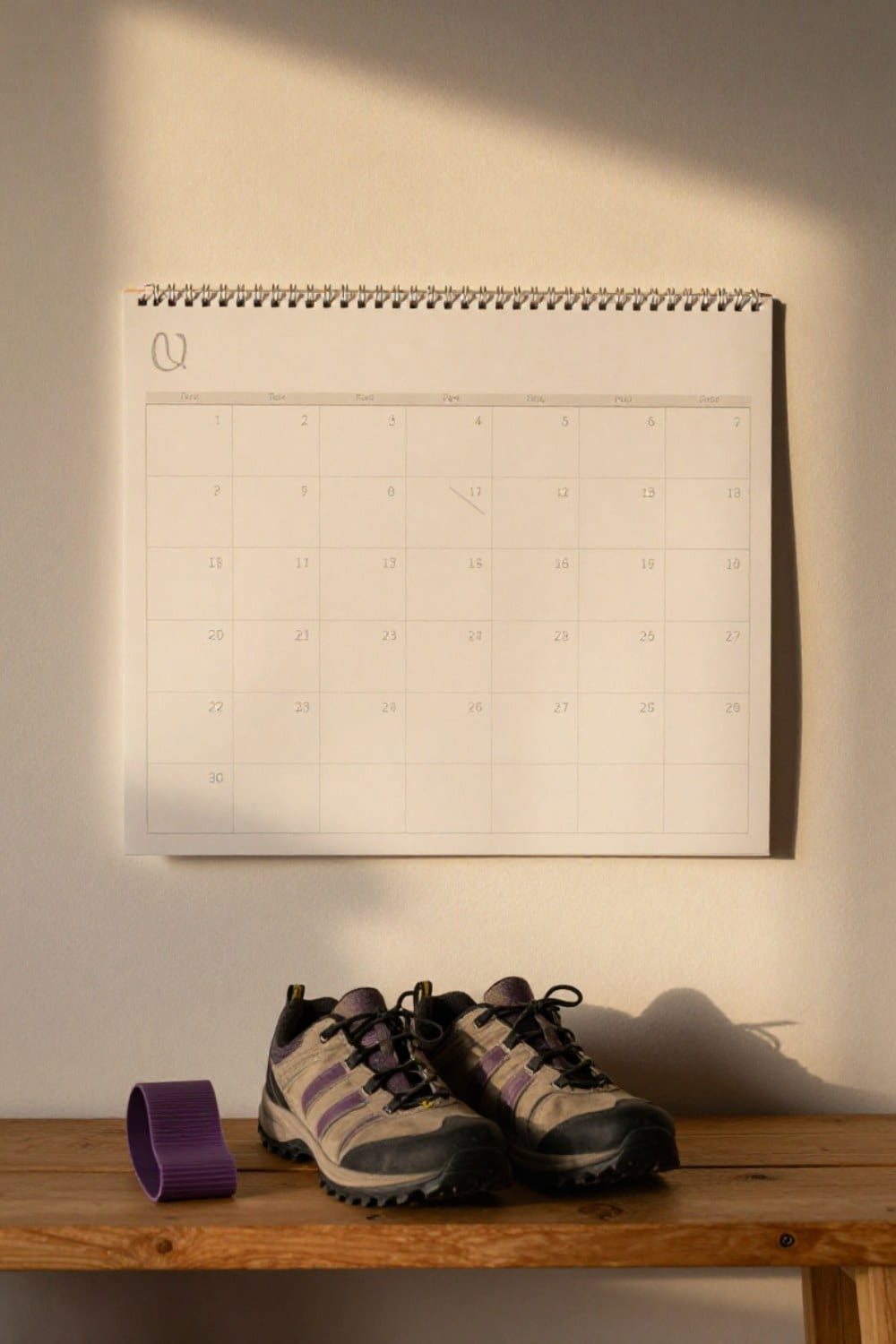
Your 30-day walking + strength plan
Four weeks. Walk anywhere — indoors, outside, on a treadmill. The only additions are two strength sessions and a little brisk effort, layered in one at a time.
| Week | Walking | Add This | How It Should Feel |
|---|---|---|---|
| Week 1One of those days is a shorter, easier fifteen-minute reset. The seventh is fully off. Both count exactly as much as the longer days. | About 30 minutes, 5–6 days, wherever you like to walk | Nothing new yet — just the walk you already have | Steady and familiar, maybe a little proud of how automatic it already feels |
| Week 2Still one lighter walking day and one full rest day. The strength session doesn't replace either one. | About 30 minutes, 5 days | One 10–15 minute bodyweight or resistance-band strength session, on a non-walking day or right after a walk | A little unfamiliar in a good way — mild next-day soreness is normal, sharp pain is not |
| Week 3Same lighter day, same rest day. If the second strength session feels like too much this week, hold at one a little longer. | 30–35 minutes, 5 days, with a few brisk bursts folded into two of them | A second 10–15 minute strength session, different muscles than session one | Purposeful — you should finish a brisk-burst walk a little warm, not drained |
| Week 4Same lighter day, same rest day, one more time. Consistency is the entire goal of week four. | 30–35 minutes, 5 days, brisk bursts continuing on two of them | Both strength sessions continue exactly as they were — nothing new added | Steady and capable — this week proves you can hold the pattern, not add to it |
Week 2: the first strength day
This doesn't need to be long or complicated. Ten to fifteen minutes, bodyweight or a resistance band, on a day you're not walking — or right after a walk, if that fits your day better. Think supported squats holding a counter, wall push-ups, a few rows with a band anchored to a door. Our full walking-and-strength guide lays out an actual two-part weekly structure with real sessions; this page just tells you when to add them.
Expect a little muscle soreness in the day or two after that first session, especially if it's been a while since you asked your muscles to do this kind of work. That's ordinary. Sharp pain, or pain that sits inside a joint, is a different signal — stop and check with your doctor if that's what you're actually feeling.
Week 3: the second strength day, and a little brisk work
Week three adds one more strength session, aimed at a different set of muscles than the first so you're building rather than repeating. It also asks two of your walks each week to include a few short bursts of brisker effort — not a full workout redesign, just a change of pace inside a walk you already know.
We won't re-teach that piece here, because we've already written the exact protocol in detail elsewhere. Our guide to Japanese interval walking covers the brisk-and-easy interval structure step by step — borrow it for these two walks a week, and keep the rest of your walking exactly as steady as it's always been.
If two strength sessions plus interval bursts in the same week feels like a lot, it's allowed to be too much. Drop back to one strength session, or skip the brisk bursts for another week. Nothing about week four requires week three to have gone perfectly.
Week 4: hold the pattern, don't chase a bigger one
Week four doesn't add anything new. Same two strength sessions, same brisk bursts, same lighter day, same day fully off. Its only job is proving you can hold what weeks two and three built — not stack a third strength session on top of it.
That restraint is deliberate. The fastest way to lose a month like this one is adding a fourth layer before the first three feel close to automatic.
Why thirty days won't make this permanent — and why that's fine
You'll see '30 days to change your life' attached to a lot of plans, and it oversells what any single month can actually do. This one won't pretend otherwise.
What thirty days is actually good for: proving that a slightly bigger walk, plus two short strength sessions, fits into an ordinary month without taking it over. Day thirty-one is still up to you. Plenty of women just extend this same pattern, a little further along than when they started it.
What this month is actually building
None of this is about a smaller number on a scale, and this site never measures it that way. What walking plus a little strength actually supports is muscle, bone, balance and heart health — the quiet parts of getting older that decide whether ordinary life stays easy or gets harder.
Mayo Clinic's own review of strength training reaches a similar conclusion: regular resistance work is linked to keeping and building muscle, protecting bone density, and supporting balance, a genuinely underrated form of capability in your forties and beyond.
Please be careful
Where this comes from
Every claim above is backed by one of these four sources.
- 1How Can Strength Training Build Healthier Bodies as We Age?
National Institute on Aging (NIH)
Supports: That muscle mass and strength (sarcopenia) decline with age, and that resistance and strength exercise are the interventions shown to help protect against that decline.
- 2Strength training: Get stronger, leaner, healthier
Mayo Clinic
Supports: That regular strength training helps maintain and build muscle mass and bone density, and supports balance and steadiness as we age.
- 3Adult Activity: An Overview
Centers for Disease Control and Prevention · 2024
Supports: That adults benefit from about 150 minutes of moderate aerobic activity a week plus muscle-strengthening activity on 2 or more days working all the major muscle groups.
- 4How are habits formed: Modeling habit formation in the real world
European Journal of Social Psychology · 2010
Supports: That new daily habits took a median of 66 days to become automatic in this study, with a wide range across individuals, and that missing occasional days didn't meaningfully disrupt the trend.
Free, and printable
The free 30-Day Walk + Strength Calendar
The plan sign-up is not live yet — the mailing list is still being set up. In the meantime, email hello@strongandrooted.com and Diane will send it to you herself.
One email when there is something worth sending. Unsubscribe whenever you like.
Frequently asked questions
I can only walk twenty minutes comfortably, not thirty. Should I still start this plan?
Do I need real weights for the strength days, or does a resistance band count?
Will finishing this challenge help me lose weight?
What if week three's two strength sessions plus interval work is too much in the same week?
Thirty days from today, the plan is simple to describe even on the days it didn't feel simple to live: the same walk you started with, two short strength sessions folded in, and a little brisk effort borrowed from Japanese interval walking. If you haven't read what walking really does for a midlife metabolism, that's the honest, cited case for why any of this is worth doing at all. And if you're building this habit from the very beginning, start with our indoor walking plan for beginners or the full walking for women over 40 guide — this page is one month inside a much longer one. For today, though, just walk the thirty minutes you already have. That's still the only step that matters.
Free, and printable
The 4-Week Indoor Walking Plan
The plan sign-up is not live yet — the mailing list is still being set up. In the meantime, email hello@strongandrooted.com and Diane will send it to you herself.
One email when there is something worth sending. Unsubscribe whenever you like.
Written by
Diane Marsh
At 49 I was tired, achy, sleeping badly, and being told to do more cardio and eat less — which was making all of it worse. I started walking. Fifteen minutes, indoors, in socks. Three years later I am stronger than I was at forty. I write down exactly what I did, cite the research where it exists, and admit where it doesn't.
Diane is not a doctor, a physical therapist, or a dietitian. She is a woman who rebuilt her own strength after perimenopause, reads the research carefully, cites it, and says so when nobody actually knows.
Keep reading
Everything this site knows about walking after 40, in one place — what actually changes in your body, the honest version of every trending method, and exactly which article to read next for where you are right now.
Is Walking Enough for Your Bones and Joints After 40?Walking really is linked to stronger hips — the research on this is genuinely encouraging. But if bone density and joint health are what you're after, walking is the first chapter, not the whole book. Here's the honest, cited version of what to add.
What Walking Really Does for a Midlife Metabolism (An Honest Answer)You've probably been told a walk will change everything menopause does to your body. It won't, not on its own — but here's the honest mechanism instead: what actually changes after 40, why it matters for your heart and blood sugar rather than your mirror, and what genuinely helps more than walking alone.