Walking + Strength: The Two-Part Week for Women Over 40
Walking is the habit that gets you moving again. Strength is the part that protects what you're building — the muscle and bone walking alone doesn't fully reach. Here's the two-part week that covers both: most days a walk, twice a week two resistance bands and a kitchen chair for balance.

By Diane Marsh··10 min read
Claims on this page about muscle, bone and the menopause transition are checked against Cleveland Clinic, the National Institute on Aging (NIH), The Menopause Society and a peer-reviewed bone-health journal — all four are linked below.
This post contains affiliate links. As an Amazon Associate I earn from qualifying purchases — at no extra cost to you.
General education, not medical advice. Talk to your doctor before starting something new.
The short version
- Walk most days of the week, and add two short strength sessions — that's the whole plan, and neither half substitutes for the other.
- Muscle quietly declines after 40, and research links a further acceleration to the hormonal shifts of perimenopause and menopause, not age alone.
- Bone needs a similar nudge: walking is weight-bearing, but on its own it's a fairly modest load — pairing it with resistance training is the well-sourced combination.
- The strength half can be two resistance bands and a kitchen chair for balance. No gym, no membership, no experience required.
- If you only manage one strength session some weeks, one honestly still counts for more than zero — this plan bends to real weeks, not the other way around.
Here's an honest question worth asking if you've been walking faithfully for a few months now: is this enough? You've built the habit, you've probably felt some of it working — steadier energy, better sleep, a little more patience by four in the afternoon — and now you're wondering whether you're supposed to be doing something else too.
The honest answer: walking is the habit, and strength is the insurance. Neither one replaces the other. Walking is what gets you moving most days and keeps your heart, mood and blood sugar in decent shape — and it's genuinely enjoyable once it stops being a decision. Strength is the part that specifically protects the muscle and bone a body quietly starts setting down somewhere in its 40s, and walking, however faithfully you do it, was never built to ask much of either one.
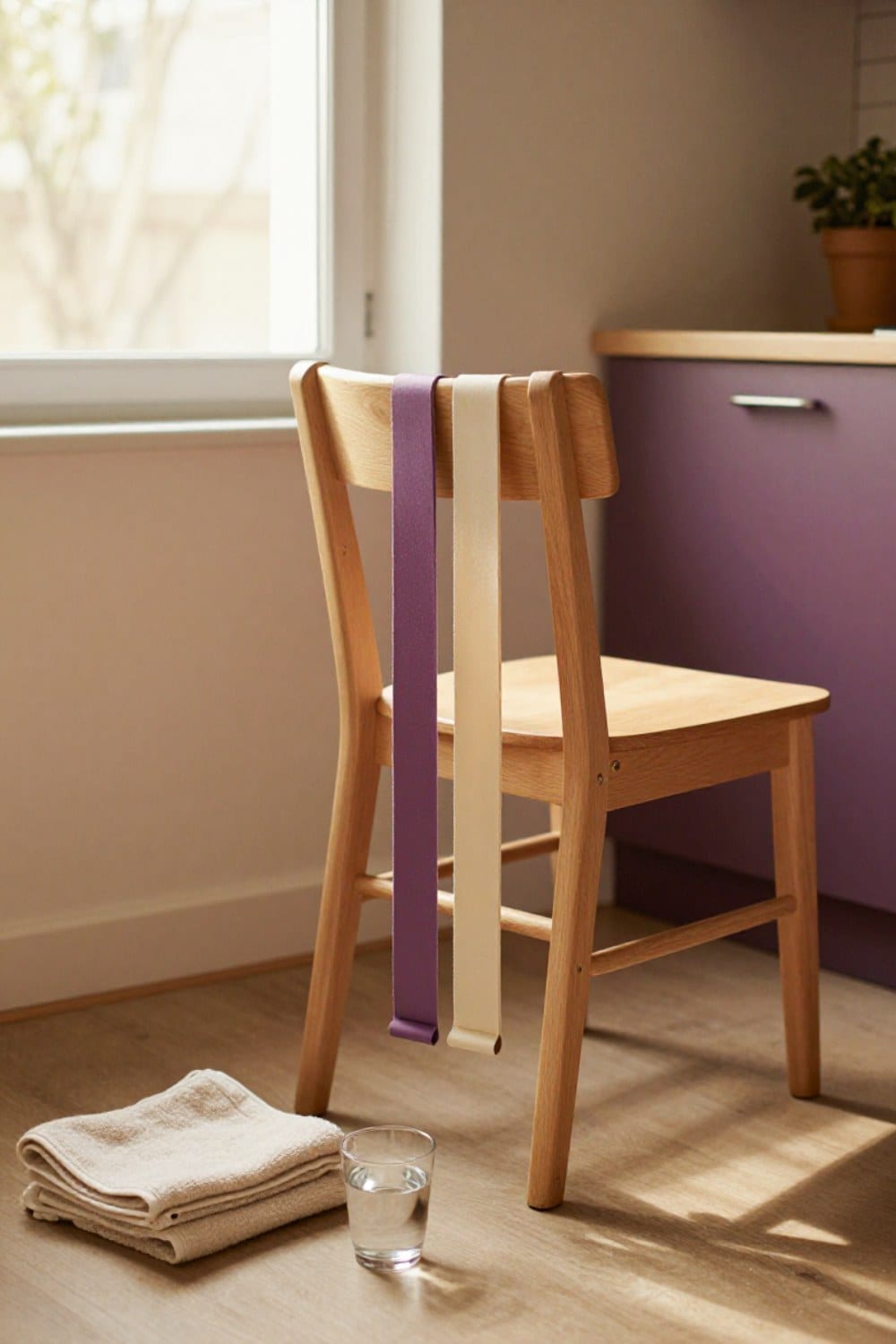
So here's the whole plan, stated plainly: walk most days of the week, and add two short strength sessions. That's the entire plan. The strength half doesn't need a gym membership or a spare room full of equipment — two resistance bands and a kitchen chair for balance cover almost everything below.
What your walking habit is already doing for you
If you started here with our indoor walking plan for beginners over 40, or you've simply been walking on your own for a while, give yourself real credit. Regular walking is linked to genuine cardiovascular and metabolic benefit. It is not a lesser workout, and it's not a placeholder for something harder you're supposed to graduate to.
It's doing more for your midlife metabolism than most people give it credit for, too — we've written a full, honest page on that, if you're curious.
Here's the honest turn, though. Walking is weight-bearing, which is good, but it's a fairly light, repetitive load. It asks your legs and your heart to show up, and it does that well. It doesn't ask very much of your upper body, and on its own, it's a fairly modest load for your skeleton to respond to. That's not a flaw in walking — it's just not what walking is for.
Why muscle is the real lever after 40
Muscle doesn't announce its own departure. There's no single birthday you wake up with less of it — just a quiet, gradual decline that starts earlier than most women expect, long before it shows up anywhere you'd notice.
For a lot of women, that quiet decline speeds up further around perimenopause and menopause — not from age alone, but from what's happening hormonally underneath it.
None of this is a reason to panic, or to distrust a walking habit you've worked hard to build. It's a reason to add the one thing walking wasn't built to provide: a regular reason for your muscles to work against real resistance. Think of it like a retirement account — withdrawals happen whether you make deposits or not. The only real question is whether anything is going back in.
And bone is asking for the same thing
Bone follows a similar pattern to muscle, for similar reasons.
Walking helps here too, genuinely — it's weight-bearing, and weight-bearing exercise is part of the standard advice for bone health. But it's worth being honest about how much walking alone actually asks of your skeleton.
That's the entire case for the second half of this week's plan. Not because walking failed you, but because bone and muscle both respond to a kind of load walking, by itself, doesn't fully provide. We go deeper on the bone-and-joint side specifically here, if you want the fuller picture.
The two-part week
Here's what it actually looks like on an ordinary calendar. Six of the seven days involve walking, at whatever length already fits your life. Two of those days also include a short strength session — fifteen to twenty minutes, using nothing more than a resistance band and a kitchen chair for balance.
Your two-part week
Same seven days you already have. Two of them just do a little more.
| Day | Movement | What it's for |
|---|---|---|
| Monday | Walk | Whatever length fits today — fifteen to forty minutes, your call |
| Tuesday | Strength — Session A | Legs and balance: chair sit-to-stands, band rows, wall push-ups |
| Wednesday | Walk | Same easy, steady pace as Monday |
| Thursday | Walk | Same again, or split into two shorter walks if today's full |
| Friday | Strength — Session B | Upper body and core: band presses, pull-aparts, standing marches |
| Saturday | Walk | Longer, if you have the time — the same length as always if you don't |
| Sunday | Rest, or a gentle walk | Whatever your body's asking for by day seven |
Two bands and a kitchen chair: what the strength side looks like
You don't need a twelve-exercise program and a spreadsheet to track it. Four or five simple moves, repeated consistently, cover what a beginner session needs.
- Chair sit-to-stands — up and down from a sturdy chair, using your hands less each week as your legs get more confident
- Band rows — anchored under a closed door or looped around a sturdy railing, pulling the band toward your ribs
- Wall or counter push-ups — an upright push-up against a wall or kitchen counter, easing toward a lower incline over time
- Band overhead presses — pressing a band or a light dumbbell straight up from shoulder height
- Standing marches, holding a chair back for balance — because balance matters as much as strength does
Two rounds of those five moves, resting whenever you like, is a complete session. It doesn't need to leave you sore to count — consistency is doing the real work here, same as the walking.
Please be careful
The gear, if you want it
None of this requires a purchase — bodyweight and a chair are a genuinely complete starting point. If you do want a band or two, here's what I'd look for; compare current listings and reviews first, since availability shifts.
A quick comparison across bands, dumbbells and shoes — tap through for current details on each listing.
| What it is | Best for | Why I'd pick it |
|---|---|---|
| Loop Resistance Bands (Set of Several Strengths) A set with a few different strengths means you're not stuck with just one resistance as the moves in this plan get more familiar. | Chair-based leg and glute work, plus travel | A set with a few different strengths means you're not stuck with just one resistance as the moves in this plan get more familiar. |
| Tube Resistance Bands with Handles Handles make anchored moves like the door-anchored row far more comfortable on your hands than a flat loop band. | Rows, presses and anything that mimics a dumbbell move | Handles make anchored moves like the door-anchored row far more comfortable on your hands than a flat loop band. |
| Adjustable Light Dumbbells Worth adding once the band moves feel easy — one adjustable pair covers a wide range without a shelf full of separate weights. | Progressing past what a band alone can offer | Worth adding once the band moves feel easy — one adjustable pair covers a wide range without a shelf full of separate weights. |
| Over-the-Door Resistance Band Anchor Anchors the band at the top, middle or bottom of a door, which is most of what separates a beginner routine from a genuinely varied one. | Turning one band into a dozen different pulling moves | Anchors the band at the top, middle or bottom of a door, which is most of what separates a beginner routine from a genuinely varied one. |
| Supportive Training Shoes A flatter, more stable sole tends to feel steadier under a chair sit-to-stand than the cushioned shoe built for a walk. | A stable base on both walking days and strength days | A flatter, more stable sole tends to feel steadier under a chair sit-to-stand than the cushioned shoe built for a walk. |
No prices here — Amazon requires them to be live, so click through to see what something costs today. Equipment helps; it is never the thing that makes a plan work.
None of this is about your specific body — only about what the general research on muscle, bone and resistance training actually supports, cited plainly below.
Where this comes from
Every claim above about muscle, bone and the menopause transition traces to one of these.
- 1Sarcopenia: What It Is and What Causes It
Cleveland Clinic · 2024
Supports: That age-related muscle loss (sarcopenia) is real and well documented, and that adults can lose as much as 8% of their muscle mass per decade starting in their 30s and 40s, a pace that quickens further in later decades.
- 2Premature Menopause Linked to Increased Musculoskeletal Pain and Likelihood of Sarcopenia
The Menopause Society · 2024
Supports: That research links accelerated muscle loss and musculoskeletal discomfort around the menopause transition more closely to hormonal change — the drop in estrogen and testosterone — than to chronological age alone.
- 3Osteoporosis Could Prove Deadly in Postmenopausal Women
The Menopause Society
Supports: That bone density drops fastest in the five to ten years around the menopause transition, largely because of the drop in estrogen.
- 4Position Statement: Exercise Guidelines for Osteoporosis Management and Fall Prevention in Osteoporosis Patients
Journal of Bone Metabolism
Supports: That walking is a simple, self-manageable way to help support bone density, but that its effect appears limited when done alone, and that resistance training two to three times a week is specifically recommended alongside it.
- 5How Can Strength Training Build Healthier Bodies as We Age?
National Institute on Aging (NIH)
Supports: That resistance and strength exercise are the interventions specifically shown to help protect against age-related muscle and strength decline.
Free, and printable
The free 4-Week Indoor Walking Plan
The plan sign-up is not live yet — the mailing list is still being set up. In the meantime, email hello@strongandrooted.com and Diane will send it to you herself.
One email when there is something worth sending. Unsubscribe whenever you like.
Frequently asked questions
Do I really need strength training if I'm already walking every day?
What if I can only manage one strength session most weeks, not two?
Will two resistance bands actually do anything, or do I need a real gym?
How sore should I actually be after a strength session?
Walking gets you moving; two short strength sessions protect what walking alone can't reach. That's the whole two-part week, and none of it requires a gym. If you haven't already, start with the indoor walking plan and let the habit get automatic first. Curious what walking does for a midlife metabolism? Here's the honest version. Want the deeper bone-and-joint case? It's here. Want this week turned into a full 30-day calendar? Here's that version. Or for the complete picture — every method, every plan, in one place — start with the complete guide. Two bands, a kitchen chair, two extra boxes checked each week. That's genuinely the whole thing.
Free, and printable
The 4-Week Indoor Walking Plan
The plan sign-up is not live yet — the mailing list is still being set up. In the meantime, email hello@strongandrooted.com and Diane will send it to you herself.
One email when there is something worth sending. Unsubscribe whenever you like.
Written by
Diane Marsh
At 49 I was tired, achy, sleeping badly, and being told to do more cardio and eat less — which was making all of it worse. I started walking. Fifteen minutes, indoors, in socks. Three years later I am stronger than I was at forty. I write down exactly what I did, cite the research where it exists, and admit where it doesn't.
Diane is not a doctor, a physical therapist, or a dietitian. She is a woman who rebuilt her own strength after perimenopause, reads the research carefully, cites it, and says so when nobody actually knows.
Strong & Rooted is a participant in the Amazon Services LLC Associates Program, an affiliate advertising program designed to provide a means for sites to earn advertising fees by advertising and linking to Amazon.com. As an Amazon Associate I earn from qualifying purchases. If you click a link and buy something, I may receive a small commission at no additional cost to you. I recommend only equipment I have used myself or would hand to a friend, and commission never decides the order of a list. Prices are never shown here because Amazon requires displayed prices to be live — click through to see what something costs today.
Keep reading
Everything this site knows about walking after 40, in one place — what actually changes in your body, the honest version of every trending method, and exactly which article to read next for where you are right now.
Is Walking Enough for Your Bones and Joints After 40?Walking really is linked to stronger hips — the research on this is genuinely encouraging. But if bone density and joint health are what you're after, walking is the first chapter, not the whole book. Here's the honest, cited version of what to add.
What Walking Really Does for a Midlife Metabolism (An Honest Answer)You've probably been told a walk will change everything menopause does to your body. It won't, not on its own — but here's the honest mechanism instead: what actually changes after 40, why it matters for your heart and blood sugar rather than your mirror, and what genuinely helps more than walking alone.