What Actually Changes in Your Body After 40
Nobody sits you down at 40 and explains what's actually happening to your muscle, bone, metabolism and joints. Here's the honest, cited version — what's changing, why, what genuinely helps, and what even the researchers haven't figured out yet.

By Diane Marsh··12 min read
Every claim on this page is checked against The Menopause Society, NIAMS (NIH), Harvard Health, Mayo Clinic, the National Institute on Aging, the CDC and peer-reviewed research — eleven sources in total, all linked below.

General education, not medical advice. Talk to your doctor before starting something new.
The short version
- Muscle loss is real and often speeds up around menopause — but resistance training tends to be what helps most with that trajectory, not a supplement.
- Bone loss can also accelerate quickly around menopause, and it responds to real load, not luck.
- Your metabolism didn't break — real, measurable shifts happen, but the honest answer is still muscle and movement, never a diet trick.
- Fat moving toward your middle is a heart-and-blood-sugar question, not an appearance one — and spot-targeting it isn't possible, whatever an ad promises.
- Almost none of this is a willpower problem. Much of it responds to load, protein, sleep and time.
Nobody sits you down at 40 and explains what's actually about to happen to your body. You just start noticing things instead — a hill that used to be nothing, a favorite pair of jeans that fit differently even though nothing else changed, a shoulder that aches for no reason you can name. And when you ask, you get "that's just aging" and not much else.
So here's the page I wish someone had handed me. This is the honest, cited mechanism behind four systems that shift in your 40s and 50s — muscle, bone, metabolism, and your joints, sleep and mood — what's actually changing, why, what genuinely helps, and, just as important, what even the researchers haven't fully worked out yet. It's part of our complete guide to menopause and the midlife body, and it's meant to be the page the rest of this site leans on.
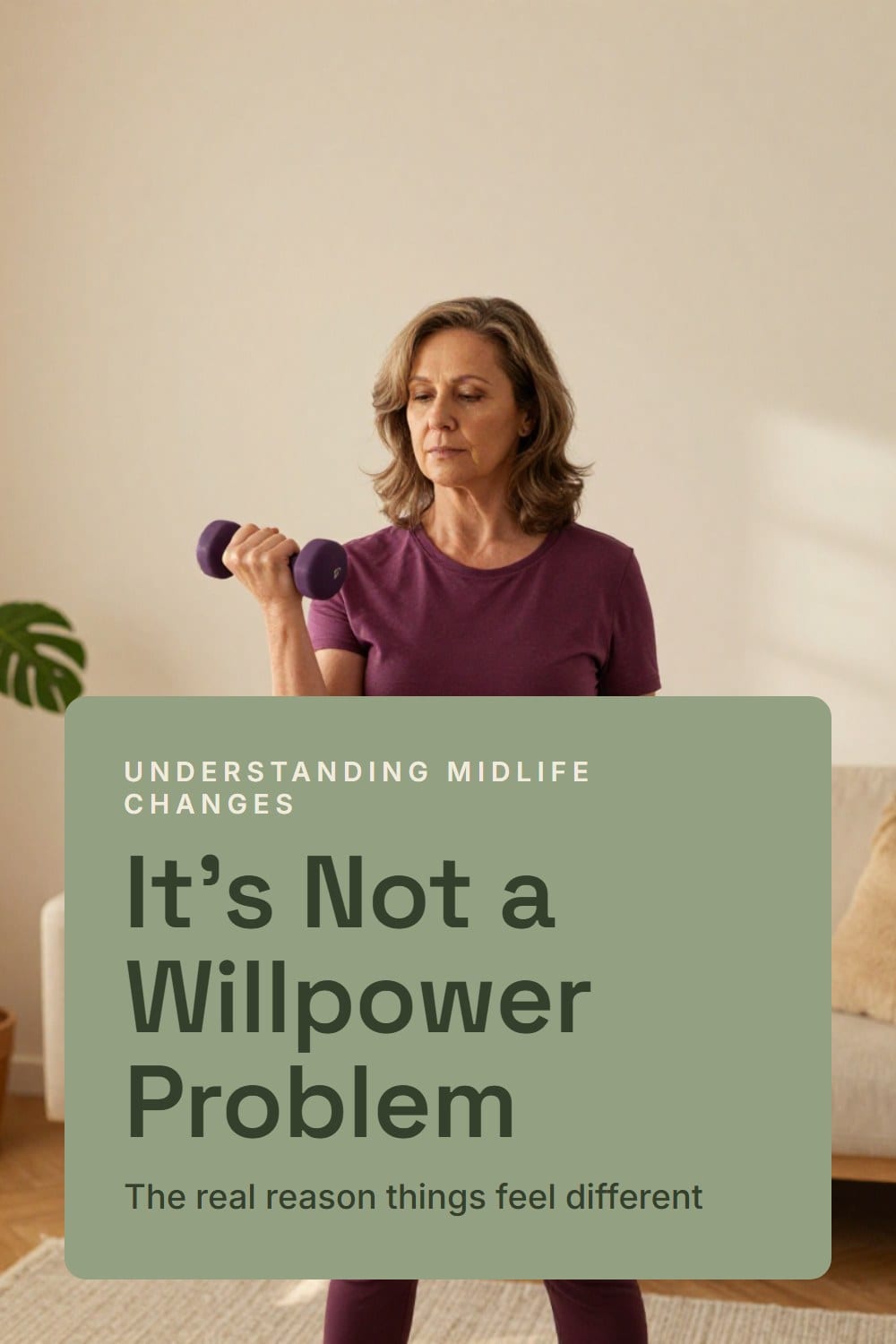
Your muscle: it leaves quietly
Muscle mass and strength decline gradually through your 30s and 40s — Cleveland Clinic puts the general pace at up to 8% of muscle mass per decade once that starts, and it happens to everyone, menopause or not.
But for a lot of women, it speeds up further around menopause specifically.
Here's the actual answer, and it isn't a supplement: resistance training is the thing that tends to help most with this trajectory, and eating enough protein is a sensible partner for it. Not stop it entirely — nobody can promise that — but bend the curve, meaningfully, at any age you start. Our complete guide to strength after 40 walks through exactly how to begin.
What's still genuinely unclear: exactly how much of any individual woman's muscle loss traces to menopause itself versus simply years passing — researchers are still teasing that apart, and it likely varies a lot from person to person. That's a reasonable thing to raise with your own doctor rather than guess at.
Your bones: they answer to load, not luck
Bone is living tissue — it's constantly being broken down and rebuilt, and for most of your life, that stays roughly balanced. Around menopause, the balance tips.
Falling estrogen accelerates the breakdown side and slows the rebuilding side at the same time, and the shift can start earlier than you'd think — for many women, bone loss is already underway a year or two before their very last period, not after.
Bone responds to load — real, honest mechanical stress, not luck and not a supplement. Resistance training and impact exercise are what tends to help here, and our guide to exercises for bone density after 40 covers exactly what that looks like and how hard it needs to be.
What's still unclear: exactly how much load any one woman's own bones need depends on her starting density, which a general article like this one simply can't know. If you already have a diagnosis, that's a conversation for your doctor before you change anything, not a number to guess from a blog.
Your metabolism: it didn't break
It's tempting to think your metabolism just gives out at some point — and the truth is a little more interesting, and more honest, than that.
In women who were actually tracked through the menopause transition, both resting energy use and fat oxidation measurably dropped — roughly a 9% fall in 24-hour energy expenditure, and about a third less fat being used for fuel — compared with women of the same age who hadn't yet gone through menopause. So something real is shifting. It isn't just "getting older" in the abstract; it's tied to the transition itself.
At the same time, fat tends to move — away from the hips and thighs and toward your middle. Here's the honest reframe on that: this isn't really about how it looks.
And no, you can't target it. When researchers pooled more than a dozen controlled studies on exactly this question, training one area produced no meaningful extra fat loss there compared with anywhere else. Crunches don't spot-reduce anything. Muscle and overall movement are the actual levers, and our honest look at walking and midlife metabolism covers what that looks like in practice.
What's still being worked out: exactly how much of what you feel — lower energy, a slower response to the same habits — is the hormonal shift itself, versus the muscle and activity changes that tend to happen around the same years. Probably some of both. Nobody's untangled the exact split yet.
Your joints, sleep and mood: the cluster with a new name
Achy joints. Stiffness that wasn't there before. Sleep that won't hold together. A mood that feels less like "yours." These tend to get dismissed one at a time, as separate little complaints — but the joint-and-muscle piece of this now has a newly named condition, written up by Harvard Health: musculoskeletal syndrome of menopause. It's estimated to affect around 70% of women during this transition, and for close to a quarter of them, it's seriously limiting.
The mechanism is straightforward, once someone actually explains it: your joints, tendons and connective tissue have estrogen receptors too, not just your ovaries. When estrogen falls, tissue that depended on it responds — with aching, stiffness, and less resilience than before.
Sleep and mood are murkier. Night sweats fragment plenty of women's sleep, which alone can sour a mood by 10 a.m. But how much of the rest is hormonal versus just a genuinely hard stretch of life — this stage tends to arrive stacked on top of aging parents, teenagers and a full-time job — honestly isn't fully figured out yet, and I'd rather tell you that than pretend otherwise.
What actually helps overlaps with everything above: regular movement, strength work, and protecting your sleep as best you can, even on the nights that make it harder. If joint pain is sudden, one-sided, or comes with swelling, that's a different situation — a reason to call your doctor, not push through a routine. Our guide to perimenopause symptoms can help you sort out what you're noticing, and when to talk to your doctor about perimenopause covers exactly that conversation.
A note
The four systems, at a glance
The honest mechanism behind each one — and where the rest of this site can take you deeper.
| What changes | Why | What actually answers it | Where to start | |
|---|---|---|---|---|
| MuscleNot a supplement question — a load-and-protein question. | Mass and strength decline, faster around menopause for many women | Age on its own, plus a likely hormonal push from falling estrogen | Resistance training and enough protein | Our complete guide to strength after 40 |
| BoneBone responds to load, not to luck. | Density can drop quickly around menopause, sometimes before it | Falling estrogen speeds up breakdown and slows rebuilding | Real load — resistance and impact exercise | Our guide to exercises for bone density after 40 |
| MetabolismA heart-and-blood-sugar question, not an appearance one. | Resting energy use and fat oxidation shift; fat moves toward your middle | Estrogen decline changes how your body handles fuel and stores fat | Muscle and consistent movement, never a spot exercise | Our honest look at walking and midlife metabolism |
| Joints, sleep, moodThe murkiest system here, and worth saying so plainly. | Aching, stiffness, restless sleep, a shifted mood | Estrogen receptors sit in joints and connective tissue too | Movement, strength work, steady sleep habits | Perimenopause symptoms 101 — or your doctor, if it's severe |
So here's the honest synthesis, after all four systems: almost none of this is your fault, and much of it responds to the same short list — loading your muscles and bones, eating enough protein, protecting your sleep, and giving it real time to work. Not a shortcut, not a supplement — just the mechanism, honestly explained, so you can decide what's actually worth your time. If you're building your plan from here, our guide to exercise for perimenopause is a good next stop.
Where this comes from
Every claim above traces to one of these.
- 1Sarcopenia: What It Is and What Causes It
Cleveland Clinic · 2024
Supports: That age-related muscle loss can reach up to 8% of muscle mass per decade, beginning as early as your 30s or 40s — a general aging pattern this page ties to age itself, not to menopause or estrogen specifically.
- 2Premature Menopause Linked to Increased Musculoskeletal Pain and Likelihood of Sarcopenia
The Menopause Society · 2024
Supports: That an abrupt, early loss of estrogen and testosterone — as in premature or surgical menopause — is linked to a higher likelihood of sarcopenia and musculoskeletal pain than natural menopause, tying accelerated muscle loss to hormonal change more than chronological age alone.
- 3Osteoporosis Could Prove Deadly in Postmenopausal Women
The Menopause Society · 2026
Supports: That declining estrogen levels accelerate bone breakdown and slow new bone formation at the same time, driving a rapid decrease in bone mineral density around menopause.
- 4Osteoporosis Causes, Risk Factors, & Symptoms
NIAMS (National Institutes of Health)
Supports: That for many women, bone loss begins developing a year or two before menopause itself, and that low estrogen after menopause is a recognized risk factor for osteoporosis.
- 5Increased Visceral Fat and Decreased Energy Expenditure During the Menopausal Transition
International Journal of Obesity · 2008
Supports: That in women tracked through the menopausal transition, 24-hour energy expenditure fell by roughly 9%, resting energy expenditure fell even further, and fat oxidation dropped by around a third — declines not seen in women who stayed premenopausal over the same stretch.
- 6The Reality of Menopause Weight Gain
Mayo Clinic
Supports: That as estrogen declines, fat storage tends to shift away from the hips and thighs and toward the abdomen, and that both regular aerobic activity and strength training are recommended through this transition.
- 7Adipose Inflammation, Insulin Resistance, and Cardiovascular Disease
JPEN Journal of Parenteral and Enteral Nutrition · 2008
Supports: That visceral fat is metabolically active tissue, releasing inflammatory compounds linked to worsened insulin resistance and a higher risk of cardiovascular disease — a heart-and-blood-sugar concern distinct from appearance.
- 8Musculoskeletal Syndrome of Menopause: When Menopause Makes You Ache All Over
Harvard Health Publishing · 2026
Supports: That a newly named condition links falling estrogen to widespread joint and muscle aching, stiffness and fatigue in an estimated 70% of women during the menopause transition, seriously limiting daily life for close to a quarter of them — and that regular activity, strength training and consistent sleep are part of what's recommended for it.
- 9A Proposed Model to Test the Hypothesis of Exercise-Induced Localized Fat Reduction (Spot Reduction), Including a Systematic Review With Meta-Analysis
Human Movement · 2022
Supports: That when researchers pooled 13 controlled studies on this question, localized muscle training produced no meaningful difference in fat loss at the trained site compared with the untrained side — evidence against spot reduction.
- 10Adult Activity: An Overview
CDC
Supports: That the baseline movement guideline for adults is 150 minutes of moderate aerobic activity a week, plus muscle-strengthening activity on 2 or more days a week covering all major muscle groups.
- 11How Can Strength Training Build Healthier Bodies as We Age?
National Institute on Aging (NIH)
Supports: That skeletal muscle plays a major role in glucose uptake and energy use, tying muscle health directly to metabolic health, and that resistance training is among the interventions shown to help protect against age-related muscle loss.
Free, and printable
The free 4-Week Indoor Walking Plan
The plan sign-up is not live yet — the mailing list is still being set up. In the meantime, email hello@strongandrooted.com and Diane will send it to you herself.
One email when there is something worth sending. Unsubscribe whenever you like.
Frequently asked questions
Is "menopause belly" actually a real thing, or am I just not trying hard enough?
Is muscle loss after 40 something I can actually stop?
Will exercise really help my bones, or is that overhyped?
Should I talk to my doctor about hormone therapy for any of this?
What changes in your body after 40 is real and physical, and it isn't something you talked yourself into. What you do next is still very much in your hands: load your muscles and bones, eat enough protein, protect your sleep, and give it time. If you want the full picture of this category, start at our complete guide to menopause and the midlife body, or go straight to when to talk to your doctor about perimenopause if that's the piece you actually came here for.
Free, and printable
The 4-Week Indoor Walking Plan
The plan sign-up is not live yet — the mailing list is still being set up. In the meantime, email hello@strongandrooted.com and Diane will send it to you herself.
One email when there is something worth sending. Unsubscribe whenever you like.
Filed under
Written by
Diane Marsh
At 49 I was tired, achy, sleeping badly, and being told to do more cardio and eat less — which was making all of it worse. I started walking. Fifteen minutes, indoors, in socks. Three years later I am stronger than I was at forty. I write down exactly what I did, cite the research where it exists, and admit where it doesn't.
Diane is not a doctor, a physical therapist, or a dietitian. She is a woman who rebuilt her own strength after perimenopause, reads the research carefully, cites it, and says so when nobody actually knows.
Keep reading
Every corner of the internet has an opinion about menopause weight gain, and most of it is diet culture wearing a lab coat. Here's the honest version instead: what's actually changing in your body, why it matters for your heart and blood sugar rather than your mirror, and what movement genuinely can — and can't — do about it.
Movement That Works Around Hot Flashes and Broken SleepHot flashes and broken sleep don't have to end your workouts. Here's the honest, well-sourced answer on what exercise can and can't do for hot flashes, plus how to keep moving around the heat and the bad nights instead of fighting them.
Exercise for Perimenopause: What Actually Helps (and What Doesn't)She was told to do more cardio and eat less — and it made everything worse. Here's the honest map of what perimenopause actually does to a body that trains: what genuinely helps (ranked), what doesn't, a realistic week you can keep, and what even the researchers admit they don't know yet.