When to Talk to Your Doctor About Perimenopause (and How to Be Heard)
So many of us already had this appointment — brought up the symptoms, and got waved away. This is the honest guide to when it's actually worth going, how to be heard once you're in the room, and what to do if you've already been dismissed.

By Diane Marsh··11 min read
Every claim on this page is checked against Cleveland Clinic, The Menopause Society, and a peer-reviewed study published in the Journal of Women's Health — all sources are linked below.
General education, not medical advice. Talk to your doctor before starting something new.
The short version
- If it's affecting your life, that's a good enough reason to make the appointment — full stop.
- A short list of things — unusual bleeding, chest pain or breathlessness, a sudden severe headache, a new breast lump — deserve a same-day call, not a 'someday.'
- A single hormone test often can't confirm perimenopause on its own — most doctors diagnose it from your age, symptoms and cycle history instead.
- Writing your symptoms down and leading with how they're affecting your life can change how the conversation goes — it's a learnable skill, not luck.
- One dismissive appointment isn't the final word — asking for a second opinion or a menopause-experienced doctor is a normal, reasonable next step.
“Talk to your doctor” is the last line of almost every article about perimenopause — mine included. It's true, and it's also the part nobody actually explains. How much is “enough” to bring up? What do you actually say in twenty minutes? And what do you do if you already went, and it didn't go the way you hoped?
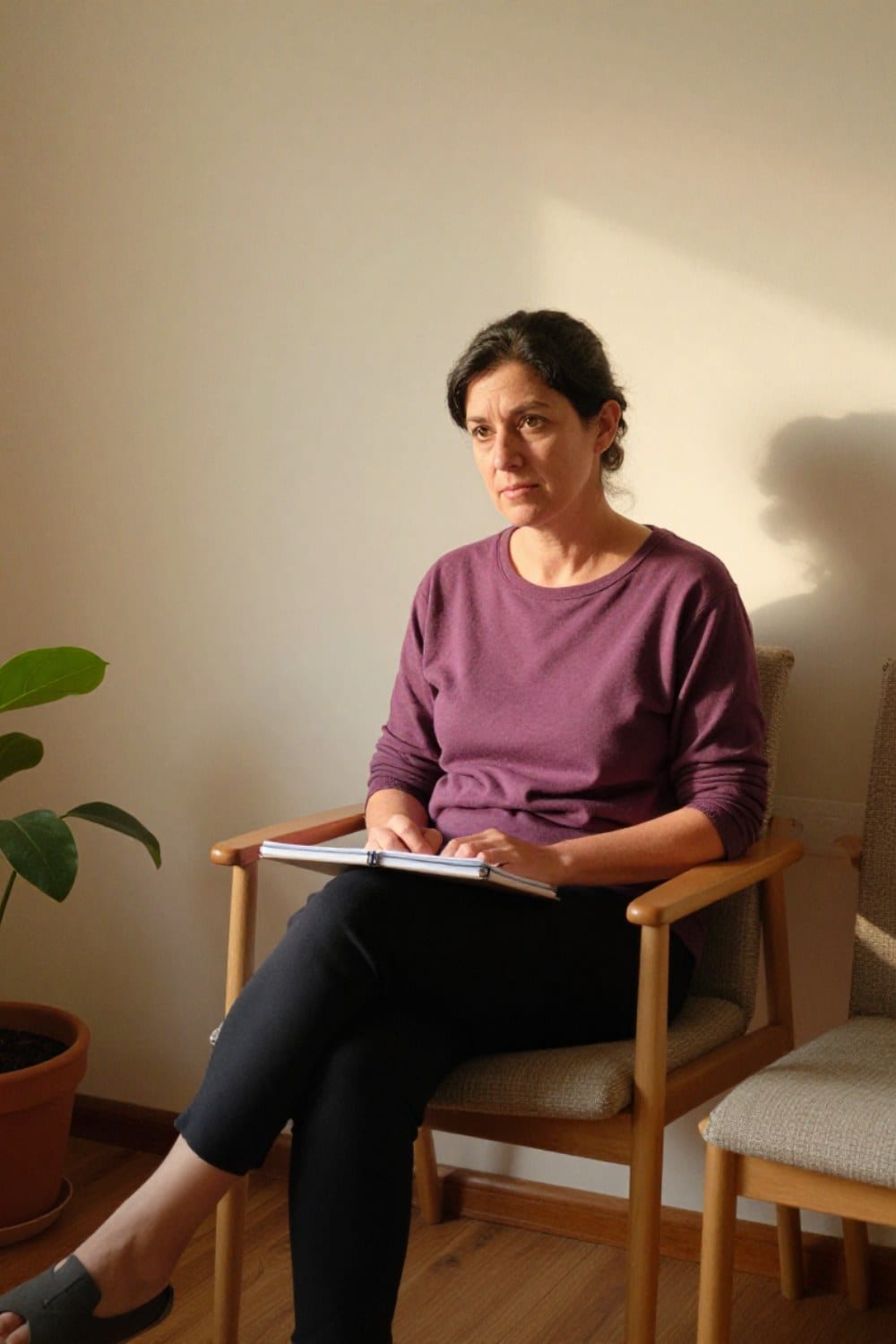
That's the real reason I wanted to write this one. So many of us have already had that appointment. We brought up the hot flashes, or the exhaustion, or the periods that don't make sense anymore, and left with a “that's just getting older” and a smile.
If that's already happened to you, I want to say this clearly: you didn't imagine it, and that appointment wasn't the end of the conversation. It was a disappointing first draft of it.
When It's Actually Worth Seeing a Doctor
Let's start with the question a lot of us sit with quietly for months: is this even worth taking up someone's time?
Here's the honest bar, and I mean this plainly: if it's affecting your life, that's enough. Not “enough to justify bothering someone.” Enough, full stop.
That might be one rough night a week, or five. It might be something you can name exactly, or just a sense that you haven't felt like yourself in months and can't quite say why. Either one is a real, legitimate reason to pick up the phone. If you're not even sure whether what you're noticing sounds like perimenopause, our rundown of common perimenopause symptoms is a good place to start — not to diagnose yourself, just to see if any of it rings a bell.
The Short List of Things to Call About Today
Before we get to the everyday stuff, there's a short list of things that deserve a same-day call — not “I'll mention it next time I'm in.” None of these are perimenopause on their own, and each one deserves a doctor's attention regardless of everything else going on this year.
Please be careful
None of this is meant to frighten you. Most of the time, whatever's behind it turns out to be something ordinary that responds well once it's found. But each one needs a doctor's own eyes on it, soon, specifically because it could be something other than perimenopause. Make the call. A same-day slot, an urgent care visit, or a nurse line — whatever's actually available to you counts, if your regular doctor can't see you right away. Let an actual professional rule things out — that part was never yours to guess at alone.
How to Actually Be Heard Once You're in the Room
Getting the appointment is step one. Getting taken seriously inside it is a different skill, and nobody ever taught it to us. Here's what actually seems to change the conversation.
- Write it down before you go. Two weeks of notes beats trying to remember everything under fluorescent lighting with a stranger waiting on your answer.
- Lead with impact, not a symptom list. “I'm not sleeping more than four hours a night and it's affecting my work” tends to land harder than “I have hot flashes.”
- Bring dates. When did this start? Is it more frequent than it was six months ago? A rough timeline says more than “lately.”
- Ask for the reasoning, not just the answer. “What would confirm that, or rule it out?” is a fair, completely normal question to ask out loud.
- Bring someone if it helps you stay steady. A second set of ears remembers what you were too rattled to catch.

Your Appointment Prep Sheet
Fill this out a few days ahead of time. It can help turn a fifteen-minute visit into one where you're more likely to be heard.
| Before you go | What that actually looks like | |
|---|---|---|
| Track | About two weeks of notes | Which nights sleep falls apart, which days you feel off, and when any bleeding happens — a running note on your phone is enough. |
| Bring | Your list, and a person if it helps | A written list you can hand over, plus a friend or partner if having someone there helps you stay steady. |
| Say | Impact first, symptoms second | “This is affecting my sleep, my work, and my patience with my own family” lands harder than a symptom list alone. |
| Ask | At least three questions | What do you think is going on? What would confirm or rule that out? What are my options? |
What a Doctor Can Actually Check (and Why One Test Often Isn't the Answer)
Here's something that surprises a lot of women: there's often no single test that says “yes, this is perimenopause,” the way a strep test gives you a clean yes or no.
What a doctor can actually do: take a real history, ask about your cycle and your family history, do an exam, and check for other things that can look similar from the outside. If you're curious what's actually changing under the hood — hormones, muscle, bone, all of it — we lay it out here.
If your first appointment ends with “let's watch and see,” that can be a legitimate answer, especially early on — not automatically a brush-off. But there's a real difference between “let's watch and see, and here's exactly what to track and when to call me” and just being sent home with nothing. You're allowed to ask which one you actually just got.
What to Ask About Your Options
Once a doctor has an actual picture of what's going on, the conversation turns to what might help. This is the part where I'm going to stop short, on purpose.
Menopausal hormone therapy is a real, legitimate option that some women and their doctors decide is right for them. It's also had a confusing reputation for a couple of decades, so it's worth asking your doctor what's changed. I'm not going to tell you whether it's right for you. Honestly, I couldn't — that decision depends on your own health history, your specific symptoms, and your own doctor's judgment, not a blog post. What I will say: it's a completely legitimate thing to bring up, by name, and a doctor who waves off the question without discussing it at all is worth noting. Ask what your options are — plural — and let your own doctor walk you through what actually fits your situation.
The same goes for anything involving your pelvic floor. If that's part of what you're noticing — pressure, leaking, a sense that something's shifted — it deserves its own specialist conversation, not a home fix you piece together yourself. Here's what that conversation actually looks like.
If You Weren't Taken Seriously the First Time
If you've already had this appointment and it didn't go well, here's what to do with that — instead of quietly giving up on the whole thing.
- Ask for it noted in your chart. “Can we note that I raised this today?” is a reasonable, unemotional sentence, and it creates a record even if nothing else happens at that visit.
- Ask for a second opinion. This is a completely normal, unremarkable request — not a betrayal of your doctor, not a big dramatic step.
- Ask if anyone in the practice has real menopause experience. Not every doctor has had much training in this. It's fair to ask before you assume the whole field failed you.

None of this is about deciding your doctor is the enemy. Most of them are doing their best inside fifteen-minute slots. It's about not letting one appointment be the whole verdict on you. You're allowed to want a better conversation than the one you got, and to go find it.
None of this is a diagnosis, and it isn't a promise about what's going on with you specifically — only what the research and the actual experts say, cited plainly below, so you can check it yourself instead of just trusting me.
Where this comes from
Every claim above traces to one of these.
- 1Perimenopause: Age, Stages, Signs, Symptoms & Treatment
Cleveland Clinic
Supports: That very heavy periods or large clots, changing a pad or tampon every one to two hours, periods lasting several days longer than usual, spotting or bleeding between periods, bleeding after sex, or periods coming less than 21 days apart are reasons to contact a healthcare provider; and that hormone testing isn't necessary to diagnose perimenopause because hormone levels fluctuate too much to be reliable, with diagnosis instead based on a physical exam, age, symptoms and medical history.
- 2Postmenopausal Bleeding: Causes, Diagnosis & Treatment
Cleveland Clinic
Supports: That any vaginal bleeding occurring a year or more after your last menstrual period is considered unusual and should prompt contacting a healthcare provider, since in about 10% of cases it's linked to uterine cancer, even though most causes turn out to be benign.
- 3Women, Don't Ignore These 3 Subtle Heart Attack Symptoms
Cleveland Clinic
Supports: That chest pressure or tightness is the most common heart attack symptom in women, that new breathlessness during ordinary activity is a warning sign, and that chest pressure or tightness which started that same day should be evaluated in an emergency room rather than waiting for a regular doctor's visit.
- 4Thunderclap Headaches
Cleveland Clinic
Supports: That a sudden, severe headache — often described as the worst headache of your life — requires immediate medical attention, since it can signal a serious condition that can't be told apart from a harmless headache by symptoms alone.
- 5Breast Lumps
Cleveland Clinic
Supports: That a new lump or a change in a lump you already have should be checked by a healthcare provider, and that most breast lumps are not cancer — but early evaluation matters when it is.
- 6The Menopause Society Comments on the FDA Announcement on Hormone Therapy
The Menopause Society
Supports: That hormone therapy is a legitimate, evidence-based option for appropriate candidates, and that the decision should be individualized and reviewed with a patient's own doctor based on personal and family health history and preferences, rather than applied as a blanket rule.
- 7Seeking Health Care for Perimenopausal Symptoms: Observations from The Women Living Better Survey
Journal of Women's Health · 2023
Supports: That among women who brought their most bothersome perimenopause symptom to a health care provider, nearly half described the experience as negative or unsatisfying — with many reporting they were told they were 'too young' or simply getting older — while women who felt genuinely listened to, with their symptoms regarded as a normal part of this life stage, reported far better experiences.
Free, and printable
The Free 4-Week Indoor Walking Plan
The plan sign-up is not live yet — the mailing list is still being set up. In the meantime, email hello@strongandrooted.com and Diane will send it to you herself.
One email when there is something worth sending. Unsubscribe whenever you like.
Frequently asked questions
What if my doctor won't listen?
Do I need a blood test to know if it's perimenopause?
How do I know if it's “enough” to bring to a doctor?
Should I ask my doctor about hormone therapy?
Talking to your doctor about perimenopause is supposed to be simple advice. In practice, it's a skill — one that gets easier with a little preparation, and a lot of permission to go back if the first try didn't land. If it's affecting your life, that's reason enough to make the call. If you want the bigger picture of what's actually changing in your body through this stretch, our full guide to menopause and the midlife body is a good next stop — and once you've got some clarity, here's how we think about movement through perimenopause, gently, and around whatever your body's doing this week.
Free, and printable
The 4-Week Indoor Walking Plan
The plan sign-up is not live yet — the mailing list is still being set up. In the meantime, email hello@strongandrooted.com and Diane will send it to you herself.
One email when there is something worth sending. Unsubscribe whenever you like.
Written by
Diane Marsh
At 49 I was tired, achy, sleeping badly, and being told to do more cardio and eat less — which was making all of it worse. I started walking. Fifteen minutes, indoors, in socks. Three years later I am stronger than I was at forty. I write down exactly what I did, cite the research where it exists, and admit where it doesn't.
Diane is not a doctor, a physical therapist, or a dietitian. She is a woman who rebuilt her own strength after perimenopause, reads the research carefully, cites it, and says so when nobody actually knows.
Keep reading
Nobody sits you down at 40 and explains what's actually happening to your muscle, bone, metabolism and joints. Here's the honest, cited version — what's changing, why, what genuinely helps, and what even the researchers haven't figured out yet.
Menopause and Weight Gain: An Honest Look at What Movement Can DoEvery corner of the internet has an opinion about menopause weight gain, and most of it is diet culture wearing a lab coat. Here's the honest version instead: what's actually changing in your body, why it matters for your heart and blood sugar rather than your mirror, and what movement genuinely can — and can't — do about it.
Movement That Works Around Hot Flashes and Broken SleepHot flashes and broken sleep don't have to end your workouts. Here's the honest, well-sourced answer on what exercise can and can't do for hot flashes, plus how to keep moving around the heat and the bad nights instead of fighting them.