Fiber in Perimenopause (The Least Glamorous Thing That Actually Helps)
Fiber doesn't have a brand, a supplement funnel, or a single viral reel — which might be exactly why almost nobody's telling you that most of us eat about half of what we actually need. Here's the honest picture: what fiber really does for your energy and your gut, the emerging (and genuinely unfinished) gut-hormone research, and how to add more without a rough week to show for it.

By Diane Marsh··10 min read
Claims on this page are checked against Harvard Health Publishing, Cleveland Clinic, MedlinePlus and NIDDK (both part of the National Institutes of Health), the American Journal of Lifestyle Medicine, and a 2026 review in Nutrients — all six sources are linked below.
General education, not medical advice. Talk to your doctor before starting something new.
The short version
- Most women eat about half the fiber they actually need — that's not a personal failing, it's just an unglamorous nutrient nobody's selling you.
- Fiber's real job is steadier energy after meals, fullness that actually lasts, and keeping things moving — a quieter kind of feeling better, not a transformation.
- The gut-hormone research connecting fiber to estrogen is genuinely interesting and genuinely unfinished — anyone selling a supplement on it is ahead of the evidence.
- Add fiber gradually, with plenty of water — the fastest way to quit is to add a week's worth of change in a single day.
- Food-first tends to beat a powder for most women: a few ordinary swaps across a normal day get you most of the way there.
Nobody is building a brand around fiber. There's no supplement funnel for it, no glossy influencer reel, no logo you could put on a water bottle. It doesn't promise anything dramatic by any particular date. It's just a plain, faintly boring nutrient — and it might be doing more for how you feel at 50 than half the things that do have a logo.
Here's the honest starting point: most of us aren't getting nearly enough of it. Not because we're failing at nutrition. Because it's a hard thing to sell, so almost nobody bothers selling it to you.
This one's for the unglamorous stuff that actually helps. Let's talk about fiber — what it really does, the gut-hormone research that's genuinely interesting and genuinely unfinished, and how to get more of it without spending a week regretting your own enthusiasm.
How Much Fiber Do You Actually Need?
Here's a number worth keeping in your back pocket: most women under 50 need somewhere around 25 grams of fiber a day. After 50, that guidance eases down slightly, to around 21 grams — mostly because it's tied to how many calories you're eating overall, and that number tends to shift a bit with age too.
Now here's the number that actually matters more: most American adults land closer to 15 or 16 grams a day. That's not a small miss. That's roughly half of what's recommended, for a lot of us.
It's not a fringe problem, either. When researchers looked at how many American adults actually meet fiber recommendations, the number that came back was startling — only about 1 in 20 do. That's not a handful of people eating carelessly. That's most of us, most days, including plenty of women who eat carefully in every other way.
If that's you, I want to be clear about something: this isn't a lecture. Nobody sat us down and taught fiber as its own subject. It got folded into “eat your vegetables” and left there — vague, easy to nod at, and easy to forget — while protein and steps and sleep got all the attention instead.
What Fiber Actually Does For You At 50
So why does a number like 25 grams matter more than it sounds like it should? A few honest reasons, roughly in order of how often they actually show up in a normal day.
- Steadier energy after meals. Fiber slows down how quickly food moves through your system, so the sugar from a meal reaches your bloodstream more gradually — less of a spike, less of a crash an hour later.
- Fullness that actually lasts. High-fiber foods tend to fill you up and keep you feeling that way, mostly because they simply take longer to digest — no tracking or willpower required.
- Regularity — let's just say it plainly, since we're all adults here. Fiber adds bulk and helps keep things moving, which matters more, not less, as you get older.
- A gut that's genuinely doing its job. Fiber is what your gut bacteria actually eat. Feed them well and the whole ecosystem down there tends to run more smoothly.
There's one more piece of the fiber story, though — and it's the one nobody's finished writing yet.
The Gut-Hormone Story, Honestly
Here's where this gets genuinely interesting. Researchers have been looking at how the bacteria living in your gut interact with estrogen — and it turns out your gut isn't just a bystander in that process. It's actually involved in recycling some of the estrogen your body has already made.
The short version: your gut bacteria carry tools that can reactivate estrogen your liver had already flagged for removal, sending some of it back into circulation instead of out of your body. Researchers have started calling this whole community of bacteria your “estrobolome” — which sounds like a supplement name, but it's really just a description of what these particular bacteria do.
So here's the sentence this whole article exists to say out loud: nobody knows yet, not really — and anyone selling you a supplement based on this research is ahead of the evidence, not standing on top of it. If you see a product promising to set your hormones straight through your gut, that promise is running well past what the science currently supports.
That's not a reason to ignore your gut, though. It's a reason to feed it well with real food, and let the researchers keep doing the slow, unglamorous work of figuring out the rest.
How To Actually Get More Fiber
This is where I'd gently push back on most fiber advice, which tends to hand you a supplement aisle or a complicated smoothie with twelve ingredients. Neither one is how most of us actually eat on an ordinary Tuesday.
The more honest approach is food-first and small: a handful of ordinary swaps and adds, stacked across a normal day, until they add up to something real. No overhaul required — just a few things worth keeping around the kitchen.
A Day Of Fiber, Roughly
You don't need a perfect day. You need a few of these, most days.
| Meal | An easy add | Roughly how much it brings |
|---|---|---|
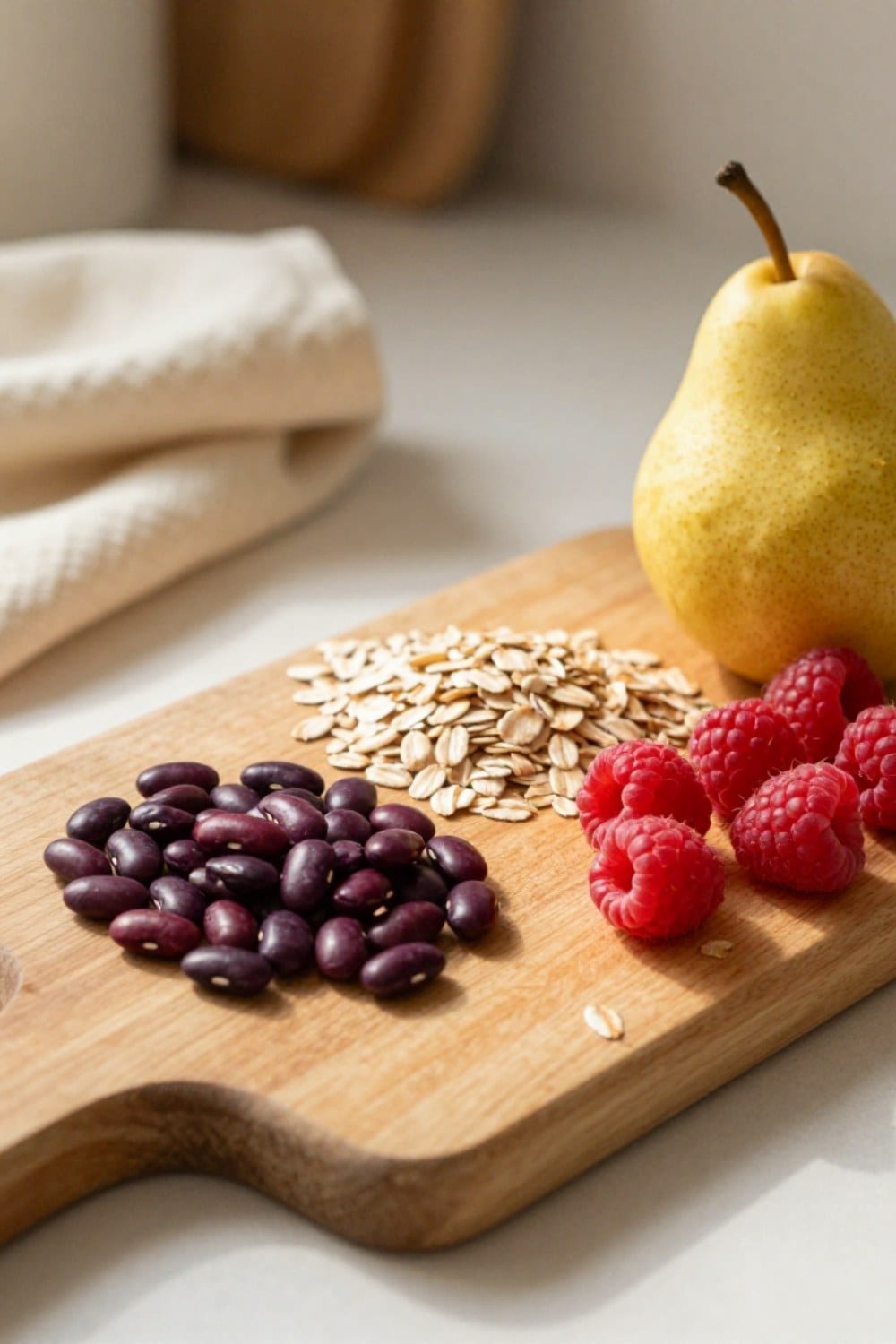
| Breakfast | Oatmeal instead of a cereal bar, topped with a handful of raspberries or blueberries | About 10 grams |
| Lunch | A scoop of black beans or lentils added into whatever you're already having | About 7-8 grams |
| Afternoon | A pear or an apple, skin on, instead of a packaged snack | About 4-5 grams |
| Dinner | A cup of broccoli, Brussels sprouts, or another vegetable you'd normally skip | About 4-5 grams |
| Anytime | The whole-grain version of your usual bread or rice, when you have a choice | About 2-3 grams more, every time |
Notice what's not on that list: a juice regimen, a powder, or a plan that asks you to eat differently from your own family at dinner. This is groceries, not a program.
Where Fiber Sits Next To Protein
Fiber doesn't do its best work in isolation, and neither does protein — the two actually complement each other nicely at this age. Both slow digestion, and both support that same steady, lasting fullness, just through different mechanisms. A meal built around both tends to hold you longer than a meal built around neither.
Fiber also plays into your day-to-day blood sugar, and it fits naturally alongside the broader eating habits that tend to matter most in this decade. None of these are separate diets to juggle — they're the same handful of honest habits, just looked at from a few different angles.
None of this is a specific plan for your body or your hormones — just what the general research supports, cited honestly below, plus what actually happened when I tried it on myself.
Where this comes from
Every claim above traces to one of these six.
- 1Should I be eating more fiber?
Harvard Health Publishing · 2019
Supports: That women need about 25 grams of fiber daily up to age 50 and 21 grams after 50 (38 and 30 for men), and that most Americans eat well below either target.
- 2How Much Fiber Do You Need per Day?
Cleveland Clinic
Supports: That only about 5% of U.S. adults get enough fiber, average intake is close to 16 grams a day, fiber supports blood sugar management, digestion, heart health and lasting fullness, and it's best added gradually with plenty of water to avoid gas and bloating.
- 3Fiber
MedlinePlus (NIH)
Supports: That adults need roughly 21 to 38 grams of fiber a day, Americans average around 16 grams, and fiber supports healthy cholesterol levels, digestion and lasting fullness.
- 4Eating, Diet, & Nutrition for Diverticular Disease
NIDDK (National Institutes of Health)
Supports: That a 2,000-calorie diet calls for about 28 grams of fiber daily, and that adding fiber a little at a time helps the body adjust comfortably.
- 5Closing America's Fiber Intake Gap
American Journal of Lifestyle Medicine · 2016
Supports: That an estimated 95% of American adults and children fall short of recommended fiber intake, mean daily intake is about 16 grams, and recommendations range from 19 to 38 grams depending on age and sex, with women 19 to 50 needing about 25 grams daily.
- 6Diet, the Gut Microbiome, and Estrogen Physiology: A Review in Menopausal Health and Interventions
Nutrients · 2026
Supports: That gut bacteria, collectively called the estrobolome, help regulate how much estrogen is reabsorbed into circulation, that higher fiber intake has been linked to a more stable gut environment, and that the researchers describe studies proving a direct cause-and-effect link as still few, with the ideal gut makeup for perimenopause still unclear.
Free, and printable
The Free 4-Week Indoor Walking Plan
The plan sign-up is not live yet — the mailing list is still being set up. In the meantime, email hello@strongandrooted.com and Diane will send it to you herself.
One email when there is something worth sending. Unsubscribe whenever you like.
Frequently asked questions
How much fiber do I actually need in perimenopause?
Do I need a fiber supplement?
Is the gut-hormone connection to estrogen real?
Will more fiber upset my stomach?
Fiber was never going to be the exciting part of getting stronger after 40 — there's no logo for it and no viral reel. It's just a plain habit that steadies your energy, keeps things moving, and feeds a gut community researchers are still, honestly, figuring out. Start with one swap today, add slowly, and keep the water nearby. For the fuller picture, the complete nutrition guide ties fiber together with protein and everything else that matters on a midlife plate, and this look at what's actually changing in your body after 40 is a good next stop if you want the bigger picture behind all of it.
Free, and printable
The 4-Week Indoor Walking Plan
The plan sign-up is not live yet — the mailing list is still being set up. In the meantime, email hello@strongandrooted.com and Diane will send it to you herself.
One email when there is something worth sending. Unsubscribe whenever you like.
Written by
Diane Marsh
At 49 I was tired, achy, sleeping badly, and being told to do more cardio and eat less — which was making all of it worse. I started walking. Fifteen minutes, indoors, in socks. Three years later I am stronger than I was at forty. I write down exactly what I did, cite the research where it exists, and admit where it doesn't.
Diane is not a doctor, a physical therapist, or a dietitian. She is a woman who rebuilt her own strength after perimenopause, reads the research carefully, cites it, and says so when nobody actually knows.
Keep reading
This is the whole nutrition territory in one honest place — not a diet, not a meal plan, just four ideas that actually hold up: protein, fiber, steady energy and what's really just marketing. Read it once and you'll know exactly which deeper guide is yours.
Blood-Sugar-Friendly Habits for Steadier Energy After 40The 3 PM crash feels like a personal failing, but it's mostly a blood-sugar story — what you ate, in what order, and whether you moved afterward. Here's what's actually happening after a meal, why it can feel different in midlife, and the small, honest swaps that make the afternoon gentler.
How Much Protein Do You Actually Need After 40?Most of us are eating less protein than we think, and the old government minimum was never built for a woman trying to hold onto her muscle after 40. Here's the real number in grams you can actually use, why it goes up instead of down with age, and what a full day of it looks like on an ordinary plate — no recipes required.