A Calming Bedtime Routine for a Midlife Body (That Isn't a Pinterest Fantasy)
Every bedtime routine online assumes ninety free minutes and an empty house. This one is built for about twenty — a cooler room in actual degrees, an earlier wind-down, the wake time that matters more than any of it, plus the honest midlife layer nobody puts on a pin: running hot, a racing brain, and when it's a doctor's job, not a routine's.

By Diane Marsh··11 min read
Claims on this page are checked against Harvard Health, Cleveland Clinic, the CDC, the NHLBI (National Institutes of Health), and the American Academy of Sleep Medicine — all sources are linked below.
General education, not medical advice. Talk to your doctor before starting something new.
The short version
- The four things with real support are simpler than any Pinterest routine: a consistent wake time, a cooler room, less light before bed, and a wind-down that starts early enough to matter.
- A consistent wake time can do more for your sleep than a perfect bedtime — even on the nights you can't control anything else.
- The midlife layer is real — running hot, night sweats, a racing list at 10 p.m. — and none of it means you're doing this wrong.
- The lazy, five-minute version of this routine still counts on the nights the full one isn't happening.
- If you're exhausted no matter how many hours you get, that's a conversation for your doctor, not a routine to try harder at.
Every bedtime routine on Pinterest assumes the same woman: ninety free minutes, a silk pillowcase, a diffuser already going, and a house that's quiet for the night. Nobody else needs the bathroom in the next twenty minutes. Nobody's snoring through the wall. Her only job before sleep is her own calm, and she has all the time in the world to get there.
That's not most of us, and it was never going to be. This one is for a body that runs hot at 11 p.m. for no obvious reason, a brain that starts filing tomorrow's to-do list the second the lights go down, and someone else's breathing to work around — with about twenty honest minutes to spend, not ninety. Here's what the research actually backs, what midlife adds on top of it, and what a routine, however good, was never going to be able to do.
The Four Things With Actual Support Behind Them
Wellness feeds love a routine with fourteen steps and a jade roller somewhere in the mix. The research keeps pointing at something much shorter: four things, and none of them are complicated.
Your Wake Time Is the Anchor, Not Your Bedtime
Here's the one that surprises people most: the time you get up tends to matter more than the time you go to sleep. A wandering bedtime is forgivable. A wandering wake-up time is what actually confuses your body's clock.
So if you do exactly nothing else on this list, get up at the same time tomorrow. It's a strange thing to hear on a bedtime-routine article, but it's the part I'd put first.
A Cool Room, in Actual Degrees
"Keep your room cool" shows up in every sleep article ever written, and it's rarely specific enough to act on. Here's the actual number.
You don't need a smart thermostat for this. A window cracked an inch, a fan pointed at the bed, or just nudging the number down a few degrees all count.
Light Down Early, Not Just "Screens Off"
"No screens before bed" is the advice everyone repeats and almost nobody fully follows. The more useful version is about light in general, not just your phone.
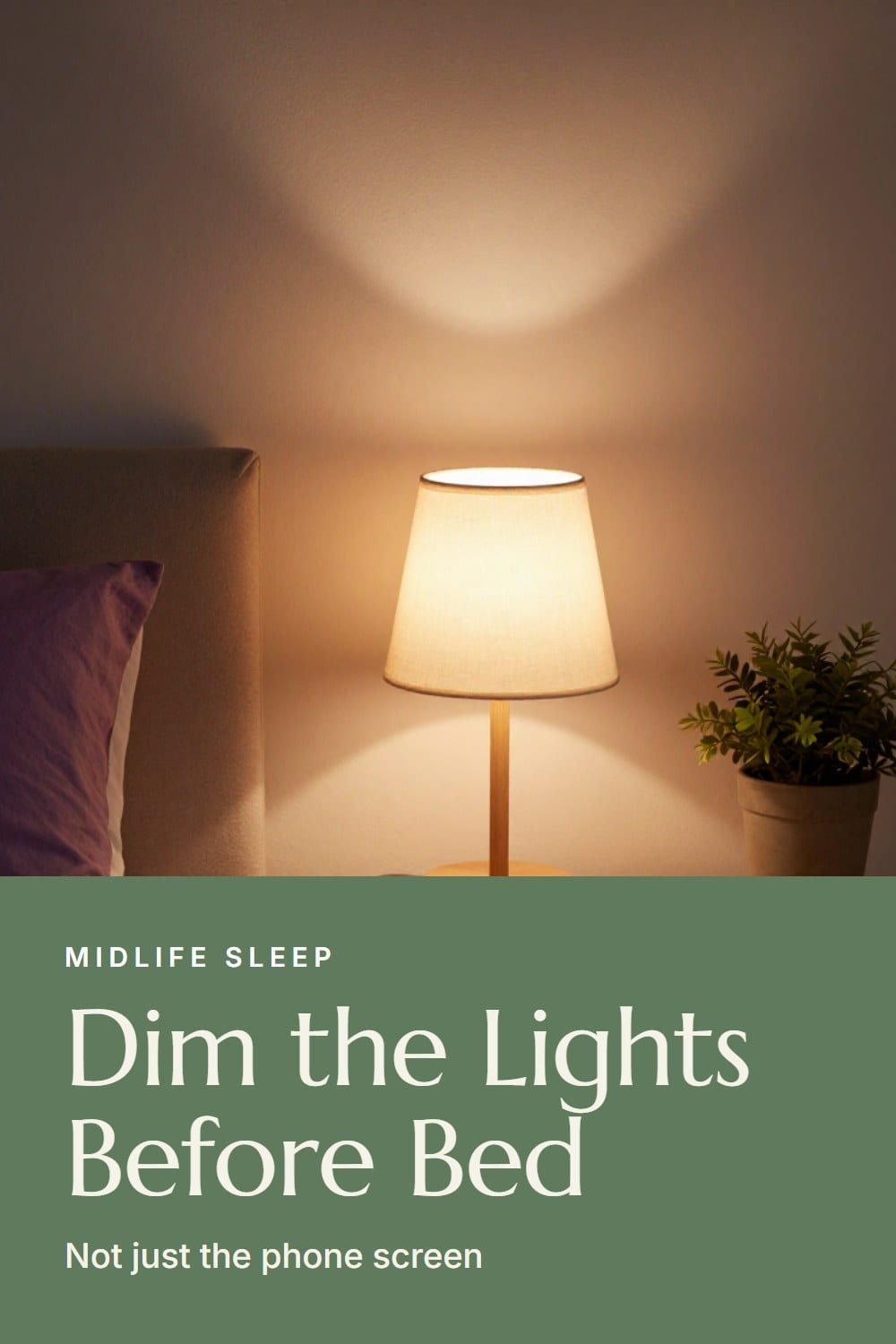
That means the lamp in the hallway and the overhead light in the kitchen count too, not only the screen in your hand.
A Wind-Down That Starts Before You're Already Wired
This is the one almost everyone gets backwards: starting the wind-down once you're already in bed, wide awake, wondering why it isn't working yet. By then it's too late to be the first step of anything.
Harvard's own guidance suggests starting the wind-down roughly ninety minutes before you want to be asleep — screens off, lights low, something unstimulating like reading instead of your phone. It's a small head start, and it's the difference between a routine that works and one that starts a lap behind.
The Twenty Minutes, Not the Ninety
Here's all four of those folded into an actual twenty minutes — the version for a real night, not a spa night.
Your Actual Twenty Minutes
Four things, folded into one ordinary night — not a spa ritual.
| Time | What | Why It Helps | The Lazy Version |
|---|---|---|---|
| 20 minutes before | Nudge the room a few degrees cooler | A cooler room supports the temperature drop good sleep depends on | Just lower the thermostat — skip opening the window |
| 15 minutes before | Dim the lights around the house, not just your phone | Bright light this late tells your body it's still daytime | Turn off one overhead light on your way to bed |
| 10 minutes before | Write down whatever's looping in your head for tomorrow | Getting the list out of your head is often what quiets it | One sticky note with tomorrow's first task still counts |
| 5 minutes before | Change into something light and layerable | Fewer layers to fight with means fewer wake-ups to fix them | Sleep in whatever you've already got on |
| Lights out | Same wake-up time tomorrow, no matter what | This is the anchor the other nineteen minutes are built around | Even this alone is worth doing on its own |
None of this needs to happen in order, and skipping a step on a rough night doesn't undo the others. This is a routine you can actually keep, which is the entire point.
What Midlife Actually Adds to This
None of the four things above are midlife-specific — they'd help anyone. What's different for us is everything working against them.
Running Hot
A cool room matters more than it used to, because a lot of us are generating our own heat now, on a schedule that has nothing to do with the thermostat.
None of it is glamorous. All of it is more useful than a routine marketed with a candle sitting next to it.

The Bathroom Trip and the Racing List
If you're up once a night for the bathroom, a small nightlight in the hallway means you're not fully waking yourself up under a bright bulb just to get back to bed.
And if it's not your bladder but your brain — the list of tomorrow that shows up right as your head hits the pillow — you're not the only one. I go into what's actually happening at that hour, and why it isn't really about willpower, in this piece on 3 a.m. waking.
A Partner Who Snores
If someone else's sleep is interrupting yours, that's a real, common piece of this puzzle, and it deserves an honest mention instead of getting quietly left out. Earplugs, a white-noise machine, or — if it's become a real pattern — a gentle nudge for him to mention it at his own next appointment are all reasonable, ordinary responses. None of that means diagnosing him from across the bed. It just means you're both allowed to take your own sleep seriously.
The Honest Bit: What a Routine Can't Do
Everything above helps a body that's basically fine — one dealing with ordinary midlife sleep, not an underlying problem quietly going unaddressed. That's an important line, and it's worth being straightforward about.
This page is about bedtime specifically. What you do with the other sixteen hours matters just as much — a calmer daytime routine and gentle movement like yoga both feed back into how you sleep at night, and neither one needs to happen at 10 p.m. to count.
None of this is a diagnosis or a promise about your own nights specifically — just what the general guidance actually supports, cited plainly below.
Where this comes from
Every claim above traces to one of these six.
- 1Restructure Your Day to Get a Better Night's Sleep
Harvard Health
Supports: That a consistent wake-up time functions as the anchor of the circadian sleep rhythm, that setting a fixed wake time is recommended over focusing mainly on bedtime, and that a wind-down period — stopping electronics and keeping lights low starting roughly ninety minutes before bed — supports falling asleep.
- 2Best Bedroom Temperature for Sleep
Cleveland Clinic · 2026
Supports: That a bedroom temperature of about 60 to 67 degrees Fahrenheit is recommended for sleep, since core body temperature needs to drop during sleep as part of the circadian rhythm, and a room that is too warm interferes with that drop.
- 3Effects of Light on Circadian Rhythms
CDC
Supports: That bright light in the morning helps a person feel more alert and fall asleep more easily that night, that avoiding bright light in the two hours before bedtime makes falling asleep easier, and that dimming the lights in that window is recommended for people who have trouble falling asleep.
- 4Women's Sleep Health: Menopause and the Menstrual Cycle
AASM (American Academy of Sleep Medicine)
Supports: That more than a third of women ages 45 to 64 report night sweats or hot flashes that disrupt their sleep because of menopause.
- 5Night Sweats
Cleveland Clinic
Supports: That night sweats are common during perimenopause and menopause, and that practical steps like a bedroom fan or air conditioning, lightweight layered bedding that can be removed during the night, and loose cotton or linen sleepwear can help manage them.
- 6Sleep Apnea and Women
NHLBI (National Institutes of Health)
Supports: That women's risk for sleep apnea increases during and after menopause, that women more often experience symptoms like daytime sleepiness, morning headaches, insomnia, tiredness and frequent nighttime waking rather than loud snoring, and that this atypical presentation can make sleep apnea harder for a woman or her provider to recognize.
Free, and printable
The Free 4-Week Indoor Walking Plan
The plan sign-up is not live yet — the mailing list is still being set up. In the meantime, email hello@strongandrooted.com and Diane will send it to you herself.
One email when there is something worth sending. Unsubscribe whenever you like.
Frequently asked questions
How long should a bedtime routine actually take?
What's the best bedroom temperature for sleep?
I do everything right and still wake up at 3 a.m. Why?
What if this routine just isn't working?
A calming bedtime routine doesn't need ninety minutes, a diffuser, or an empty house to count — it needs about twenty honest ones, done most nights, by a real woman who still has a whole life happening around her at 10 p.m. If you want the fuller picture — the stress side, the 3 a.m. waking, and the actual first-line therapy most women have never heard of — the sleep, stress and recovery guide covers all of it in one place. However far you get tonight, the same twenty minutes are still there tomorrow, waiting for you to try again.
Free, and printable
The 4-Week Indoor Walking Plan
The plan sign-up is not live yet — the mailing list is still being set up. In the meantime, email hello@strongandrooted.com and Diane will send it to you herself.
One email when there is something worth sending. Unsubscribe whenever you like.
Written by
Diane Marsh
At 49 I was tired, achy, sleeping badly, and being told to do more cardio and eat less — which was making all of it worse. I started walking. Fifteen minutes, indoors, in socks. Three years later I am stronger than I was at forty. I write down exactly what I did, cite the research where it exists, and admit where it doesn't.
Diane is not a doctor, a physical therapist, or a dietitian. She is a woman who rebuilt her own strength after perimenopause, reads the research carefully, cites it, and says so when nobody actually knows.
Keep reading
Your sleep really did change after 40, and it isn't just stress or bad habits — there's a real, hormonal reason, plus one safety check almost no sleep article mentions. Here's the honest version: why it happens, the thing doctors say gets missed in women, and what genuinely helps versus what's just marketing.
Stress Management for Midlife Women (When You Can't Just Remove the Stress)Every stress article tells her to reduce it. She can't — not with the parents, the job, and the body she has this year. Here's what to do instead: build the buffer, spend the free levers well, and know the honest difference between stress and something more.
Nervous-System-Friendly Daily Routines (What's Real and What's Marketing)Vagus-nerve hacks, tapping, somatic shaking, pricey courses — "nervous system regulation" is everywhere. Here's an honest sort of what the research actually backs (slow breathing, daylight, movement, people) from what's mostly marketing.