The Hot Girl Walk at 50: The Gratitude Walk That Isn't About How You Look
The name makes it sound like this walk is about how you look. It never was — Mia Lind built it in 2020 around three questions: gratitude, your goals, and your confidence. Here's the honest version for 50, at whatever distance you've actually got today.
By Diane Marsh··10 min read
Claims on this page are checked against Mayo Clinic, the National Institute on Aging (NIH), the CDC and Cleveland Clinic — all four are linked below.
General education, not medical advice. Talk to your doctor before starting something new.
The short version
- The Hot Girl Walk started in 2020 as a roughly four-mile outdoor walk built around three questions: gratitude, your goals, and your confidence — never your appearance.
- You can steal the entire mindset at any distance. Ten minutes around the block, with the same three questions, counts as a full version of this walk.
- In 2026, real-world group Hot Girl Walks are drawing women of every age into city parks, chanting "Gratitude! Goals! Confidence!" together.
- Outdoor walking and daylight are linked to real mood and sleep benefits, and doing it with another woman adds a second, separate benefit: connection.
- There's a free printable version of our 4-Week Indoor Walking Plan if you want the habit-building structure behind all of this.
Let's deal with the name first, because it's probably the reason you almost didn't click this. "Hot Girl Walk" sounds like one more piece of advice about how you're supposed to look while you exercise. It isn't, and it never was.
A stressed-out college student named Mia Lind started it in 2020, during a pandemic that had her stuck in her own head. Her walk was about four miles, outdoors, and the rule was simple: think about three things the whole time — what you're grateful for, what your goals are, and how confident you are. Nothing about your body ever made the list.
At 50, you almost certainly have more to be grateful for and more real goals than a college trend built for twenty-somethings ever assumed. This is the version of that walk built for you — the mindset, kept in full; the name and the four miles, both entirely optional.
What the Hot Girl Walk Actually Is
The "hot" in the name comes from Megan Thee Stallion's "Hot Girl Summer," not from a beauty standard. Lind was a senior at USC, overwhelmed and looking for a way to move her body and get out of her own head at the same time. She started walking roughly four miles around her neighborhood and narrating her own life to herself as she went.
The structure she landed on had three parts, and they're the entire practice: gratitude first, then your goals, then your confidence. Not your reflection in a store window. Not a number on a scale. What you're building, what you're thankful for, and what you already know you're capable of.
The Name Is the Worst Part. The Practice Is One of the Best.
By 2026, this had grown into something bigger than a solo habit. Real-world group walks now draw women of every age into city parks, and walking groups have popped up in cities across the country, some of them chanting "Gratitude! Goals! Confidence!" out loud.
I'll say the quiet part out loud: the name is genuinely the worst thing about this trend, and the practice underneath it is one of the better ones to come out of the internet in years. Nobody age-gates gratitude. Nobody age-gates a goal. And confidence at 50 — real, earned, not-asking-anyone's-permission confidence — deserves its own thirty minutes outside just as much as it did at twenty-two.
That's really the case for doing this at 50 specifically. A twenty-two-year-old has goals too, but a woman who's raised kids, survived a career, or rebuilt a life more than once carries a deeper well of things to be genuinely grateful for and confident about. The original trend never got around to writing that version. This is that version.
Steal the Good Part — You Don't Need Four Miles
The four-mile distance was Mia Lind's personal habit, not a rule of the practice. The actual practice is the three questions, and they work at any distance you've got today: a single loop around the block, a lap of the park, or the full four miles if that's genuinely what you want to do with your afternoon.
If what you actually want is a structured, timed method — intervals, a specific pace pattern — that's a different tool. Our guide to Japanese walking is the one with a stopwatch. This one has no timer at all. It has three questions and however many minutes you can give it — no pace chart, nothing to check against.
And if you don't have any kind of regular walking habit yet, indoors or out, start smaller than any of this. Our 4-week indoor walking plan begins at fifteen minutes with no outdoor loop required at all. Bring these three questions outside once that feels easy, whenever that ends up being — there's no deadline attached to "easy."
Your Version of the Walk
Pick the size that fits today. None of these is the "real" one — the real one is whichever you'll actually do again tomorrow.
| Your version | Time | Distance | Your mindset prompt |
|---|---|---|---|
| ShortThis is a full Hot Girl Walk. It is not a lesser version of one. | 10–15 minutes | Roughly half a mile — once around the block | Name one specific thing you're grateful for today, out loud or in your head. |
| MediumThis is the size most women actually settle into. | 25–35 minutes | About 1.5–2 miles — your regular loop | Walk through one goal like you're explaining your plan to a friend. |
| LongSave this one for a day you actually have the time, not as the bar you feel you have to clear. | 60–75 minutes | About four miles — the original distance | Rotate through all three: gratitude, one goal, one thing you're confident about. |
How to Actually Use the Three Prompts (Without Feeling Silly)
Start with gratitude, and make it specific and small. Not "my family" — "the way my neighbor waved this morning." Not "my health" — "that my knees let me do this walk today." Specific gratitude tends to stick. Vague gratitude evaporates by the second block.
Next, pick one goal and walk through it like you're explaining the plan to a friend, not reciting a wish list. "I want to call my sister back today" is a real goal you can finish by dinner. "I want to be healthier" isn't a goal yet — it's a direction. Use the walk to turn it into one.
Last, if the word "confidence" still snags on old associations for you, swap the question entirely: not "how confident am I," but "what's one thing I did recently that I'm proud of." Same energy, and it never once asks you to think about your body.
Why Outdoors and Daylight Actually Matter Here
You can do this exact practice on a treadmill or a living-room loop, and it still counts in full. But taking it outside, into real daylight, appears to add something on top of the walking itself.
Why Doing This With Other Women Might Be the Real Active Ingredient
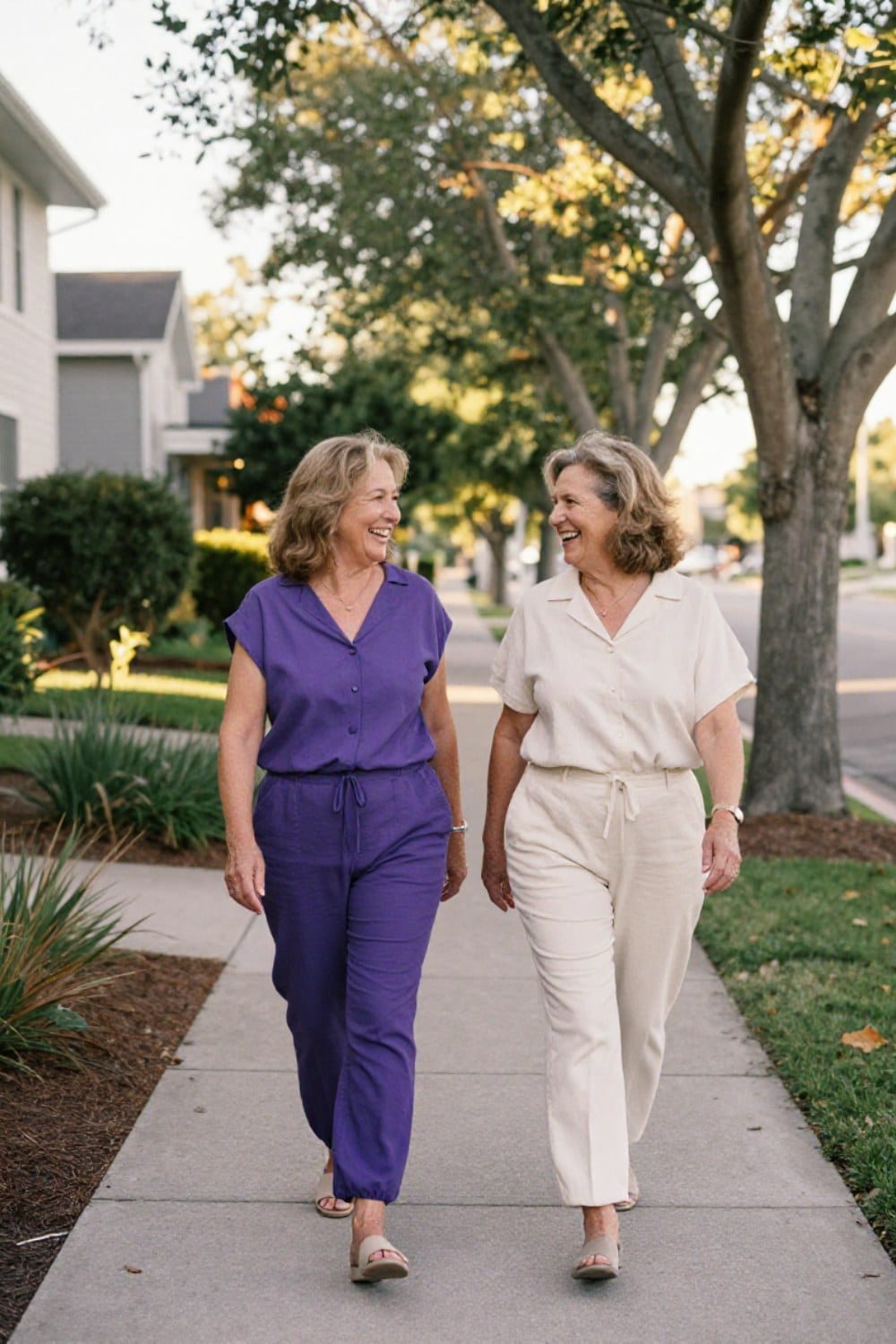
The version of this trend that's grown fastest in 2026 isn't solo at all — it's the group walks. A group of women in a park, chanting the same three words together, isn't really a fitness class. It's closer to a standing invitation to show up as you are, say the true thing out loud, and have it witnessed by other women roughly your age who get it without needing an explanation.
Where this comes from
Every claim above is backed by one of these four sources.
- 14 Tips for Keeping a Gratitude Journal
Cleveland Clinic
Supports: That practicing gratitude is linked to improved mood, lower anxiety and depression, and better sleep.
- 2Depression and anxiety: Exercise eases symptoms
Mayo Clinic
Supports: That regular physical activity like walking can ease symptoms of anxiety and depression, boost mood-related brain chemistry, and increase self-confidence.
- 3Getting a Good Night's Sleep
National Institute on Aging (NIH)
Supports: That exposure to natural daylight during the day helps regulate the body's circadian rhythm and supports better nighttime sleep.
Free, and printable
The free 4-Week Indoor Walking Plan
The plan sign-up is not live yet — the mailing list is still being set up. In the meantime, email hello@strongandrooted.com and Diane will send it to you herself.
One email when there is something worth sending. Unsubscribe whenever you like.
Frequently asked questions
Do I really need to walk four miles for this to count?
Isn't "Hot Girl Walk" really just about how you look?
Can I listen to music or a podcast, or does it have to be silent thinking?
What if I feel silly saying "gratitude, goals, confidence" to myself?
Take these three questions on a walk around the block this week, and see how far the mindset carries you before the distance ever matters. Want a timed, structured method instead? Japanese walking is the one with a stopwatch. Haven't built any walking habit yet? Our 4-week indoor plan is where to actually start. And on the days your knees or the weather say no to the outdoors, the low-impact indoor version carries the same three questions just fine. Wherever you walk it, the questions travel with you: what are you grateful for, what are you working toward, and what do you already know you can do. Answer those three often enough, on foot, and the answers have a way of showing up in the rest of your week too.
Free, and printable
The 4-Week Indoor Walking Plan
The plan sign-up is not live yet — the mailing list is still being set up. In the meantime, email hello@strongandrooted.com and Diane will send it to you herself.
One email when there is something worth sending. Unsubscribe whenever you like.
Written by
Diane Marsh
At 49 I was tired, achy, sleeping badly, and being told to do more cardio and eat less — which was making all of it worse. I started walking. Fifteen minutes, indoors, in socks. Three years later I am stronger than I was at forty. I write down exactly what I did, cite the research where it exists, and admit where it doesn't.
Diane is not a doctor, a physical therapist, or a dietitian. She is a woman who rebuilt her own strength after perimenopause, reads the research carefully, cites it, and says so when nobody actually knows.
Keep reading
Everything this site knows about walking after 40, in one place — what actually changes in your body, the honest version of every trending method, and exactly which article to read next for where you are right now.
Is Walking Enough for Your Bones and Joints After 40?Walking really is linked to stronger hips — the research on this is genuinely encouraging. But if bone density and joint health are what you're after, walking is the first chapter, not the whole book. Here's the honest, cited version of what to add.
What Walking Really Does for a Midlife Metabolism (An Honest Answer)You've probably been told a walk will change everything menopause does to your body. It won't, not on its own — but here's the honest mechanism instead: what actually changes after 40, why it matters for your heart and blood sugar rather than your mirror, and what genuinely helps more than walking alone.