Why Habits Don't Stick After 40 (It Isn't Willpower)
You've probably decided you just don't have the discipline for new habits. I want to show you what the research actually says instead — where the 21-day rule really comes from, the honest 66-day range, and why it was never about your willpower at all.

By Diane Marsh··12 min read
Claims on this page are checked against a 2010 University College London habit-formation study, a 2024 pooled look at habit research, Cleveland Clinic and Harvard Health — all five sources linked below.
General education, not medical advice. Talk to your doctor before starting something new.
The short version
- The '21 days to build a habit' rule isn't from habit research at all — it traces to a 1960s plastic surgeon watching patients adjust to a changed appearance.
- The real number is closer to 66 days on average, and the honest range runs from 18 to 254 days depending on the habit.
- It's the habit's complexity that sets the timeline, not your willpower — a glass of water can go automatic in under three weeks; fifty sit-ups a day can take the better part of a year.
- Missing a single day doesn't meaningfully change whether a habit forms. One missed Tuesday is not a failure — it's a Tuesday.
- The habits that stick fastest are small, attached to something you already do, and chosen by you — not assigned to you.
You've probably told yourself some version of this: 'I just don't have the discipline for this stuff.' You started the morning routine, or the stretching, or the daily walk, and somewhere around the third week, it quietly fell apart. So you filed it under personality — yours, specifically — and felt a little worse about the next attempt before you'd even made it.
I want to show you the actual research on that, because it says something different, and you deserve to hear it plainly: it was never about your willpower. It was about which habit you picked, and how many days you gave it before deciding you'd failed.
The number everyone quotes — 21 days — isn't from habit research at all
You've heard it more times than you can count: it takes twenty-one days to build a habit. It's on posters, inside fitness apps, and baked into nearly every '30-day challenge' on the internet. It also isn't true, and tracing where it actually came from is oddly satisfying.
The number traces back to a 1960s book called Psycho-Cybernetics, written by Maxwell Maltz — a plastic surgeon, not a habit researcher. Maltz noticed his patients took roughly three weeks to get used to a changed appearance after surgery, and that a phantom-limb sensation faded on a similar timeline after an amputation. From that, he wrote that it takes 'a minimum of about 21 days' to adjust to a change like that.
That's a real, honest observation about adjusting to a new appearance. It was never a study about building a new daily habit. Somewhere across sixty-plus years of repetition, the two got tangled together, and the careful hedge in that original sentence — 'a minimum of about' — quietly disappeared along the way.
So what's the real number? About 66 days — and the honest range is wider than that
The most-cited real research on this comes out of University College London, where a researcher named Phillippa Lally and her team followed 96 people for twelve weeks. Each person chose one new daily habit to build — things like drinking a glass of water with lunch, eating a piece of fruit, or doing fifty sit-ups — in the same context, every day.
On average, it took 66 days for a new behavior to start feeling automatic instead of effortful. But 'average' is doing a lot of quiet work: the actual range across those 96 people ran from 18 days on the fast end to 254 on the slow end. When researchers pooled a couple dozen more habit studies together in 2024, the typical habit landed almost exactly there — a median of 59 to 66 days.
Here's the part that actually matters: it's the habit's size, not your willpower
This is the reframe I most want you to sit with, because I think it quietly undoes a decade of feeling like something's wrong with you: the timeline in that study wasn't random, and it wasn't personality-based. It tracked the size of the habit itself.
Read that again with your own history in mind. If you tried a full workout routine, an elaborate skincare regimen, or cutting something out entirely — and gave it three weeks before deciding you'd failed — you didn't fail a willpower test. You picked something that was never going to finish in 21 days, and then graded yourself against a deadline no research actually supports.
That's the whole reframe, said as plainly as I can put it: you didn't lack discipline. You picked a 250-day habit and judged yourself at day 21. Those are two completely different problems, and only one of them was ever yours to fix.
The permission almost nobody gives you: missing a day doesn't matter
There's a second finding in Lally's data that I think matters just as much, and gets repeated far less often: missing a single day of practice did not meaningfully change whether the habit went on to form. Not just a small effect: no meaningful one.

What actually works, once you know all of this
None of this means timelines are irrelevant — it means you can stop fighting the wrong battle. A few things tend to help a new habit along, and none of them ask for more discipline than you already have.
- Use the same cue, in the same place, as often as you can. Habits are triggered by something specific — a location, a time of day, the action right before it — and a steady trigger matters more than hitting a perfectly rigid clock time.
- Attach the new thing to something already automatic. That's the plain-English version of 'habit stacking': instead of hoping you'll remember a brand-new habit on its own, you let an existing one remind you. Brushing your teeth, making coffee and sitting down for lunch are three of the most reliable anchors most people already have, several times a day.
- Pick the smallest version that still genuinely counts. Not the impressive version — the one you'd still do on a day you're tired, distracted and not feeling especially disciplined, because that describes most days, for every single person.
- Choose it yourself. When researchers compared habits people picked for themselves against habits assigned to them, the self-chosen ones stuck more often. You already know more about what you'll actually keep doing than any article, including this one, can tell you.
This is also the exact idea behind the self-care that actually holds up in midlife — small, boring, repeatable, and attached to something you already do, rather than an occasional indulgence that takes remembering to schedule.
How to pick a habit that's actually an 18-day habit, not a 250-day one
If you want to stop re-living the same three-week disappointment, the fix usually isn't more willpower — it's a smaller habit and a clearer cue. Here's the same pattern across a few common goals, so you can borrow it for whatever you're actually working on.
Pick a habit that sticks
Same pattern, different habit. Notice that the right-hand columns are always smaller, and always borrowed from a moment that already happens.
| The habit you want | Why it's a 250-day habit | The 18-day version | The cue to attach it to |
|---|---|---|---|
| A full workout every morning | It's five or six decisions bundled into one — what to wear, which moves, how long, whether you're too tired. New, effortful, with no built-in trigger. | Ten bodyweight squats, right where you're standing | The moment you turn off your morning alarm |
| Drink more water | 'More' has no obvious finish line and no natural moment attached to it — vague goals rarely turn into a cued habit. | One full glass with lunch, same glass, same seat | Sitting down at the table for lunch |
| Meditate every day | Abstract, easy to postpone the moment the day gets loud, and most people never find a version small enough to actually start with. | Three slow breaths before you check your phone | Picking up your phone for the first time each day |
| Go to bed earlier | It fights an entire evening's momentum — the TV, the scrolling, the 'one more thing' list — all at once, every single night. | Charge your phone in the kitchen, starting tonight | Turning off the kitchen lights |
Notice what all four right-hand columns have in common: they're small enough to survive a bad day, and they're borrowed from a moment that already happens without you having to remember it. That combination is doing almost all of the actual work.
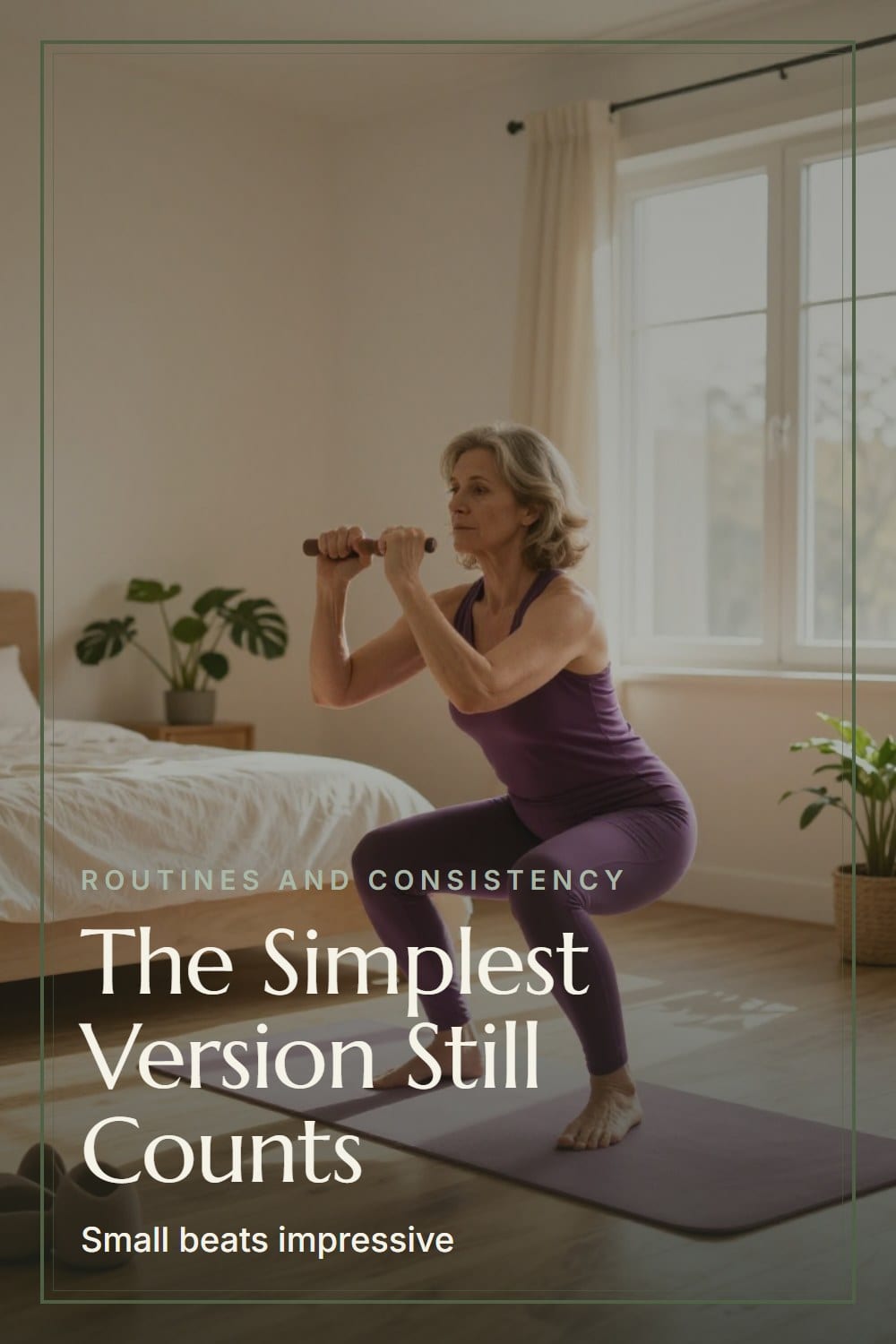
If you want to put this into practice around movement, a realistic midlife morning routine is built entirely on this idea — small habits stacked onto cues you already have, in an order that survives an actual Tuesday. And if you've read the 28-day indoor walking challenge on this site, you've seen the short version of this research, used to explain why missing a day there doesn't restart the calendar. This article is where that reasoning lives.
Free, and printable
The free 4-Week Indoor Walking Plan
The plan sign-up is not live yet — the mailing list is still being set up. In the meantime, email hello@strongandrooted.com and Diane will send it to you herself.
One email when there is something worth sending. Unsubscribe whenever you like.
None of this is a promise about any specific habit you're trying to build, or a diagnosis of why a past one didn't take. It's the general pattern the research shows, cited plainly below so you can look at it yourself instead of just taking my word for it.
Where this comes from
Every claim above traces to one of these five.
- 1How Are Habits Formed: Modelling Habit Formation in the Real World
European Journal of Social Psychology · 2010
Supports: That in a 12-week study of 96 people each building one new daily habit, the habits took an average of 66 days to become automatic, with an individual range of 18 to 254 days; that simpler habits with an existing trigger (like drinking water with a meal) became automatic in as few as 18 days while more effortful ones (like fifty sit-ups a day) took several months; and that missing a single day of practice did not meaningfully change whether the habit went on to form.
- 2Time to Form a Habit: A Systematic Review and Meta-Analysis of Health Behaviour Habit Formation and Its Determinants
Healthcare · 2024
Supports: That when researchers pooled 20 separate habit-formation studies together, the typical health habit reached automatic status at a median of 59 to 66 days; that simpler, clearly cued behaviors formed faster than complex ones across the pooled studies; and that habits people chose for themselves tended to succeed more often than habits assigned to them.
- 3Busting the 21 Days Habit Formation Myth
University College London — Behavioural Science and Health · 2012
Supports: That the popular '21 days to form a habit' claim traces to Dr. Maxwell Maltz's 1960 book Psycho-Cybernetics, in which he described plastic surgery patients and amputees taking about three weeks to adjust to a changed appearance — an observation about adapting to a new physical reality, not evidence about how long it takes to build a new daily habit.
- 4Everything You Need To Know About Habit Stacking for Self-Improvement
Cleveland Clinic
Supports: That habit stacking works by attaching a new behavior to a routine already done on autopilot, which lowers the effort needed to start it; that beginning with one simple version of a habit works better than an ambitious one; and that forgetting or skipping a habit for a day does not mean the habit, or the person, has failed.
- 5Trade Bad Habits for Good Ones
Harvard Health Publishing · 2016
Supports: That habits are triggered by consistent cues — a location, a time of day, an emotional state, other people, or the action right before it — and that keeping the trigger itself consistent matters more than repeating a habit at the exact same clock time every day.
Frequently asked questions
How long does it really take to build a new habit?
Is the 21-day rule completely made up?
What happens if I miss a day?
What's the fastest way to make a new habit actually stick?
Twenty-one days was never the real deadline — it was a plastic surgeon's guess about a healing face, borrowed by an industry that needed a tidy number to sell. The honest range is wider and kinder than that: some habits are done in 18 days, some are still forming at day 90, and neither says a thing about your discipline. For the pillar this category sits under, a daily wellness routine for women over 40 is the place to start; for the whole-life version of this same idea, the 30-day midlife wellness challenge walks it through movement, sleep and stress together, one small thing at a time. Or start smaller: pick one row from the table above, attach it to a cue you already have, and give it the number of days it actually needs. For everything else this category covers, the full guide to midlife wellness routines is next. Strong, not skinny — and never measured in three-week deadlines.
Free, and printable
The 4-Week Indoor Walking Plan
The plan sign-up is not live yet — the mailing list is still being set up. In the meantime, email hello@strongandrooted.com and Diane will send it to you herself.
One email when there is something worth sending. Unsubscribe whenever you like.
Written by
Diane Marsh
At 49 I was tired, achy, sleeping badly, and being told to do more cardio and eat less — which was making all of it worse. I started walking. Fifteen minutes, indoors, in socks. Three years later I am stronger than I was at forty. I write down exactly what I did, cite the research where it exists, and admit where it doesn't.
Diane is not a doctor, a physical therapist, or a dietitian. She is a woman who rebuilt her own strength after perimenopause, reads the research carefully, cites it, and says so when nobody actually knows.
Keep reading
Every October, the internet sells you a countdown to a smaller body by the holidays. Here's a different one: eight to ten weeks to a body that can carry every bag in one trip, breeze through travel, and still have energy at nine at night. Strong, not skinny — that's the whole plan.
Strong by Summer: An Energy Plan, Not a Swimsuit PlanEvery spring, the same message shows up: a body you're supposed to want by a certain date. This is a different plan — eight to ten weeks built around the energy and capability you actually want this summer: walking the beach, keeping up on the hike, carrying the cooler, saying yes to the trip. Not one part of it is about how you'll look.
A New Year Reset for Women Over 40 (Without the Crash Diet)For thirty Januarys, the deal has been the same: fix yourself, starting now, no exceptions. Here's the honest alternative — keep the fresh start, skip the crash diet, and build something small enough to actually survive a real winter Tuesday. Two anchors, not twelve rules, and the research on why day 21 was never a fair place to judge yourself.